Key takeaways
- Tread depth over step count: Anything you will stand on for more than a minute wants a tread at least three inches deep, ideally four. Deep, flat pedals let your whole foot bear load; narrow rungs push pressure into the arch and shorten how long you can work comfortably.
- Duty rating with real margin: Add your body weight, your tools, and whatever you are carrying, then choose a ladder rated well above that total. Ratings are static test figures, not a description of how the frame feels under a person shifting their hips at the top step.
- Joint and fastener quality: Look for riveted or bolted hinge plates rather than spot welds alone, positive-engagement locking pins you can hear seat, and rubber feet that are replaceable. These three details decide whether the ladder is still rigid in year six.
- Handrail or grab point at hip height: A rail you can reach without bending preserves three points of contact while your hands work. On taller multi-position ladders, check that the top section gives you something to hold at chest level when standing two steps down.
- Folded thickness and finish: Measure your storage gap before buying. A powder-coated steel stool that lives in a damp garage will chip and rust at the hinge; anodized aluminum tolerates that environment far better and weighs less to carry upstairs.
What's inside
A folding ladder is one of the few household tools most people buy on price and then use, unmodified, for a decade or more. That mismatch is where injuries and disappointment come from. A rung barely two inches deep concentrates your entire body weight onto the arch of the foot, which starts to burn within a couple of minutes and quietly encourages the exact posture shift that causes falls. Thin-gauge steel legs feel solid in the box and develop a spongy lateral sway after fifty cycles. Hinges rated for a static load say nothing about how they behave after two hundred open-and-close motions in a humid garage.
This guide looks at folding ladders through two lenses: how the ladder treats your body during the ten minutes you are actually standing on it, and how its joints, feet, and fasteners hold up over years of storage abuse. Below you will find picks spanning compact kitchen stools to 14-foot multi-position frames, followed by the specifications that genuinely predict comfort and longevity — and the ones that are mostly marketing.
As an Amazon Associate we earn from qualifying purchases.




How to Choose a Folding Ladder (2026)
- Tread depth over step count: Anything you will stand on for more than a minute wants a tread at least three inches deep, ideally four. Deep, flat pedals let your whole foot bear load; narrow rungs push pressure into the arch and shorten how long you can work comfortably.
- Duty rating with real margin: Add your body weight, your tools, and whatever you are carrying, then choose a ladder rated well above that total. Ratings are static test figures, not a description of how the frame feels under a person shifting their hips at the top step.
- Joint and fastener quality: Look for riveted or bolted hinge plates rather than spot welds alone, positive-engagement locking pins you can hear seat, and rubber feet that are replaceable. These three details decide whether the ladder is still rigid in year six.
- Handrail or grab point at hip height: A rail you can reach without bending preserves three points of contact while your hands work. On taller multi-position ladders, check that the top section gives you something to hold at chest level when standing two steps down.
- Folded thickness and finish: Measure your storage gap before buying. A powder-coated steel stool that lives in a damp garage will chip and rust at the hinge; anodized aluminum tolerates that environment far better and weighs less to carry upstairs.
The Best Folding Ladders of 2026, Reviewed
LANBITOU 4-Step 14 FT Multi-Position Extension Ladder
The most genuinely versatile pick here: an A-frame that extends to 14 feet and reconfigures for staircases, making it a legitimate one-ladder solution for gutters, ceilings, and awkward split-level landings. At 330 pounds capacity with anti-slip feet, it earns its keep on durability, though the telescoping sections need a periodic wipe to keep the locks moving cleanly.
KINGRACK 4-Step Folding Ladder with Handrail
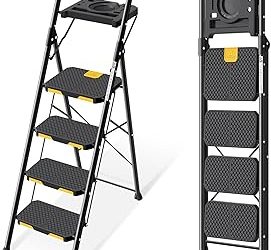
An 800-pound rating on a household stool is unusual, and it shows in how little the frame flexes under load. The wide non-skid pedals and full-length handrail make this the pick for anyone who spends real time at the top step reorganizing a pantry or closet rather than grabbing one item and stepping down.
Little Giant Jumbo Step 3-Step Aluminum Stool
The stair-like treads and rotating handrail are the best ergonomic package in this roundup, letting you climb and descend facing forward the way you would on stairs. Aluminum construction plus a 375-pound rating and integrated tool tray means it stays useful and rigid long after cheaper steel stools have started to rack.
EN131 8.5 ft Aluminum Telescoping Ladder
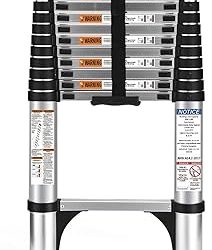
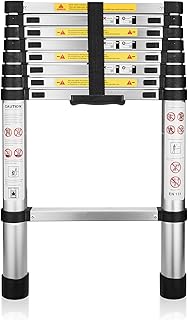
Collapsing to roughly the length of a duffel bag, this is the answer for RV owners, apartment dwellers, and anyone storing a ladder in a car trunk. The EN131 certification is meaningful reassurance on rung strength; just retract it deliberately, one section at a time, to protect the locking mechanisms.
5-Step Heavy-Duty Folding Ladder
Five wide anti-slip steps give you meaningful reach without the bulk of a full extension ladder, and the 330-pound rating suits general household and light workshop use. Best suited to a garage or utility room where its folded depth is not competing for narrow closet space.
Frequently Asked Questions
How much weight capacity do I actually need?
Take your body weight, add 30 to 50 pounds for tools and materials, and treat that as your minimum. Choosing a rating comfortably above that number buys you rigidity and a longer service life, not just a safety buffer.
Is aluminum or steel better for a folding ladder?
Aluminum is lighter, easier to carry between floors, and far more resistant to corrosion at the hinges. Steel costs less and feels reassuringly dense, but weight becomes a real deterrent to actually using the ladder, and any chip in the coating starts rusting.
Can I use a folding ladder on stairs?
Only if it is explicitly designed for it, like a multi-position model with independently adjustable sections. Standard A-frames and step stools require a level surface, and shimming a leg is never an acceptable workaround.
How do I keep a folding ladder safe over the long term?
Inspect the rubber feet, hinge rivets, and locking pins twice a year, wipe telescoping sections clean of grit, and store the ladder somewhere dry rather than against a damp exterior wall. Retire any ladder with a bent rail or a lock that no longer seats firmly.
Final Thoughts
For the best combination of foot comfort and long-term rigidity, the Little Giant Jumbo Step is the one to beat, with its stair-like treads and rotating rail. The KINGRACK 4-Step is the value pick for household use thanks to its wide pedals and enormous load margin, while the LANBITOU 14 FT multi-position ladder is the right choice if you need one ladder to cover indoor chores, stairwells, and roofline work.