Key takeaways
- Match seat depth to your leg length: You want two to three fingers of clearance between the seat edge and the back of your knee. Oversized and big-and-tall models often run 22 inches or deeper, which is excellent at 6’2″ and circulation-restricting at 5’4″. Measure from the back of your hip to that knee crease before you shop.
- Dual motor over single motor for long sittings: A single-motor chair locks the backrest and footrest into a fixed relationship. Dual motor lets you drop the back without launching your legs, which is how you reach a true zero-gravity or infinite-position posture where the knees sit above the heart and lumbar load drops off.
- Read the foam and frame, not the photo: High-resilience foam at 1.8 lb/ft³ or better resists the pocketing that ruins seat geometry within a year. Look for kiln-dried hardwood or steel frames with reinforced pivot points, and treat plywood-only construction as a shorter-term purchase.
- Upholstery: genuine leather earns its premium: Top-grain leather develops patina and tolerates body oils and heat cycling far better than bonded leather, which delaminates at stress folds. If you want faux leather, check for a stated abrasion rating and expect to condition the high-contact zones on the arms and headrest.
- Plan your clearance and your power: Wall-hugger designs travel forward instead of back and need only a few inches behind them. Standard mechanisms want 12 to 18. Also confirm charging ports match your devices — USB-A alone is dated in 2026, and Type-C or wireless pads save an outlet.
What's inside
Most power recliner complaints trace back to two things: a chair that fits the room but not the body, and a mechanism that feels solid in month one and grinds by month eighteen. Seat pans run too deep for shorter legs, leaving thighs unsupported behind the knee. Lumbar curves sit too low or too high to do anything useful. And the parts doing the actual work — the actuator, the scissor mechanism, the transformer — are almost never listed on the spec sheet, which is exactly where buyers lose money.
This guide looks at power recliners through two lenses I trust more than styling: how the geometry treats a seated body over a three-hour stretch, and how the moving parts hold up under daily cycling. I’ve weighted seat depth and back articulation, foam density and frame construction, upholstery wear resistance, and whether the lift or recline motor is a single unit doing double duty or a dual-motor setup that lets the back and footrest move independently. Sizing notes and clearance requirements are included, since a wall-hugger and a full-travel lift chair ask very different things of a room.
As an Amazon Associate we earn from qualifying purchases.


How to Choose a Home Furnishings Power Recliner (2026)
- Match seat depth to your leg length: You want two to three fingers of clearance between the seat edge and the back of your knee. Oversized and big-and-tall models often run 22 inches or deeper, which is excellent at 6’2″ and circulation-restricting at 5’4″. Measure from the back of your hip to that knee crease before you shop.
- Dual motor over single motor for long sittings: A single-motor chair locks the backrest and footrest into a fixed relationship. Dual motor lets you drop the back without launching your legs, which is how you reach a true zero-gravity or infinite-position posture where the knees sit above the heart and lumbar load drops off.
- Read the foam and frame, not the photo: High-resilience foam at 1.8 lb/ft³ or better resists the pocketing that ruins seat geometry within a year. Look for kiln-dried hardwood or steel frames with reinforced pivot points, and treat plywood-only construction as a shorter-term purchase.
- Upholstery: genuine leather earns its premium: Top-grain leather develops patina and tolerates body oils and heat cycling far better than bonded leather, which delaminates at stress folds. If you want faux leather, check for a stated abrasion rating and expect to condition the high-contact zones on the arms and headrest.
- Plan your clearance and your power: Wall-hugger designs travel forward instead of back and need only a few inches behind them. Standard mechanisms want 12 to 18. Also confirm charging ports match your devices — USB-A alone is dated in 2026, and Type-C or wireless pads save an outlet.
The Best Home Furnishings Power Recliners (2026) Reviewed
MCombo 7040 Power Lift Recliner
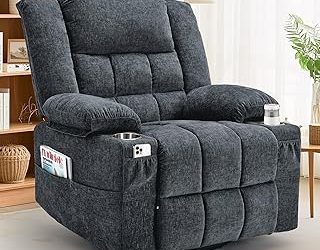
The medium sizing is the point here: it’s one of the few lift chairs built around average-frame users rather than scaled down from a big-and-tall pattern, so the seat depth actually supports the thigh. FSC-certified frame, heat and massage zones, and thoughtful port placement round it out, though the faux leather will want periodic conditioning at the arm caps.
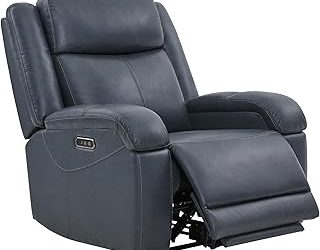
Watson & Whitely Oversized Leather Power Recliner (Navy)
A genuine-leather wall hugger sized for larger frames, with an independent power headrest that lets you correct cervical alignment without changing the back angle. The wall-hugger geometry is the real win for apartments and tight living rooms where a conventional recliner would need a foot and a half of breathing room.
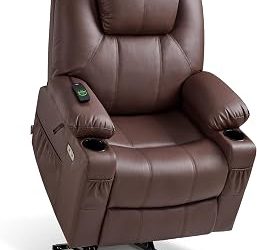
Watson & Whitely Lay Flat Power Recliner (Saddle)
Full lay-flat travel plus a powered headrest makes this the most postural-flexible chair in the group, and the leather is honest top-grain that will look better in year five than year one. Well suited to home theater use where you’re seated long enough for pressure distribution to matter.
Ashley Boyington Zero Gravity Power Recliner
The zero-gravity position and extended ottoman work together to keep the legs elevated and the lumbar spine decompressed, which is genuinely useful for anyone with lower back complaints. Note the 250-lb capacity — it’s the tightest limit in this roundup, so confirm fit before committing.
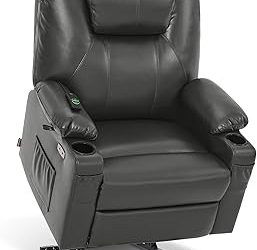
Dual Motor Oversized Lift Recliner with Arm Storage
Infinite positioning from a true dual-motor setup, in an oversized footprint with lay-flat travel and integrated arm storage that keeps remotes and readers within reach instead of on the floor. The heat and massage functions are secondary; the reason to buy it is the independent back and footrest control.
Frequently Asked Questions
Do power recliners fail more often than manual ones?
They have more failure points, but the common ones are cheap fixes: transformers and hand controls are inexpensive, user-replaceable parts. The expensive failure is the lift actuator or a bent scissor mechanism, which is why frame quality and stated weight capacity matter more than feature count.
How much space do I need behind the chair?
Budget 12 to 18 inches for a standard power recliner and as little as three to four for a wall hugger. Lift chairs also need front clearance, since the seat tilts forward past the footprint when raising you to standing.
Is heat and massage worth paying for?
Heat helps with muscle stiffness and is a reasonable add. Vibration massage is pleasant but shallow — it won’t substitute for correct seat geometry, so never trade fit for a massage motor.
What happens during a power outage?
Look for a battery backup port, standard on most quality lift chairs. A 9V battery gives you one or two cycles, which is enough to get out of a fully reclined position safely.
Final Thoughts
If you want the best long-session ergonomics, the Watson & Whitely Lay Flat Power Recliner in saddle leather is the one I’d buy, thanks to its full-flat travel, independent headrest, and upholstery that ages well. For assisted standing without oversizing the seat, the MCombo 7040 in medium is the smarter fit for average frames, and the Watson & Whitely Oversized Navy model is the pick for larger bodies in rooms that can’t spare the wall clearance.