Key takeaways
- Working height and stance: A benchtop saw on a 36-inch bench puts the table near chest height, which forces you to lift your shoulders on every cut. Aim for a table roughly 40–44 inches off the floor total, or buy a model with a matched stand so the geometry is already sorted.
- Frame mass and vibration path: Cast-aluminum or steel-bodied frames damp the harmonic buzz that stamped sheet housings transmit straight into your hands. If a saw walks across the bench during a resaw, you will feel it in your forearms long before the blade dulls.
- Tension and blade access: Look for a quick-tension lever and tool-free doors. Detensioning between sessions roughly doubles blade and tire life, and you will only bother doing it if the mechanism takes five seconds rather than five minutes with a hex key.
- Trunnion and tilt quality: A 0–45° table is standard, but the trunnion underneath is what keeps 90° repeatable. Cast trunnions with a positive stop return to square; thin stamped brackets creep, and you end up re-squaring with a machinist’s square every setup.
- Speed range matched to material: Wood wants 2,300–3,000 FPM. Steel and aluminum want somewhere in the 100–500 FPM band. A variable-speed metal saw is not a slow woodworking saw, and a fast woodworking saw will not cut mild steel without cooking the blade.
What's inside
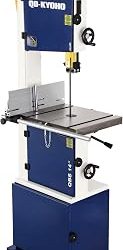
Most benchtop band saws are bought for the wrong reason: throat depth. Buyers compare an 8-inch to a 10-inch, pick the bigger number, and then discover the real limitations six months in — a table that sits too low to work at without hunching, a tension knob buried behind the upper door, blade guides that drift out of alignment every time the machine gets bumped, and enough vibration through the frame to numb a wrist during a long run of curves. Cutting capacity is the easiest spec to publish and the least likely to be the thing that frustrates you.
This guide looks at benchtop band saws from the two angles that actually predict long-term satisfaction: how the machine treats your body over hundreds of cuts, and how its structure holds tolerance as the bearings and blade wheels accumulate hours. We cover frame rigidity and where the mass sits, table height and tilt mechanisms, tension and blade-change access, switch and safety-key placement, dust extraction at breathing level, and which models are built for wood versus the slow-speed grind of metal. Reviews below cover both woodworking saws and variable-speed metal cutters, since the ergonomic demands of each are genuinely different.
As an Amazon Associate we earn from qualifying purchases.


How to Choose a Benchtop Band Saw (2026)
- Working height and stance: A benchtop saw on a 36-inch bench puts the table near chest height, which forces you to lift your shoulders on every cut. Aim for a table roughly 40–44 inches off the floor total, or buy a model with a matched stand so the geometry is already sorted.
- Frame mass and vibration path: Cast-aluminum or steel-bodied frames damp the harmonic buzz that stamped sheet housings transmit straight into your hands. If a saw walks across the bench during a resaw, you will feel it in your forearms long before the blade dulls.
- Tension and blade access: Look for a quick-tension lever and tool-free doors. Detensioning between sessions roughly doubles blade and tire life, and you will only bother doing it if the mechanism takes five seconds rather than five minutes with a hex key.
- Trunnion and tilt quality: A 0–45° table is standard, but the trunnion underneath is what keeps 90° repeatable. Cast trunnions with a positive stop return to square; thin stamped brackets creep, and you end up re-squaring with a machinist’s square every setup.
- Speed range matched to material: Wood wants 2,300–3,000 FPM. Steel and aluminum want somewhere in the 100–500 FPM band. A variable-speed metal saw is not a slow woodworking saw, and a fast woodworking saw will not cut mild steel without cooking the blade.
The Best Benchtop Band Saw (2026)s Reviewed
WOODSKIL 10-Inch Benchtop Bandsaw with Stand
The stand is the headline feature from an ergonomics standpoint — it puts the table at a natural working height and moves the machine’s center of mass off your bench, which noticeably reduces vibration coupling. Dual speeds at 2,360 and 3,000 FPM plus a 5-1/8-inch cutting height and quick-tension system make this the most complete package here for anyone resawing thicker stock.
SEESII Benchtop Band Saw for Woodworking
An 8-inch throat with a 3-1/8-inch cutting height covers the vast majority of furniture-scale curve work, and the double-sided fence is a genuinely thoughtful inclusion for repeat cuts. The 0–45° tilting table and miter gauge round it out as a detail saw rather than a resaw machine.
PeakPursuit 8-Inch Band Saw
The pure copper motor is the durability argument here: copper windings run cooler and tolerate the intermittent duty cycle of hobby work better than aluminum equivalents. At 1,800 RPM it handles hardwood and non-ferrous aluminum comfortably, with the usual fence and miter gauge for straight work.
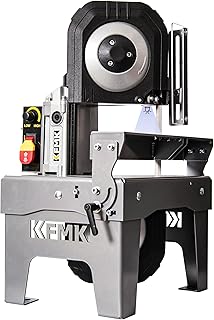
BUCKTOOL 5-Inch Metal Band Saw
A 1.5 HP, 10-amp variable-speed head running 137–472 FPM is proper metal-cutting territory, and the extension table is what makes it usable without a helper supporting long stock. Expect to work slowly and deliberately — that is the point, and the low speed is far kinder to blades than a repurposed wood saw.
8-Inch 3-Amp Bandsaw with Removable Safety Key
The removable safety key is worth calling out for shared or family workshops, since it prevents accidental starts far more reliably than a paddle switch alone. It is a straightforward 1,800 FPM saw with a 0–45° tilt, fence, and miter gauge, best suited to lighter, occasional curve cutting.
Frequently Asked Questions
How much throat depth do I actually need for furniture work?
Eight inches handles chair legs, cabriole blanks, curved aprons, and most template work. Ten inches becomes worthwhile if you regularly cut large arcs or resaw veneer from wide boards.
Can I cut metal on a woodworking band saw?
Not safely or economically. Wood saws run four to twenty times too fast for steel, which work-hardens the material and destroys blade teeth in minutes. Use a variable-speed metal saw instead.
Why does my blade keep drifting off the wheel?
Usually tracking or tension rather than a bad blade. Check that the upper wheel tracking adjustment centers the blade on the crown, then verify guide bearings sit just behind the gullets — not against the teeth.
Does detensioning the blade really matter?
Yes. Leaving a blade fully tensioned overnight compresses the rubber tires and puts constant load on the wheel bearings. Releasing tension after each session meaningfully extends the life of both.
Final Thoughts
For most home furniture makers, the WOODSKIL 10-Inch with its stand is the best overall buy — the working height and quick-tension access matter more day to day than any spec on the box. The SEESII 8-inch is the smarter pick if your work is detailed curve cutting rather than resawing, and the BUCKTOOL 5-Inch variable-speed is the one to get if metal is part of your workflow.