Key takeaways
- Sustained CFM over peak numbers: Check the SCFM rating at 40 PSI for HVLP and 90 PSI for conventional or LVLP guns, then add roughly 30 percent headroom. A gun that needs 4 CFM on a machine rated 4.6 CFM will run the pump nearly continuously, which cooks the motor and pushes heat and moisture into your line.
- Tank volume as a buffer, not a spec: Larger tanks don’t create air, they smooth delivery between cycles. For cabinet doors and small case pieces, 8 to 13 gallons keeps pressure stable through a full panel. Under 3 gallons works only for touch-ups and detail guns.
- Noise you can tolerate for an hour: The 60 to 70 dBA range from induction-motor designs is genuinely conversational. Above 85 dBA you’ll need hearing protection, which fogs your view of the wet edge and makes you hurry.
- Carry ergonomics and rolling geometry: Look for a balanced center handle over the tank axis, not a bracket bolted to one end. If it has wheels, measure the axle height against your shop door lip and truck tailgate. A machine you dread moving is a machine you use badly.
- Durability signals worth paying for: Oil-free pumps with cast cylinders, thickened steel tank walls, thermal overload with manual reset, and a drain valve you can actually reach. That last detail decides whether the tank rusts from the inside in year three.
What's inside
Spraying a finish on furniture fails in the last ten percent of the job, not the first. Your pattern lays down beautifully across the first door panel, then the pump kicks on, pressure sags, and the fan collapses into a spitting, tailing mess of orange peel. Most buyers blame the gun. Usually the culprit is a compressor that can’t hold CFM through a continuous pull, or one so loud and awkward that you rush the pass just to be done with it. Fatigue and airflow are the same problem wearing different clothes.
This guide looks at compressors the way a shop tool gets evaluated after two years of use: how the handle sits in your palm on a stair carry, whether the wheels clear a threshold strip, how thick the tank shell actually is, and whether the pump is still pulling rated pressure after a few hundred cycles. Sound level gets real weight here, because a 90 dB machine in a garage bay changes how long you’re willing to stand there and do the work properly.
As an Amazon Associate we earn from qualifying purchases.



How to Choose a/an Air Compressor For Spraying Paint (2026)
- Sustained CFM over peak numbers: Check the SCFM rating at 40 PSI for HVLP and 90 PSI for conventional or LVLP guns, then add roughly 30 percent headroom. A gun that needs 4 CFM on a machine rated 4.6 CFM will run the pump nearly continuously, which cooks the motor and pushes heat and moisture into your line.
- Tank volume as a buffer, not a spec: Larger tanks don’t create air, they smooth delivery between cycles. For cabinet doors and small case pieces, 8 to 13 gallons keeps pressure stable through a full panel. Under 3 gallons works only for touch-ups and detail guns.
- Noise you can tolerate for an hour: The 60 to 70 dBA range from induction-motor designs is genuinely conversational. Above 85 dBA you’ll need hearing protection, which fogs your view of the wet edge and makes you hurry.
- Carry ergonomics and rolling geometry: Look for a balanced center handle over the tank axis, not a bracket bolted to one end. If it has wheels, measure the axle height against your shop door lip and truck tailgate. A machine you dread moving is a machine you use badly.
- Durability signals worth paying for: Oil-free pumps with cast cylinders, thickened steel tank walls, thermal overload with manual reset, and a drain valve you can actually reach. That last detail decides whether the tank rusts from the inside in year three.
The Best Air Compressor For Spraying Paint (2026)s Reviewed
California Air Tools 8010 PK with LVLP Kit
The 8-gallon steel tank paired with a 1.0 HP ultra quiet pump at 60 dBA is close to ideal for furniture work, and the bundled LVLP gun means your air supply and atomization are matched from day one. The upright wheeled frame rolls easily, though the low-slung handle asks for a slight stoop on longer moves.
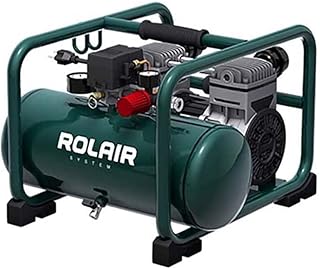
Rolair JC20 Hand Carry
Rolair’s 2 HP JC20 is the machine finishers keep for a decade: 70 dBA, a genuinely balanced carry handle, and a pump that shrugs off duty cycles that would overheat lighter units. Small tank volume means it’s best on detail and touch-up guns rather than full spray-out sessions.
VEVOR 13-Gallon Oil-Free
At 4.6 SCFM at 90 PSI with 125 PSI max and 66 dBA, this is the volume-and-quiet combination that lets an LVLP gun run continuously across a tabletop. The thickened steel body and wheeled base feel substantial, and the trade-off is simply mass, so plan your staging before you start rather than repositioning mid-coat.
Rolair FC2002 Twin Stack
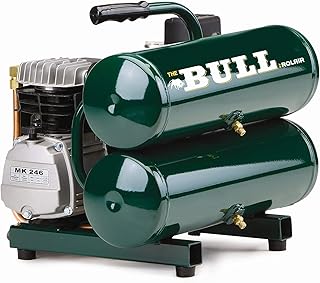
The twin-stack layout gives you meaningful reserve air in a footprint that still fits under a bench, and the overload protection with manual reset is exactly the kind of serviceable design that survives job-site abuse. It is louder than the quiet-class units, so budget for hearing protection.
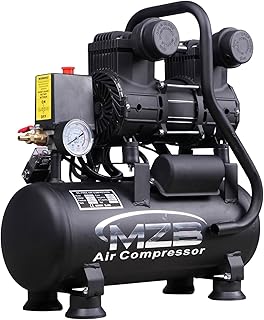
MZB 2.4 Gallon Ultra Quiet
A 1.2 HP oil-free pump delivering 5.65 CFM at 70 dBA in a compact steel-tank package makes this the most portable serious option here. The tiny reservoir means it cycles often, so treat it as a detail and repair-work compressor rather than your primary refinishing machine.
Frequently Asked Questions
How much CFM do I really need to spray furniture?
Most HVLP guns want 4 to 6 CFM at 40 PSI, and LVLP guns often run comfortably on 2 to 3.5 CFM. Match the gun’s requirement first, then choose a compressor that exceeds it, since undersized air is the leading cause of dry spray and heavy texture.
Does an oil-free pump last long enough for regular use?
Modern oil-free designs with cast cylinders handle intermittent shop use for years and eliminate the risk of oil carryover contaminating a finish. Oil-lubricated pumps still win on continuous production duty, but that’s rarely the pattern for furniture work.
Do I need a separate moisture filter?
Yes. Every compressor produces condensate, and water reaching a spray gun causes fisheye and blush. Run at minimum a desiccant or coalescing filter at the gun, and drain the tank after each session.
Is a quiet compressor worth the extra cost?
For anyone spraying indoors or in an attached garage, it’s the single upgrade that most changes how the work feels. Lower noise means you keep your ear protection off, watch the wet edge properly, and stop rushing passes.
Final Thoughts
For most furniture refinishing, the California Air Tools 8010 PK is the balanced choice, giving you enough tank, genuinely quiet operation, and a matched LVLP gun in one purchase. Step up to the VEVOR 13-Gallon if you spray larger surfaces and want uninterrupted airflow, or choose the Rolair JC20 if long-term durability and easy one-hand portability matter more than reservoir size.