Key takeaways
- CFM headroom, not peak PSI: Match sustained delivery at your working pressure to your gun’s requirement, then add roughly 30 percent. HVLP guns are thirsty, and a compressor running at its ceiling cycles constantly, runs hot, and shortens pump life.
- Oil-free versus oil-lubricated: Oil-free pumps mean no maintenance schedule and no risk of oil mist reaching a finish, which matters on lacquered furniture. Oil-lubricated units generally run cooler and last longer under heavy loads. For weekend furniture work, oil-free wins on convenience.
- Noise as an ergonomic factor: Anything above about 80 dBA forces hearing protection and drains your concentration. Sub-70 dBA units let you work in an attached garage, hear the gun’s atomization change, and finish the day without a headache.
- Weight distribution and mobility: Look at how a unit carries, not just what it weighs. Pneumatic wheels and a balanced handle beat a lighter tank with an awkward center of gravity, especially if you move between shop and site.
- Cleanup architecture: Count the parts you must remove to reach the fluid passage. Fewer components, wider apertures, and stainless or hard-anodized needle seats mean faster teardown and far less premature wear from aggressive scrubbing.
What's inside
Most spray-finish disappointments don’t start at the gun. They start about twenty minutes in, when the compressor drops below its rated pressure, your forearm starts protesting the trigger, and a hose you’ve been dragging across the shop snags the leg of the dresser you just tacked off. Furniture work in particular punishes undersized equipment, because it asks for long, unbroken passes at steady CFM rather than short bursts. A pump that recovers slowly forces you to stop mid-panel, and a stop mid-panel is a lap mark you’ll be sanding out tomorrow.
This guide looks at spray-capable compressors and sprayer outfits through two lenses that spec sheets tend to skip: how they feel over a two-hour session, and how they hold up over a few hundred of them. We weighed pump design and duty cycle against grip geometry, trigger effort, cup balance, hose stiffness, noise fatigue, and how much disassembly cleanup demands. Below are the setups worth your bench space in 2026, plus the buying criteria that actually predict long-term satisfaction.
As an Amazon Associate we earn from qualifying purchases.



How to Choose a Paint Sprayer Air Compressor (2026)
- CFM headroom, not peak PSI: Match sustained delivery at your working pressure to your gun’s requirement, then add roughly 30 percent. HVLP guns are thirsty, and a compressor running at its ceiling cycles constantly, runs hot, and shortens pump life.
- Oil-free versus oil-lubricated: Oil-free pumps mean no maintenance schedule and no risk of oil mist reaching a finish, which matters on lacquered furniture. Oil-lubricated units generally run cooler and last longer under heavy loads. For weekend furniture work, oil-free wins on convenience.
- Noise as an ergonomic factor: Anything above about 80 dBA forces hearing protection and drains your concentration. Sub-70 dBA units let you work in an attached garage, hear the gun’s atomization change, and finish the day without a headache.
- Weight distribution and mobility: Look at how a unit carries, not just what it weighs. Pneumatic wheels and a balanced handle beat a lighter tank with an awkward center of gravity, especially if you move between shop and site.
- Cleanup architecture: Count the parts you must remove to reach the fluid passage. Fewer components, wider apertures, and stainless or hard-anodized needle seats mean faster teardown and far less premature wear from aggressive scrubbing.
The Best Paint Sprayer Air Compressors Reviewed (2026)
California Air Tools 8010 PK Ultra Quiet Compressor and LVLP Kit
The 60 dBA rating changes how long you’re willing to stay in the booth, and the 8-gallon tank gives an LVLP gun enough reserve to carry a full tabletop without the pump kicking in mid-pass. The wheeled frame moves easily for its class, and the oil-free pump removes the one maintenance chore most hobbyists forget.
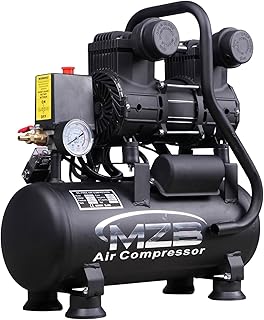
MZB 2.4 Gallon Ultra Quiet Compressor
At 5.65 CFM from a compact 2.4-gallon footprint, this one punches above its size for trim, chairs, and cabinet doors, and the 70 dB level keeps it neighbor-friendly. The small tank does mean more frequent cycling on large flat panels, so treat it as a detail and small-project machine.
Binks Trophy Series HVLP Pressure Pot Outfit
Moving the material off the gun and into a 2.8-gallon pressure pot is the single biggest ergonomic upgrade available to a spray finisher, since your wrist no longer carries a full cup at every angle. With a 1.4 mm nozzle and 25 feet of hose, it’s built for production runs and thicker pigmented finishes, though the setup and purge routine rewards patience.
InoKraft NEO Airless Paint Sprayer Kit
A genuinely light airless unit at 3000 PSI, this one shines on latex and stain across walls, fences, and cased goods where speed matters more than a mirror finish. The ten-minute cleanup claim held up in practice, and integrated accessory storage keeps tips and filters from scattering.
1000W Electric Sprayer with 6 Nozzles
Six nozzles and three spray patterns cover most furniture geometry, and the 47 oz container reduces refills on longer sessions. The tradeoff is handheld mass, so plan on breaks or a support strap for extended overhead work.
Frequently Asked Questions
How much CFM do I need for furniture spraying?
Most HVLP guns want 8 to 13 CFM at 30 to 40 PSI; LVLP guns often run comfortably on 4 to 6. Check your gun’s spec at working pressure, not the compressor’s peak number.
Do I need a moisture trap?
Yes. A desiccant filter or water separator at the gun costs little and prevents fisheye and blushing, which no amount of technique will fix after the fact.
Is airless or air-assisted better for cabinets?
Air-assisted setups produce finer atomization and less overspray, which suits visible furniture surfaces. Airless is faster on large or textured areas where a slightly coarser film is acceptable.
Can a small pancake compressor run a spray gun?
It can drive a small detail or touch-up gun, but it will cycle constantly and struggle to sustain full-panel passes. Tank volume buys you continuous work time.
Final Thoughts
For most furniture builders, the California Air Tools 8010 PK is the balanced choice: quiet enough to use daily, large enough to sustain real passes, and maintenance-free. Add the Binks Trophy pressure pot outfit if you spray in volume and want your wrist to survive it, or the InoKraft NEO if latex and stain over large surfaces is the bulk of your work.