Key takeaways
- Clearance math first: Measure floor to ceiling, subtract the fan’s total height, and confirm the blade plane sits at 7 feet or higher. Most flush fans occupy 8 to 12 inches, so a 96-inch ceiling leaves you comfortable margin only if you also keep blades at least 18 inches from any wall or sloped surface.
- DC motor over AC for low-profile bodies: Hugger housings run hot because they sit tight against the ceiling with limited airflow. DC motors draw less current, shed less waste heat, and typically use higher-grade bearings, all of which extend service life in exactly the mounting condition that stresses a motor most.
- Glare geometry, not just lumens: A flush fan puts the light source near eye level in sightlines from a sofa or bed. Look for frosted or diffused lenses and dimming down to at least 10 percent. Selectable 3CCT (typically 3000K, 4000K, 5000K) lets you run warmer light in the evening, which reduces visual fatigue.
- Control ergonomics: Remotes with raised, tactile buttons and a wall cradle beat flat membrane pads and app-only control. Pull chains are still the most reliable interface long term, but only if the chain is genuinely reachable without a stretch.
- Blade material and finish durability: Sealed hardwood or ABS composite blades resist warping in humid rooms; unsealed MDF does not. For covered patios or bathrooms, insist on a damp- or wet-rated ETL listing rather than assuming an indoor fan will cope.
What's inside
Hugger fans exist for a single, unglamorous reason: not every room has the vertical budget for a downrod. On an 8-foot ceiling, a standard-mount fan drops the blade plane to roughly 7 feet, which is close enough to trigger the flinch reflex every time someone tall walks under it. Flush-mount fans solve the clearance problem, but they trade away the air gap above the blades that a motor relies on to move air efficiently. That trade is where most disappointment comes from, and it is also where the good models separate themselves from the cheap ones.
This guide looks at hugger fans with integrated lighting through two lenses that matter more than styling: ergonomics (head clearance, glare, control reach, noise at the speeds you actually use) and durability (motor type, bearing quality, blade material stability, and whether the LED module is a serviceable part or a disposable one). Below are the models worth shortlisting in 2026, followed by the specifications I would check before committing.
As an Amazon Associate we earn from qualifying purchases.




How to Choose a Hugger Ceiling Fan With Light (2026)
- Clearance math first: Measure floor to ceiling, subtract the fan’s total height, and confirm the blade plane sits at 7 feet or higher. Most flush fans occupy 8 to 12 inches, so a 96-inch ceiling leaves you comfortable margin only if you also keep blades at least 18 inches from any wall or sloped surface.
- DC motor over AC for low-profile bodies: Hugger housings run hot because they sit tight against the ceiling with limited airflow. DC motors draw less current, shed less waste heat, and typically use higher-grade bearings, all of which extend service life in exactly the mounting condition that stresses a motor most.
- Glare geometry, not just lumens: A flush fan puts the light source near eye level in sightlines from a sofa or bed. Look for frosted or diffused lenses and dimming down to at least 10 percent. Selectable 3CCT (typically 3000K, 4000K, 5000K) lets you run warmer light in the evening, which reduces visual fatigue.
- Control ergonomics: Remotes with raised, tactile buttons and a wall cradle beat flat membrane pads and app-only control. Pull chains are still the most reliable interface long term, but only if the chain is genuinely reachable without a stretch.
- Blade material and finish durability: Sealed hardwood or ABS composite blades resist warping in humid rooms; unsealed MDF does not. For covered patios or bathrooms, insist on a damp- or wet-rated ETL listing rather than assuming an indoor fan will cope.
The Best Hugger Ceiling Fans With Lights (2026) Reviewed
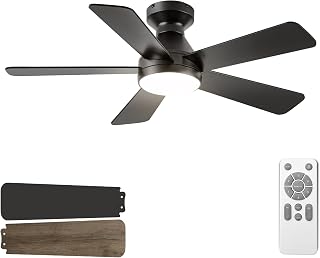
Matte Black 44″ Low Profile 5-Blade Indoor Fan
The 44-inch sweep is the sweet spot for a 12×14 bedroom, and the quiet DC motor holds its composure at mid speeds where cheaper AC units start to hum through the canopy. Matte black powder coat also hides the fine dust that shows up on gloss finishes within weeks.
48″ Retractable Fan with 6-Speed Remote
Retractable blades tuck away when the fan is off, which turns it into a pendant light and eliminates the visual bulk that makes hugger fans feel low. The mechanism adds moving parts, so it suits living rooms with steady seasonal use better than a fan you switch on and off a dozen times a day.
Hunter Builder Deluxe 52″ New Bronze
Hunter’s standard-mount Builder Deluxe is the durability benchmark here: a properly balanced AC motor, a WhisperWind-class blade pitch, and a parts pipeline that still exists a decade out. The pull chain means no remote to lose, though you need a genuine 9-foot ceiling to keep the 52-inch sweep comfortable overhead.
42″ Flush Mount with Wood Blades
A quiet DC motor, reversible operation, and power-off memory make this the most livable pick for a smaller bedroom, and the wood blades warm up rooms where black metal reads cold. Verify the blades are sealed if the room sees humidity swings.
42″ Low Profile 3CCT Black, Indoor/Outdoor
The ETL damp rating, six speeds, and 3CCT dimming make this the most versatile option for a covered porch or a screened patio with limited headroom. Reversible airflow also gives it real value in winter, pushing warm air down without the draft.
Frequently Asked Questions
What ceiling height needs a hugger fan?
Anything at or below 8 feet. At 8 feet, a flush mount typically leaves 7 feet or slightly more of clearance, which meets the standard most local codes reference for habitable rooms.
Do hugger fans move less air?
Slightly, because the reduced gap above the blades restricts intake. A well-pitched DC model largely closes the gap, and choosing a diameter appropriate to the room matters more than mount type.
Can I replace the LED in an integrated light?
Often not individually. Check whether the fan uses a removable LED module or standard bulbs, since a sealed panel eventually makes the whole fixture the replacement part.
Why does my fan wobble?
Usually loose mounting hardware or unequal blade weight, not a bad motor. Tighten the bracket to the joist, confirm all blade screws are seated, and use a balancing kit if the wobble persists.
Final Thoughts
For most 8-foot ceilings, the Matte Black 44″ Low Profile is the best balance of quiet operation, airflow, and long-term motor life, while the 42″ Wood Blade Flush Mount is the more comfortable choice in a bedroom where warm materials and dim-to-low lighting matter. If you have the headroom and want a fan that will still be serviceable in 2036, the Hunter Builder Deluxe remains the durability play.