Key takeaways
- Recline geometry over recline count: A three-position pull-tab that opens the hip angle past 105 degrees does more for lumbar decompression than a stepless mechanism that only leans back 10 degrees. Ask what the open hip angle is, not how many stops it has.
- Seat height and depth for your frame: Aim for a seat height where your heels rest flat with knees slightly below hip level, generally 19 to 21 inches for most adults. Deep 24-inch seats feel luxurious in a showroom and cut circulation behind the knee if you are under 5’6″.
- Foam density, not foam thickness: High-resilience foam around 1.8 to 2.2 lb/ft³ over a sinuous spring deck resists the crater effect. Thick low-density foam feels plush on day one and packs down to a hard shelf within a year.
- Upholstery honesty: Full-grain and top-grain leather patinas and can be reconditioned. Faux leather is easier to wipe and better for households with spills, but its polyurethane layer eventually cracks at the seat crease, so look for reinforced high-wear panels.
- Wall clearance and assembly method: Wall-hugger designs needing only three inches behind them save real square footage in small rooms. Snap-on or bolt-together backs also mean you can carry the sofa through a 30-inch doorway instead of wrestling a single sealed unit.
What's inside
Manual reclining sofas fail in predictable places. The pull-tab mechanism loosens, the seat foam collapses under the first six inches where your weight concentrates, and the frame develops that faint sideways sway that tells you the corner blocks were stapled rather than doweled. Buyers rarely see any of this in a listing photo, because photos flatter upholstery and hide joinery. What you actually feel after eighteen months is lumbar support that has migrated two inches lower than your spine expects, and a footrest that no longer locks flush.
This guide evaluates the current crop of three-seat manual recliners through two lenses: how the sofa loads your body across a long sitting session, and how its structure holds up to roughly 3,000 recline cycles a year. I look at back-tilt geometry, seat-to-floor height, armrest width relative to shoulder drop, wall clearance, and the honest difference between bonded, faux, and full-grain leather. Below are the models worth your attention in 2026, followed by a selection framework you can apply to anything not on this list.
As an Amazon Associate we earn from qualifying purchases.


How to Choose a Manual Reclining Sofa (2026)
- Recline geometry over recline count: A three-position pull-tab that opens the hip angle past 105 degrees does more for lumbar decompression than a stepless mechanism that only leans back 10 degrees. Ask what the open hip angle is, not how many stops it has.
- Seat height and depth for your frame: Aim for a seat height where your heels rest flat with knees slightly below hip level, generally 19 to 21 inches for most adults. Deep 24-inch seats feel luxurious in a showroom and cut circulation behind the knee if you are under 5’6″.
- Foam density, not foam thickness: High-resilience foam around 1.8 to 2.2 lb/ft³ over a sinuous spring deck resists the crater effect. Thick low-density foam feels plush on day one and packs down to a hard shelf within a year.
- Upholstery honesty: Full-grain and top-grain leather patinas and can be reconditioned. Faux leather is easier to wipe and better for households with spills, but its polyurethane layer eventually cracks at the seat crease, so look for reinforced high-wear panels.
- Wall clearance and assembly method: Wall-hugger designs needing only three inches behind them save real square footage in small rooms. Snap-on or bolt-together backs also mean you can carry the sofa through a 30-inch doorway instead of wrestling a single sealed unit.
The Best Manual Reclining Sofas (2026) Reviewed
ANJ Premium Genuine Leather Manual Reclining Sofa (Blue)
This is the most structurally serious option here: genuine leather over a heavy-duty frame with an oversized footprint and a genuinely padded backrest rather than a thin lumbar pillow. The wide seat pans and generous back padding suit taller sitters who normally bottom out on standard-depth recliners.
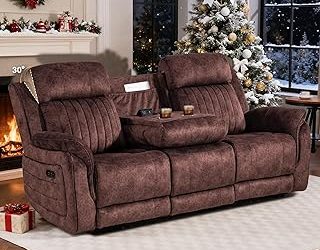
Genuine Leather Manual Reclining Sofa, Overstuffed Armrest (Dark Brown)
The overstuffed armrests sit at a height that keeps shoulders relaxed rather than shrugged, which matters more than most buyers realize during two-hour sessions. Real leather here means the seat will conform to you over time instead of glazing and cracking, and dark brown hides the inevitable wear at the recline creases.
Signature Design by Ashley Frohn Reclining Sofa (Gray Chenille)
The standout is the three-inch wall-hugger profile, which lets you place a full reclining sofa in an apartment living room without stranding it a foot from the baseboard. Chenille breathes better than leather in warm climates, and the snap-on back assembly makes delivery through tight hallways far less dramatic.
Faux Leather Mid-Century Modern Reclining Sofa (Brown)
A sensible pick for households with kids or pets, where wipe-clean upholstery beats patina. The tapered mid-century legs and tighter arm profile keep it visually lighter than most recliners, though I would treat the seat foam as the component most likely to need refreshing first.
Faux Leather 3 Seat Recliner Sofa (Dark Brown)
The most straightforward entry: simple pull-tab mechanisms, unfussy padding, and a shape that fits standard 10-by-12 rooms. Best suited to secondary spaces such as basements, offices, or guest rooms where daily-use hours are lower.
Frequently Asked Questions
Are manual recliners more durable than power recliners?
Generally yes. A steel pull-tab linkage has fewer failure points than a motor, transformer, wiring harness, and control board, and replacement parts stay available longer. The tradeoff is effort and a heavier pull if you have wrist or shoulder limitations.
How much clearance do I need behind the sofa?
Conventional recliners want 12 to 18 inches to fully open. Wall-hugger designs like the Frohn need roughly three, which is often the difference between a workable layout and a blocked walkway.
Is genuine leather worth the premium?
If the sofa will see daily multi-hour use, yes. Genuine leather stretches to your body and can be cleaned and conditioned for years, while faux leather’s surface layer typically begins delaminating at stress folds after two to four years of heavy use.
How do I keep the mechanism working smoothly?
Check and retighten the frame bolts every six months, keep the linkage free of debris, and apply a dry lubricant to pivot points annually. Recline by hand rather than dropping your weight backward, which is what shears the mounting brackets.
Final Thoughts
For long-term durability and body support, the ANJ Premium Genuine Leather sofa is the strongest all-round investment, with the Genuine Leather Overstuffed Armrest model close behind for buyers who prefer a darker, lower-maintenance finish. If your room simply cannot spare the clearance, the Ashley Frohn’s three-inch wall-hugger profile makes it the practical choice without giving up real recline.