Key takeaways
- Ambient temperature rating: Check the spec sheet for an operating range, usually 50°F to 90°F on compact units. If your garage falls outside that window, expect a freezer compartment that thaws in winter and a compressor that never rests in summer. Insulated garages and semi-conditioned spaces are far more forgiving.
- Door swing and reach geometry: Measure your aisle before you measure the fridge. A reversible door lets you flip the hinge to swing away from traffic, and a 90-degree stop is easier to live with in tight bays than a full 180. Handle height matters too: recessed pulls at chest level are kinder to shoulders than low-mounted bar handles.
- Shelf load and pull force: Tempered glass shelves resist sag better than thin wire under canned goods, but they are heavier to remove for cleaning. Slide-out shelves save you from bending into the cabinet, though only if the tracks stay smooth when loaded. Keep heavy items on the middle shelf to reduce lifting from a crouch.
- Gasket, hinge, and cabinet integrity: Magnetic gaskets should compress evenly with no visible gaps at the corners. Steel-reinforced hinges and a rigid cabinet shell survive garage life; flexible plastic liners crack when a bike handlebar catches the door. Feel for cabinet flex when you open the door on a floor model.
- Placement, clearance, and vibration: Leave two to three inches at the rear and sides for heat rejection, and never box a compact fridge into a cabinet cutout in a hot garage. A rubber mat or plywood platform under the unit dampens resonance from a concrete slab and raises the lowest shelf into a friendlier reach zone.
What's inside
Garages punish appliances in ways kitchens never do. Ambient temperature swings from 40°F to 100°F force the compressor into long, hard duty cycles; concrete floors telegraph vibration back into the cabinet; and the fridge usually ends up wedged between a workbench and a car door, so every reach for a drink becomes a twist-and-stoop. Most shoppers pick on capacity alone, then discover six months later that the door gasket has taken a permanent set, the shelf sags under a case of seltzer, or the unit runs almost continuously through August.
This guide evaluates compact refrigerators the way a durability engineer would: hinge and gasket construction, shelf deflection under real load, door swing and grab height relative to a standing adult, and how each unit copes with unconditioned ambient air. Below are six units worth considering for garage duty in 2026, followed by the selection criteria that actually predict longevity.
As an Amazon Associate we earn from qualifying purchases.



How to Choose a Garage Mini Fridge (2026)
- Ambient temperature rating: Check the spec sheet for an operating range, usually 50°F to 90°F on compact units. If your garage falls outside that window, expect a freezer compartment that thaws in winter and a compressor that never rests in summer. Insulated garages and semi-conditioned spaces are far more forgiving.
- Door swing and reach geometry: Measure your aisle before you measure the fridge. A reversible door lets you flip the hinge to swing away from traffic, and a 90-degree stop is easier to live with in tight bays than a full 180. Handle height matters too: recessed pulls at chest level are kinder to shoulders than low-mounted bar handles.
- Shelf load and pull force: Tempered glass shelves resist sag better than thin wire under canned goods, but they are heavier to remove for cleaning. Slide-out shelves save you from bending into the cabinet, though only if the tracks stay smooth when loaded. Keep heavy items on the middle shelf to reduce lifting from a crouch.
- Gasket, hinge, and cabinet integrity: Magnetic gaskets should compress evenly with no visible gaps at the corners. Steel-reinforced hinges and a rigid cabinet shell survive garage life; flexible plastic liners crack when a bike handlebar catches the door. Feel for cabinet flex when you open the door on a floor model.
- Placement, clearance, and vibration: Leave two to three inches at the rear and sides for heat rejection, and never box a compact fridge into a cabinet cutout in a hot garage. A rubber mat or plywood platform under the unit dampens resonance from a concrete slab and raises the lowest shelf into a friendlier reach zone.
The Best Garage Mini Fridges of 2026, Reviewed
Igloo 3.2 Cu. Ft. Mini Fridge with Freezer
The most versatile pick here, pairing a genuine freezer compartment with glass shelving that holds its plane under canned loads. Its adjustable thermostat gives you room to compensate for seasonal ambient shifts, though the freezer will struggle in a garage that drops below 50°F.
Frigidaire Black Retro Mini Refrigerator
The side-mounted bottle opener sounds like styling, but it removes a whole reach-and-twist motion when your hands are dirty. At 1.6 cubic feet, it fits under a bench where a taller unit would not, and the retro shell uses a thicker steel wrap than most budget compacts.
BLACK+DECKER BCRK25V 2.5 Cu. Ft. Compact Refrigerator
The best-balanced unit for durability per dollar: Energy Star certification and R600a refrigerant mean a lighter thermal load on the compressor, which matters when ambient temperatures climb. The reversible door and flat stainless-look front make it easy to place in an awkward corner.
Frigidaire EFR115 Mini Refrigerator
Slide-out shelves are the standout ergonomic feature, letting you bring contents to you instead of leaning into the cabinet. It is a lean 1.6 cubic feet, so treat it as a dedicated drink station rather than overflow food storage.
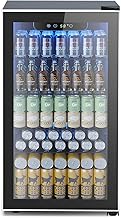
Electactic 130-Can Beverage Refrigerator
Purpose-built for beverages, with tiered shelving that keeps cans at consistent grab height and eliminates the digging that wrecks a shoulder over time. There is no freezer, which is arguably an advantage in a garage where a freezer compartment would cycle unreliably anyway.
Frequently Asked Questions
Can I run a standard mini fridge in an unheated garage?
You can, but understand the tradeoff. Below roughly 50°F, the thermostat may stop calling for cooling and any freezer section will thaw; above 90°F, the compressor runs long cycles that shorten its service life. An insulated or partially conditioned garage avoids both extremes.
Do compact fridges need a garage kit?
Garage kits are a full-size refrigerator accessory and are not available for these units. The practical equivalents are choosing a beverage-only model, keeping the unit off an exterior wall, and adding a small heat source in winter if the space gets truly cold.
How much clearance does the unit actually need?
Plan on two to three inches at the back and sides, plus clear space above. Rear coils reject heat into the surrounding air, and a hot garage already narrows that margin considerably.
Is it better to raise the fridge off the floor?
Usually, yes. A platform four to six inches high cuts vibration transfer from the slab, keeps the cabinet above dust and moisture, and moves the bottom shelf out of the deep-squat zone.
Final Thoughts
For most garages, the BLACK+DECKER BCRK25V is the soundest long-term choice thanks to its efficient refrigerant, reversible door, and rigid cabinet. Choose the Igloo 3.2 Cu. Ft. if you genuinely need freezer space and your garage stays moderate year-round, or the Electactic 130-Can if the fridge exists purely to keep drinks within easy reach.