Key takeaways
- Match reach to your eave, not your roof peak: Measure to the gutter, then add roughly three feet so the ladder extends above the landing point and gives you something to hold while transferring. A 17 ft ladder suits most single-story eaves; a 20.3 ft model covers taller ranch profiles and split-levels.
- Inspect rung geometry before rung count: Wide, flat-topped rungs with a slightly radiused edge distribute pressure across the midfoot. Narrow round rungs concentrate it, and that’s what produces the burning arch sensation after sustained standing at height.
- Test the lock action cold: Auto-locking rung systems should engage with an audible, unambiguous click and release without wrist strain. Repetitive release motions are where cheap mechanisms betray themselves, both in comfort and in service life.
- Prioritize the ground interface: A stabilizer bar widens the base and resists lateral rotation, while textured non-marring feet handle both concrete and turf. Combined with a wall standoff, they keep siding intact and the ladder planted.
- Weigh the carry, literally: Aluminum alloy keeps mass manageable, but check whether wheels and a balanced collapsed center of gravity let one person reposition the ladder without a shoulder-loading lift. That single detail determines whether the ladder gets used or avoided.
What's inside
Roof access is the one household task where equipment choice stops being a matter of convenience and becomes a matter of load paths. Most buyers arrive at this category with a specific tension: they need enough vertical reach to clear a gutter line and step onto a deck edge, but they have a garage wall, not a barn, to store the thing in. Telescoping and multi-position ladders answer that tension, though not all of them answer it well. Rung edges dig into arches after twenty minutes, thumb latches stiffen once grit works into the channel, and a frame that flexes under a 200-pound climber turns a routine chore into an unpleasant one.
This guide evaluates roof-access ladders through two lenses I use professionally: ergonomics, meaning how the ladder treats your hands, feet, and spine across a full working session, and durability, meaning how the locking hardware, extrusions, and feet hold up across seasons of expansion, grit, and UV. Below you’ll find the models worth shortlisting, a selection framework, and answers to the questions that come up most often once the box is open.
As an Amazon Associate we earn from qualifying purchases.


How to Choose a/an Ladder To Get On Roof (2026)
- Match reach to your eave, not your roof peak: Measure to the gutter, then add roughly three feet so the ladder extends above the landing point and gives you something to hold while transferring. A 17 ft ladder suits most single-story eaves; a 20.3 ft model covers taller ranch profiles and split-levels.
- Inspect rung geometry before rung count: Wide, flat-topped rungs with a slightly radiused edge distribute pressure across the midfoot. Narrow round rungs concentrate it, and that’s what produces the burning arch sensation after sustained standing at height.
- Test the lock action cold: Auto-locking rung systems should engage with an audible, unambiguous click and release without wrist strain. Repetitive release motions are where cheap mechanisms betray themselves, both in comfort and in service life.
- Prioritize the ground interface: A stabilizer bar widens the base and resists lateral rotation, while textured non-marring feet handle both concrete and turf. Combined with a wall standoff, they keep siding intact and the ladder planted.
- Weigh the carry, literally: Aluminum alloy keeps mass manageable, but check whether wheels and a balanced collapsed center of gravity let one person reposition the ladder without a shoulder-loading lift. That single detail determines whether the ladder gets used or avoided.
The Best Ladder To Get On Roof (2026)s Reviewed
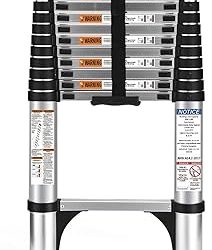
17 FT Multi-Position Telescoping Ladder with Wheels (Blue)
Five configurations from one frame make this the most adaptable pick for homeowners who alternate between gutter work, interior stairwells, and exterior wall projects. The locking hinges hold their detents firmly, and the wheel-plus-stabilizer combination means repositioning along a roofline doesn’t require a full lift-and-carry cycle.
17 FT Telescoping A-Frame with Stabilizer Bar & Wheels
The A-frame stance is genuinely useful on stair landings and uneven driveways, where a straight ladder wants to walk. With a 330 lb rating and a wide stabilizer bar, it feels planted enough that you stop bracing unconsciously, which is the real ergonomic payoff over a long session.
20.3 FT Pro Telescoping Ladder (EN 131 Certified, Silver)
EN 131 certification signals that the rungs and stiles have been tested to a recognized deflection and fatigue standard, not just a marketing load figure. The extra reach and the included wall standoff make this the strongest choice for two-story gutters and taller ranch eaves.
LANBITOU 14 FT A-Frame 4-Step Extension Ladder
A sensible pick for compact garages and lower rooflines, with anti-slip treatment where it matters and a collapsed footprint that stores upright against a wall. The step depth is more generous than the height class suggests, which pays off during longer trim and soffit work.
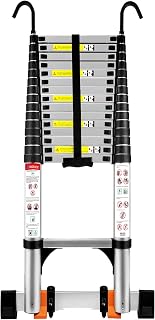
20.3 FT Telescoping Ladder with Hooks, Stabilizer & Wheels
The integrated hooks stabilize the top against a gutter lip or wall edge, reducing the micro-corrections that fatigue your grip. Auto-lock rungs extend and retract predictably, and the anti-slip feet handle transitions from lawn to concrete without shifting.
Frequently Asked Questions
What ladder height do I need for a single-story roof?
Most single-story eaves sit between 10 and 12 feet. A 17 ft ladder lets you set the correct climbing angle and still extend above the gutter, which is the safe way to transfer onto a roof deck.
Are telescoping ladders safe for roof access?
Yes, when they carry a recognized certification such as EN 131, are rated well above your combined body and tool weight, and are fully extended with every rung lock confirmed engaged before you climb.
Do I really need a standoff or stabilizer?
For roof work, treat it as essential. A standoff holds the ladder off gutters and siding, and a base stabilizer resists the sideways twist that occurs when you reach beyond the stiles.
How do I maintain the locking mechanism?
Rinse grit from the rung channels after dusty jobs, let the ladder dry fully collapsed, and apply a dry silicone lubricant rather than an oil that attracts dust. Replace worn feet as soon as the tread pattern flattens.
Final Thoughts
For most homes, the 17 FT Multi-Position Telescoping Ladder offers the best balance of adaptability and comfortable rung geometry, while the 20.3 FT Pro is the pick when your eave line sits higher and you want EN 131 certification behind the rating. If storage space is the binding constraint, the LANBITOU 14 FT A-Frame delivers respectable step comfort in a genuinely compact package.