Key takeaways
- Recline geometry over recline angle: What matters is whether your hips stay supported as the back drops. Look for a mechanism that opens the hip angle progressively and keeps your heels above knee level at full extension — that’s the position that relieves lumbar disc pressure. Wall-hugger mechanisms achieve this by sliding the seat forward rather than pivoting the whole body back, which is why they need only three to six inches of clearance.
- Dual motors and an independent headrest: Single-motor sofas lock your back and legs into one fixed relationship, so a comfortable leg position often forces an over-reclined torso. Dual motors decouple them. A powered headrest matters even more if you watch TV or read while reclined, since it lets you keep your cervical spine neutral instead of craning forward.
- Where the real hide goes: “Genuine leather” describes a category, not a grade. Ask which panels get top-grain hide and which get match material. Seat surfaces, inside backs, and arm tops absorb nearly all the abrasion and body oils, so top-grain in those three zones outperforms a sofa that’s technically all-leather but uses thin, heavily corrected hide everywhere.
- Seat depth against your inseam: A 22-inch seat depth suits most people at 5’8″ and up. Shorter sitters end up with unsupported thighs and slide forward, losing lumbar contact entirely. Measure from the back of your knee to your buttock while seated and compare it against the listed depth before anything else.
- Frame and foam specifics: Kiln-dried hardwood at the stress points, corner blocking, and sinuous springs or webbing rated for the mechanism weight. On cushions, 1.8 lb/ft³ high-resiliency foam is the practical floor for daily use; softer fills feel better on day one and bottom out within two years.
What's inside
A power recliner sofa gets judged in the showroom and lived with for a decade, and those two experiences rarely match. Five minutes of sitting tells you almost nothing about how a seat behaves at hour three, whether the lumbar shelf still supports you once the foam relaxes, or how the leather at the front edge of the cushion looks after 2,000 recline cycles. Most disappointment traces back to the same few things: a seat pan that’s too deep for shorter legs, a headrest that can’t be adjusted independently, split-hide upholstery on the high-wear panels, and a single motor trying to move both the footrest and the backrest.
This guide evaluates the current crop of leather power recliner sofas through an ergonomics and durability lens: recline geometry, support-surface density, motor architecture, hide grade and placement, and the frame joinery that determines whether a sofa loosens up or holds square. I’ve noted who each model actually fits, where the engineering is genuinely good, and where a spec sheet is doing more work than the furniture.
As an Amazon Associate we earn from qualifying purchases.


How to Choose a Power Recliner Leather Sofa (2026)
- Recline geometry over recline angle: What matters is whether your hips stay supported as the back drops. Look for a mechanism that opens the hip angle progressively and keeps your heels above knee level at full extension — that’s the position that relieves lumbar disc pressure. Wall-hugger mechanisms achieve this by sliding the seat forward rather than pivoting the whole body back, which is why they need only three to six inches of clearance.
- Dual motors and an independent headrest: Single-motor sofas lock your back and legs into one fixed relationship, so a comfortable leg position often forces an over-reclined torso. Dual motors decouple them. A powered headrest matters even more if you watch TV or read while reclined, since it lets you keep your cervical spine neutral instead of craning forward.
- Where the real hide goes: “Genuine leather” describes a category, not a grade. Ask which panels get top-grain hide and which get match material. Seat surfaces, inside backs, and arm tops absorb nearly all the abrasion and body oils, so top-grain in those three zones outperforms a sofa that’s technically all-leather but uses thin, heavily corrected hide everywhere.
- Seat depth against your inseam: A 22-inch seat depth suits most people at 5’8″ and up. Shorter sitters end up with unsupported thighs and slide forward, losing lumbar contact entirely. Measure from the back of your knee to your buttock while seated and compare it against the listed depth before anything else.
- Frame and foam specifics: Kiln-dried hardwood at the stress points, corner blocking, and sinuous springs or webbing rated for the mechanism weight. On cushions, 1.8 lb/ft³ high-resiliency foam is the practical floor for daily use; softer fills feel better on day one and bottom out within two years.
The Best Power Recliner Leather Sofa (2026)s Reviewed
CHITA Genuine Leather Power Recliner Sofa, 3 Seater with Console (Saddle)
The strongest ergonomic package here: dual motors plus a powered headrest give you genuinely independent control of hip and cervical angle, and the wall-hugger track means you get full extension without pulling the sofa into the middle of the room. Top-grain hide on the contact surfaces and a firm, supportive seat make this the pick for long sessions and long ownership.
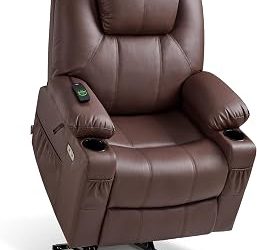
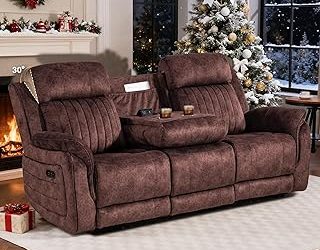
CHITA Leather Power Recliner Sofa Wall Hugger (Dark Brown, 3 Seater)
Mechanically close to the saddle version but trades the console for a drop-down table, which preserves usable three-across seating — a meaningful difference if the sofa handles guests. The darker hide hides body-oil patina better over time, and the same wall-hugger geometry keeps it viable in tighter rooms.
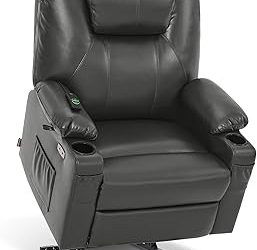
THSUPER Black Leather Power Recliner Sofa with Power Headrest
The most feature-forward option, with wireless charging, arm storage, and cup holders integrated without inflating the footprint much. Powered headrests are the standout, though the seat runs on the softer side, so it suits shorter viewing sessions and casual lounging more than all-day support.
3-Piece Leather Power Recliner Sofa Set with USB, LED Lighting & Storage Console
Best value per seat if you’re outfitting a media room from scratch, and the modular three-piece layout lets you fine-tune spacing to the room rather than the reverse. Expect adequate rather than exceptional support — the recline geometry is conventional, so verify seat depth against your inseam before committing.
Genuine Leather Power Recliner Sofa with Overstuffed Arms, USB & Type-C
The overstuffed arms and back deliver immediate comfort and the Type-C ports are a small but overdue upgrade. The plusher build means more foam settling over the first year, so it’s a better fit for secondary rooms than for a primary daily-use sofa.
Frequently Asked Questions
How much wall clearance does a power recliner sofa need?
Traditional mechanisms want 12 to 18 inches behind the backrest. Wall-hugger designs like the CHITA models need roughly three to six inches because the seat slides forward instead of the frame tipping back — the practical difference between placing a sofa against a wall and floating it in the room.
Is genuine leather worth the premium over faux leather here?
On a reclining sofa, yes. Recline cycles flex the upholstery at the seat-to-back junction thousands of times, and polyurethane coatings crack and delaminate at those fold lines within three to five years. Top-grain hide stretches and patinas instead of failing.
What happens if the motor fails?
Most power recliners use a standard external transformer and a modular motor unit, both replaceable without disassembling the frame. Confirm the mechanism warranty separately from the frame warranty, and keep the transformer model number — it’s the component most likely to need swapping.
Do the USB and wireless charging features hold up?
Charging ports are the shortest-lived component on these sofas, so treat them as a convenience rather than a deciding factor. Prioritize a model where the ports sit in an accessible console or arm rather than being buried in the mechanism housing.
Final Thoughts
For a sofa that stays comfortable and structurally sound past the five-year mark, the CHITA Genuine Leather Power Recliner in Saddle is the clearest choice — dual motors, powered headrest, and wall-hugger geometry in one package. The CHITA Dark Brown Wall Hugger is the better call if you need real three-across seating and easier-aging leather, while the THSUPER Black Leather Power Recliner suits buyers who want powered headrests and integrated charging without stepping up in price.