Key takeaways
- Construction: Look for steel panels that resist twisting, reinforced drawer fronts, and a finish that can tolerate scuffs, oil, and ordinary garage humidity.
- Drawer action: Ball-bearing runners should open smoothly and remain stable when loaded. Full-extension travel is especially useful when tools settle at the back.
- Mobility: Casters, wheel locks, handles, and overall weight determine whether the chest moves easily without becoming unstable or difficult to park.
- Security: A lock is useful for discouraging casual access, but assess whether it secures every drawer and whether the key mechanism feels practical for frequent use.
- Ergonomics: Prioritize a comfortable working height, easy-to-grip handles, protective drawer liners, and storage layouts that reduce bending, reaching, and repeated searching.
What's inside
A bargain tool chest can become an expensive mistake when thin steel flexes, drawers bind, or casters struggle under a real load of hand tools. The lowest sticker price rarely tells you how well a chest will handle daily opening, workshop dust, uneven floors, and the weight concentrated in a few drawers.
This guide evaluates the strongest deal-oriented options for practical ergonomics and long-term durability. I’m focusing on drawer access, mobility, locking design, storage flexibility, construction details, and how each format fits a garage, utility room, repair area, or home workshop.
As an Amazon Associate we earn from qualifying purchases.


How to Choose a/an Deal Tool Chest (2026)
- Construction: Look for steel panels that resist twisting, reinforced drawer fronts, and a finish that can tolerate scuffs, oil, and ordinary garage humidity.
- Drawer action: Ball-bearing runners should open smoothly and remain stable when loaded. Full-extension travel is especially useful when tools settle at the back.
- Mobility: Casters, wheel locks, handles, and overall weight determine whether the chest moves easily without becoming unstable or difficult to park.
- Security: A lock is useful for discouraging casual access, but assess whether it secures every drawer and whether the key mechanism feels practical for frequent use.
- Ergonomics: Prioritize a comfortable working height, easy-to-grip handles, protective drawer liners, and storage layouts that reduce bending, reaching, and repeated searching.
The Best Deal Tool Chest (2026)s Reviewed
24-Inch Portable 5-Drawer Metal Tool Box
This compact black chest is a sensible choice when floor space is limited but a basic drawer system is still important. Its top tray, carry handle, lockable storage, and ball-bearing runners create a practical setup for household maintenance, while the portable format makes it easier to move between a garage bench and a work area.
8-Drawer Rolling 3-in-1 Tool Chest
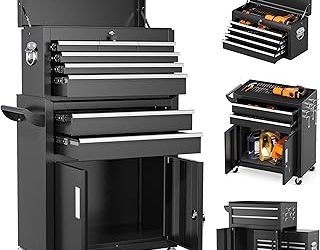
The three-part design offers useful separation between frequently used tools, larger equipment, and less often accessed supplies. Its rolling steel base and detachable upper box should appeal to users who want workshop capacity without committing to one permanently fixed cabinet, although a heavily loaded configuration is best moved slowly over smooth flooring.
DEWALT DWST17820 Modular Tool Box with Wheels
DEWALT’s modular approach is particularly well suited to tradespeople and homeowners who carry tools from storage to the job rather than simply organizing them beside a workbench. The telescopic handle, wheels, deep rolling box, and stackable TSTAK compatibility emphasize transport and system flexibility over traditional drawer-by-drawer organization.
Goplus 24-Inch 6-Drawer Steel Tool Chest
This Goplus model provides a balanced middle ground: six drawers for categorizing hand tools, a top tray for quick access, protective liners, and an automatic locking design. Smooth ball-bearing slides can reduce wrist strain during repeated use, while the portable proportions make it easier to place on or beneath a sturdy work surface.
20-Drawer Tool Chest Set
With three connected chest sections, wheels, foot pads, a stainless countertop, and a portable inner toolbox, this set is aimed at users who need extensive organization rather than a small grab-and-go box. The connection buckle and mixed drawer sizes add flexibility, but buyers should reserve adequate floor space and avoid overloading the upper sections to preserve stability.
Frequently Asked Questions
What makes a tool chest a good deal?
A good deal combines useful capacity with dependable access and a construction level suited to the workload. Smooth runners, sensible drawer dimensions, secure casters, and liners may matter more over time than a slightly lower purchase price.
Are rolling tool chests better than portable tool boxes?
Rolling chests are generally better for a fixed workshop where tool capacity and reduced lifting are priorities. Portable boxes are more convenient for carrying a selected kit between rooms, vehicles, or job sites, especially when stairs or uneven ground are involved.
How much weight should I put in each drawer?
Stay within the manufacturer’s stated drawer and total-capacity limits, and distribute dense items instead of concentrating them in one drawer. Heavy sockets, power-tool accessories, and fasteners should sit low to reduce tipping forces and make the chest easier to roll.
Do tool chest liners really help?
Yes. Liners reduce rattling, protect drawer surfaces from scratches, and help keep tools from sliding when a drawer is opened quickly. They also make small components easier to spot and can be replaced when contaminated with oil or grit.
Final Thoughts
For compact organization, the 24-Inch Portable 5-Drawer Metal Tool Box is a practical starting point; the Goplus 24-Inch 6-Drawer Steel Tool Chest adds another useful layer of categorization. If mobility and expandable storage matter most, the DEWALT DWST17820 is the strongest transport-focused pick, while the 8-Drawer Rolling 3-in-1 Tool Chest suits a more complete garage setup.