Key takeaways
- Air demand: Match compressor output and tank capacity to the job. Suspension leveling needs less sustained flow than repeated tire inflation, air horns, or pneumatic accessories.
- Control layout: Wireless remotes and smartphone apps reduce bending and reaching, while a physical gauge and manual controls remain valuable when gloves, poor reception, or a dead phone are factors.
- Single- or dual-path operation: Single-path systems adjust connected air springs together; dual-path systems can manage left and right sides independently for better load balancing.
- Mounting and heat: Choose a protected, ventilated location with solid fasteners. Compressors need clearance from exhaust heat, road spray, and surfaces that amplify vibration.
- Serviceability: Look for accessible air fittings, replaceable lines, sensible wiring, and a pressure switch or gauge that can be inspected without dismantling half the vehicle.
What's inside
Choosing an onboard air compressor is less about chasing the highest pressure number and more about matching the system to the way your vehicle is loaded, driven, and serviced. A compressor that cycles constantly, vibrates against a thin mounting panel, or relies on awkward controls can turn air suspension into a daily nuisance rather than a useful upgrade.
This guide evaluates six widely available systems through an ergonomics-and-durability lens: control convenience, installation burden, air-delivery demands, hardware quality, and long-term serviceability. The recommendations cover air suspension, leveling, air lockers, air horns, and general trail or work-truck inflation needs.
As an Amazon Associate we earn from qualifying purchases.


How to Choose a/an On Board Air Compressor (2026)
- Air demand: Match compressor output and tank capacity to the job. Suspension leveling needs less sustained flow than repeated tire inflation, air horns, or pneumatic accessories.
- Control layout: Wireless remotes and smartphone apps reduce bending and reaching, while a physical gauge and manual controls remain valuable when gloves, poor reception, or a dead phone are factors.
- Single- or dual-path operation: Single-path systems adjust connected air springs together; dual-path systems can manage left and right sides independently for better load balancing.
- Mounting and heat: Choose a protected, ventilated location with solid fasteners. Compressors need clearance from exhaust heat, road spray, and surfaces that amplify vibration.
- Serviceability: Look for accessible air fittings, replaceable lines, sensible wiring, and a pressure switch or gauge that can be inspected without dismantling half the vehicle.
The Best On Board Air Compressor (2026)s Reviewed
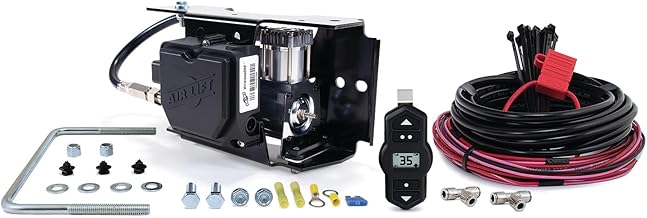
Air Lift 25980EZ WirelessONE
The Air Lift 25980EZ WirelessONE is a strong choice for straightforward single-path air-suspension control. Its handheld remote and mobile-app operation make routine leveling more comfortable, while the EZ Mount design can reduce installation time and the number of awkward under-vehicle tasks.
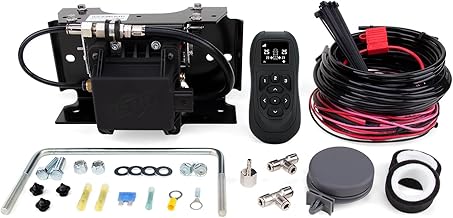
Air Lift 74000EZ WirelessAIR
For vehicles that benefit from side-to-side adjustment, the Air Lift 74000EZ WirelessAIR adds dual-path control to the same user-friendly wireless concept. It is particularly appealing for uneven loads, towing, or drivers who want finer control without repeatedly accessing a hard-to-reach valve panel.
VIAIR 150 PSI High-Flow Air Source Kit
The VIAIR 150 PSI High-Flow Air Source Kit is the most versatile option here for users who need more than suspension adjustment. Its two-gallon tank and high-pressure design suit air horns, air lockers, suspension systems, and general inflation, although the larger package deserves a carefully planned, vibration-resistant mounting position.
ARB Inflation Kit Air Compressor
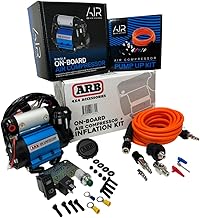
The ARB CKMA12 compressor paired with the 171302 inflation kit is a practical, established solution for controlled tire inflation and off-road use. The included hose and quick-fitting arrangement improve handling at the wheel, while the compact compressor is easier to protect and service than many improvised multi-purpose setups.
maXpeedingrods Universal Air Spring Compressor Kit
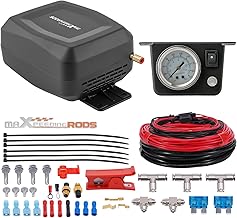
This maXpeedingrods kit is aimed at budget-conscious truck and van owners who want a complete air-spring control package with a gauge, air line, T-fittings, and installation hardware. Its value depends heavily on careful routing and connection work, so inspect every fitting, secure the line away from abrasion, and mount the compressor on a rigid surface.
Frequently Asked Questions
What size onboard compressor do I need?
For occasional air-spring leveling, a modest compressor may be sufficient. Choose a higher-flow unit with a tank when you expect repeated tire inflation, air horns, air lockers, or other accessories that consume air continuously.
Is a wireless compressor system better than a wired one?
Wireless control is more convenient and reduces cabin wiring, especially when adjusting suspension outside the vehicle. Wired gauges and switches are still useful as a dependable backup and may be preferable for work vehicles exposed to harsh conditions.
Where should an onboard air compressor be mounted?
Use a firm, well-supported location with airflow and protection from direct water, mud, exhaust heat, and stone impact. Avoid thin panels that transmit vibration; rubber isolation can help, provided it does not allow the compressor to move excessively.
Can an onboard compressor inflate tires?
Some can, but suspension compressors are not automatically ideal tire inflators. Check the compressor’s airflow, duty cycle, hose length, and recommended operating limits before relying on it for large tires or repeated inflation.
Final Thoughts
The Air Lift 25980EZ WirelessONE is the easiest all-around pick for simple air-suspension management, while the Air Lift 74000EZ WirelessAIR is better for independent side-to-side adjustment. For broader utility, including tire inflation and air-powered accessories, the VIAIR 150 PSI High-Flow Air Source Kit offers the most capable platform.