Key takeaways
- Airflow: Compare SCFM or CFM at 90 PSI with your tool’s requirement. For continuous-use tools, choose a compressor that exceeds the rating rather than merely matching it.
- Tank capacity: A larger tank provides a useful reserve for bursts of nailing or stapling, while a small tank reduces weight and storage demands. Tank size cannot replace adequate pump output.
- Portability: Look for a balanced handle, protected fittings, manageable weight, and feet that stay planted during startup. Compact pancake designs are convenient, but their broad shape can be awkward on crowded benches.
- Noise and vibration: Oil-free models simplify ownership, yet they often sound sharper than oil-lubricated compressors. Rubber feet, stable placement, and hearing protection matter in enclosed workshops.
- Duty cycle: Check whether the compressor is intended for intermittent or sustained operation. Allowing adequate cooling time improves pump life and prevents nuisance shutdowns during demanding sessions.
What's inside
Choosing an air compressor for pneumatic tools is less about chasing the highest PSI number and more about matching airflow, duty cycle, portability, and noise to the work at hand. A compressor that looks powerful on paper can still disappoint if it recovers slowly between fasteners, trips its thermal protection, or forces you to work around a short hose and awkward controls.
This guide evaluates the most useful options for furniture projects, trim installation, light construction, repairs, and general workshop duty. The focus is practical durability and ergonomics: how comfortably each unit carries, stores, operates, and sustains common pneumatic tools—not simply how impressive its specifications appear.
As an Amazon Associate we earn from qualifying purchases.



How to Choose an Air Compressor For Pneumatic Tools (2026)
- Airflow: Compare SCFM or CFM at 90 PSI with your tool’s requirement. For continuous-use tools, choose a compressor that exceeds the rating rather than merely matching it.
- Tank capacity: A larger tank provides a useful reserve for bursts of nailing or stapling, while a small tank reduces weight and storage demands. Tank size cannot replace adequate pump output.
- Portability: Look for a balanced handle, protected fittings, manageable weight, and feet that stay planted during startup. Compact pancake designs are convenient, but their broad shape can be awkward on crowded benches.
- Noise and vibration: Oil-free models simplify ownership, yet they often sound sharper than oil-lubricated compressors. Rubber feet, stable placement, and hearing protection matter in enclosed workshops.
- Duty cycle: Check whether the compressor is intended for intermittent or sustained operation. Allowing adequate cooling time improves pump life and prevents nuisance shutdowns during demanding sessions.
The Best Air Compressor For Pneumatic Tools (2026)s Reviewed
DEWALT 6-Gallon Pancake Compressor
The DEWALT Pancake Air Compressor DWFP55126 is a dependable all-rounder for brad nailers, finish nailers, staplers, and occasional framing work. Its 165 PSI maximum and 2.6 SCFM at 90 PSI provide a useful combination of reserve and recovery for furniture projects, while the oil-free pump keeps routine maintenance simple. The compact pancake footprint stores neatly, although its operating noise is more suitable for garage use than quiet indoor work.
Metabo HPT 6-Gallon 200 PSI Compressor
Metabo HPT’s EC914S stands out when tool changes and recovery speed matter. Its 200 PSI rating and stated 4 CFM flow give it more breathing room than many basic pancake compressors, making it a stronger choice for users running multiple nailers or tackling roofing and siding tasks. The extra capability adds value for a busy workshop, but buyers should still verify each tool’s actual airflow demand rather than assuming simultaneous operation is unlimited.
BOSTITCH 6-Gallon Pancake Compressor Kit
The BOSTITCH BTFP02012-WPK is a practical kit-oriented option for homeowners who want a compressor with useful accessories rather than a bare machine. Its 150 PSI capacity is well suited to intermittent fastening, trim work, upholstery tasks, and inflation. The lightweight, oil-free design is easy to move around a room, though its airflow is better matched to short bursts than continuous sanding or spray-finishing work.
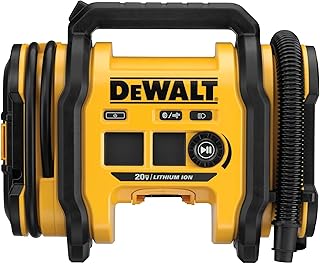
DEWALT 20V MAX Portable Tire Inflator
The DEWALT DCC020IB is not a conventional shop compressor, but it earns consideration for portable inflation and emergency maintenance. Automatic shutoff, an LED light, and cordless operation make it ergonomically convenient for tires, sports equipment, and small pneumatic chores where carrying a tank would be excessive. It is not the right tool for nailers or other high-demand air tools, and the listing is for the tool only, so a compatible battery and charger are required.
SENCO 1-Gallon Compressor
At roughly 20 pounds, the SENCO PC1010 is especially appealing for trim carpenters and furniture makers who value low carrying effort. Its one-gallon tank and compact form make it easy to place beside a workbench or carry between rooms, while its output suits brad nailers, staplers, and light finish work. The smaller reservoir means more frequent cycling, so it is best used for intermittent fastening rather than demanding, sustained applications.
Frequently Asked Questions
What size compressor is best for pneumatic nailers?
For brad, finish, and framing nailers used intermittently, a six-gallon compressor is a flexible starting point. Pay closer attention to SCFM at 90 PSI than tank size if you expect rapid firing or multiple tools.
Is higher PSI always better?
No. PSI indicates stored pressure, not how quickly the compressor can deliver air. A model with strong SCFM performance and sensible recovery can outperform a higher-PSI unit when a tool is used repeatedly.
Can an air compressor run a spray gun?
Some can, but many portable pancake models lack the sustained airflow required by spray guns. Check the gun’s recommended CFM, then select a compressor with a meaningful margin above that figure and an appropriate duty cycle.
How can I make a compressor last longer?
Drain condensation after use, keep intake vents clear, use the correct extension-cord strategy, and allow cooling breaks during heavy work. Store the compressor level and protect fittings from impact when transporting it.
Final Thoughts
For the broadest furniture-workshop usefulness, the DEWALT DWFP55126 is a dependable default. Choose the Metabo HPT EC914S when faster recovery and higher airflow matter, or the SENCO PC1010 when low weight and easy room-to-room handling are your priorities.