Key takeaways
- Repair cracks, fill deep pits, and remove grease before installation; flooring follows the condition of the slab.
- Leave the manufacturer’s recommended expansion gap around walls, posts, and fixed cabinets.
- Use a sharp blade and a straightedge for roll flooring, and dry-fit the layout before applying tape.
- Place protective pads beneath jack stands, welding equipment, and sharp-legged shelving.
What's inside
The best garage flooring does more than make a concrete slab look finished. It changes how your body works in the space: a slightly resilient surface reduces fatigue during repairs, a predictable grip improves footing, and a smooth, cleanable finish makes it easier to move tools, furniture, and storage. The right floor also protects concrete from salt, oil, moisture, dropped hardware, and repeated tire traffic.
This guide compares the main garage-floor formats—interlocking tiles, continuous rolls, and absorbent parking mats—through an ergonomics-and-durability lens. You’ll learn how to match a surface to your climate, vehicle use, cleaning routine, and workshop habits, plus which details matter more than appearance alone.
As an Amazon Associate we earn from qualifying purchases.




Start With the Garage’s Main Job
Begin by identifying how the space is actually used. A garage that houses a daily driver needs resistance to water, road salt, hot tires, and turning loads. A workshop needs secure footing, sensible rolling resistance, and enough cushioning to make kneeling or standing less punishing. A storage-focused garage may benefit most from an easy-to-clean surface that does not trap dust beneath shelves.
Interlocking tiles are versatile because damaged sections can be lifted and replaced instead of removing the entire floor. The Garage Floor Tiles Interlocking Garage Flooring option uses 12-by-12-inch modular pieces with an anti-slip, oil- and stain-resistant surface. It is a practical format for partial installations or rooms where you may need to work around cabinets and posts.
Choose Tiles or a Roll
Tiles are generally the most repairable choice. Their joints allow you to create borders, patterns, or removable service zones, and installation usually requires no adhesive. They can, however, transmit more sound and may allow spilled fluids to reach the slab through seams. Check that the subfloor is reasonably flat; uneven concrete can cause rocking, separation, or premature wear at the connectors.
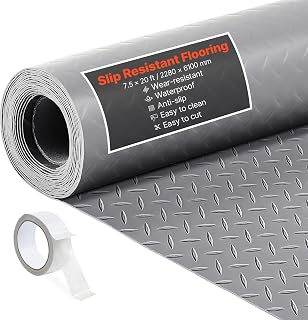
Roll flooring creates a more continuous barrier with fewer places for dirt and liquids to collect. The VEVOR Garage Floor Roll is a 2.2-millimeter PVC diamond-plate mat designed for non-slip use, while the 8×20 FT Garage Floor Mat is a thicker 2.8-millimeter PVC/rubber-style roll supplied with tape. Rolls are well suited to parking bays and broad work areas, but they require careful measuring and trimming. Wrinkles are not merely cosmetic: they can catch a caster, stress the material, and make sweeping awkward.
Evaluate Traction and Movement
Grip should feel secure without making every movement difficult. A heavily textured surface can improve traction around wet vehicles, but it may increase fatigue when you push a tool chest or roll a furniture dolly. For a workshop, test the intended floor with your actual casters if possible. Small, hard wheels expose ridges and joints more readily than pneumatic tires.
Open-grid tiles take a different approach. SnapLock RaceDeck Free-Flow tiles have a self-draining design that lets water and melted snow pass below the walking surface. This can be valuable in wet climates, provided the concrete beneath has a way to drain and you are willing to clean underneath periodically. Their open structure is less ideal where fine sawdust, soil, or small parts regularly fall through.
Consider Load, Heat, and Chemical Exposure
Do not judge load capacity by a product’s headline number alone. Rolling loads concentrate force at a few small wheels, and turning creates additional shear at tile connections. Use broad, suitable casters and follow the manufacturer’s guidance for vehicle jacks, lifts, stands, and heavy tool cabinets. Allow extra margin rather than designing right at the published limit.
Heat and chemicals are equally important. Hot tires, brake cleaner, gasoline, oil, and road salt can affect finishes differently. Polypropylene tiles such as Swisstrax Ribtrax PRO are a strong candidate for a modular, commercial-style installation, while PVC rolls offer broad spill protection and straightforward mopping. Whichever format you select, remove chemicals promptly and avoid assuming that “oil resistant” means permanently stain-proof.
Plan Installation Around the Human Body
Good flooring should make routine work easier, not create new obstacles. Keep transition edges low and secure, especially at the garage door and walk-through door. Avoid placing a seam where you frequently pivot, kneel, or push a loaded cart. A slightly softer anti-fatigue mat at a fixed bench can be more effective than choosing an overly soft floor throughout the garage, which may make carts unstable.
For a simple parking solution, the Garage Mats Oversize Garage Floor Parking Mat provides a large absorbent, waterproof area beneath a vehicle. It can be useful when you want to protect concrete without committing to a full installation. Measure with doors open and include room for walking around the vehicle. Edges should lie flat and remain outside the path of tires and casters.
Tips
- Repair cracks, fill deep pits, and remove grease before installation; flooring follows the condition of the slab.
- Leave the manufacturer’s recommended expansion gap around walls, posts, and fixed cabinets.
- Use a sharp blade and a straightedge for roll flooring, and dry-fit the layout before applying tape.
- Place protective pads beneath jack stands, welding equipment, and sharp-legged shelving.
Frequently Asked Questions
What is the most durable type of garage flooring?
There is no universal winner. Modular polypropylene tiles are durable and repairable, while thick PVC rolls provide broad protection with fewer seams. Durability depends on installation quality, rolling loads, sunlight, chemical exposure, and maintenance as much as on material.
Are interlocking garage tiles comfortable to stand on?
They are usually more comfortable than bare concrete because they add a small amount of resilience and reduce the sensation of a hard, cold slab. They are not a substitute for a dedicated anti-fatigue mat during long bench work. Choose stable tiles with secure connectors and avoid excessive flex beneath workstations.
Can garage flooring go over cracked concrete?
Minor, stable cracks may be acceptable after cleaning and leveling, but active movement, loose concrete, or substantial height changes should be repaired first. Flexible roll flooring may hide small imperfections visually, but it will not correct an uneven structural surface.
Is an absorbent garage mat enough for winter salt and water?
It can protect the main parking area, but it needs regular drying and cleaning. Trapped moisture may damage the concrete or create odor, particularly when the mat remains in place for long periods. Lift it occasionally, clean beneath it, and confirm that its edges cannot become a trip hazard.
Conclusion
The best garage flooring for 2026 is the surface that fits your work habits and your slab—not simply the most decorative option. Choose interlocking tiles when repairability and modular installation matter, a roll when continuous coverage and easy sweeping are priorities, and a parking mat when you need targeted protection. Prioritize stable traction, flat transitions, realistic load margins, and a cleaning routine you will actually follow.