Key takeaways
- Tooth count: Use roughly 24–40 teeth for fast framing cuts, 50–60 teeth for general woodworking, and 80 or more teeth for clean crosscuts in trim, plywood, and finished furniture parts.
- Blade diameter and arbor: Match the blade diameter and arbor hole to your saw exactly. A 10-inch blade is not interchangeable with a 12-inch model, and an incorrect arbor fit can create dangerous instability.
- Cut quality: High tooth counts usually improve finish quality, but tooth shape matters too. Alternate-top-bevel designs are often well suited to clean crosscuts in wood and veneered sheet goods.
- Kerf and vibration: A thinner kerf can reduce cutting resistance, which is helpful for compact saws and long sessions. Adequate plate stiffness is equally important because a flexible blade can wander or produce a rough edge.
- Application: Choose a blade for the material you actually cut. A general-purpose woodworking blade is convenient, but a dedicated finish blade is preferable when tear-out would mean extra sanding or ruined trim.
What's inside
Choosing a miter-saw blade is less about finding the highest tooth count and more about matching the blade to the work. A coarse framing blade can tear delicate trim, while an ultra-fine blade may cut slowly and wear quickly when asked to process construction lumber. Arbor size, kerf, tooth geometry, and material quality also affect vibration, edge quality, and how confidently the saw tracks through a board.
This guide compares practical options for furniture building, trim installation, framing, and general shop use. The recommendations focus on cut cleanliness, durability, workload flexibility, and the ergonomics of making repeated cuts without excessive force or distracting vibration.
As an Amazon Associate we earn from qualifying purchases.


How to Choose a/an Saw Blades For Miter Saws (2026)
- Tooth count: Use roughly 24–40 teeth for fast framing cuts, 50–60 teeth for general woodworking, and 80 or more teeth for clean crosscuts in trim, plywood, and finished furniture parts.
- Blade diameter and arbor: Match the blade diameter and arbor hole to your saw exactly. A 10-inch blade is not interchangeable with a 12-inch model, and an incorrect arbor fit can create dangerous instability.
- Cut quality: High tooth counts usually improve finish quality, but tooth shape matters too. Alternate-top-bevel designs are often well suited to clean crosscuts in wood and veneered sheet goods.
- Kerf and vibration: A thinner kerf can reduce cutting resistance, which is helpful for compact saws and long sessions. Adequate plate stiffness is equally important because a flexible blade can wander or produce a rough edge.
- Application: Choose a blade for the material you actually cut. A general-purpose woodworking blade is convenient, but a dedicated finish blade is preferable when tear-out would mean extra sanding or ruined trim.
The Best Saw Blades For Miter Saws (2026)s Reviewed
WEN BL1080 10-Inch 80-Tooth Blade
This carbide-tipped 80-tooth blade is a strong choice for furniture components, molding, and other work where a clean crosscut matters more than maximum speed. Its dense tooth pattern should be paired with controlled feed pressure; forcing the cut can increase heat and make the saw feel less stable.
WEN BL1280 12-Inch 80-Tooth Blade
Designed for 12-inch miter saws, the BL1280 brings fine-finish tooth density to larger workpieces and wider trim. It suits careful crosscutting in hardwood and finished stock, though users should confirm their saw’s clearance and arbor specifications before buying.
WEN BL1060 10-Inch 60-Tooth Blade
The BL1060 occupies the useful middle ground between speed and surface quality. Its 60-tooth layout is appropriate for everyday furniture work, shelving, casing, and dimensional lumber when you want a cleaner result than a framing blade without the slower feel of an ultra-fine blade.
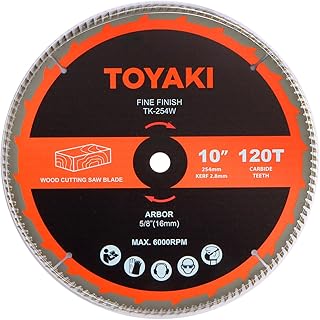
10-Inch 120-Tooth Fine-Finish Blade
With an unusually high 120-tooth count, this blade is aimed at delicate finish work where minimizing visible tear-out is the priority. It can be a sensible specialist blade for small molding and presentation-facing parts, but it is not the efficient choice for fast, thick, or rough stock.
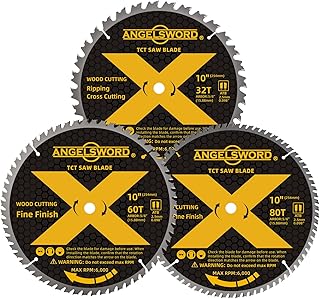
10-Inch 3-Pack, 32T/60T/80T
This three-blade set offers a practical way to cover framing, general cutting, and fine finishing without relying on one compromised all-purpose blade. The 5/8-inch arbor is common on many 10-inch saws, but compatibility still needs to be checked against the tool manual before installation.
Frequently Asked Questions
Can I use a table-saw blade on a miter saw?
Often, yes, provided the diameter, arbor, kerf, and maximum rated speed are compatible. The blade must also be intended for the material and cutting direction involved; when in doubt, follow the miter-saw manufacturer’s guidance.
Is a higher tooth count always better?
No. More teeth can produce a smoother crosscut, but they also remove material more slowly and may generate additional heat when pushed too hard. Match tooth count to the balance of finish quality and cutting speed your project requires.
How often should a miter-saw blade be replaced?
Replace or professionally sharpen it when cuts become rough despite proper setup, the saw starts requiring unusual pressure, or burning and wandering persist. Carbide blades can often be sharpened, making professional resharpening worthwhile for premium or frequently used blades.
What should I do if the blade vibrates?
Stop the saw and inspect the blade, arbor, washer, and mounting surfaces for dirt, damage, or incorrect seating. Never compensate for vibration by tightening excessively or continuing to cut; a damaged blade or tool should be removed from service.
Final Thoughts
For a dependable furniture-workshop default, the WEN BL1060 60-tooth blade offers a useful balance of finish and cutting efficiency. Choose the WEN BL1080 or BL1280 when clean trim and hardwood crosscuts take priority, and consider the 10-inch 3-pack if your projects regularly shift between framing and fine finish work.