Key takeaways
- Air delivery: Compare SCFM at 90 PSI rather than tank size alone. Higher delivered airflow matters for sanders, grinders, impact tools, and paint equipment.
- Power requirements: Most full-size stationary compressors require a 230-volt circuit and professional installation. Confirm your electrical capacity before ordering.
- Pump design: Oil-lubricated pumps typically offer good longevity and serviceability, while oil-free designs reduce routine maintenance but can be louder and less forgiving under sustained loads.
- Workspace ergonomics: Check the compressor’s footprint, access to drain valves and filters, control visibility, and clearance around the belt or pump for safe maintenance.
- Durability details: Look for a robust cast-iron pump, sensible thermal protection, a well-supported tank, and replacement parts that are readily available.
What's inside
A 60-gallon air compressor can transform a home workshop, but its large tank does not automatically make it a good buy. Buyers still need to compare recovery speed, electrical requirements, noise, pump design, service access, and whether the compressor can sustain the air demand of their tools.
This guide evaluates the leading 60-gallon models from an ergonomics-and-durability perspective. The focus is practical: how easily each unit fits into a working garage, how consistently it supplies air, and how well its design supports years of maintenance and heavy use.
As an Amazon Associate we earn from qualifying purchases.


How to Choose an Air Compressor 60 Gallon (2026)
- Air delivery: Compare SCFM at 90 PSI rather than tank size alone. Higher delivered airflow matters for sanders, grinders, impact tools, and paint equipment.
- Power requirements: Most full-size stationary compressors require a 230-volt circuit and professional installation. Confirm your electrical capacity before ordering.
- Pump design: Oil-lubricated pumps typically offer good longevity and serviceability, while oil-free designs reduce routine maintenance but can be louder and less forgiving under sustained loads.
- Workspace ergonomics: Check the compressor’s footprint, access to drain valves and filters, control visibility, and clearance around the belt or pump for safe maintenance.
- Durability details: Look for a robust cast-iron pump, sensible thermal protection, a well-supported tank, and replacement parts that are readily available.
The Best Air Compressor 60 Gallon (2026)s Reviewed
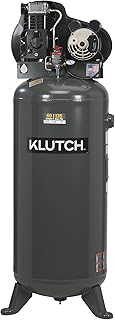
Klutch 60-Gallon Vertical Air Compressor
The Klutch is a practical choice for demanding garage and shop air-tool use, with dependable output from its 3.7-horsepower, 230-volt single-stage platform. Its vertical layout preserves floor space, while maintenance-friendly access makes routine inspection and servicing less awkward than on many bulky stationary units.
Campbell Hausfeld 60-Gallon Vertical Air Compressor
Campbell Hausfeld’s 3.7-horsepower model combines a useful 175 PSI maximum with the familiar space-saving format expected from a vertical compressor. It suits homeowners who want substantial reserve capacity for intermittent tools and appreciate a straightforward design that is easy to position and operate.
VEVOR 60-Gallon Heavy-Duty 5HP Air Compressor
With a claimed 12 SCFM at 90 PSI and a 145 PSI maximum, this VEVOR model is aimed at larger workshops that need stronger sustained airflow. The oil-lubricated pump is a sensible durability choice, but buyers should plan for proper 230-volt installation and verify plug and wiring requirements because it is sold without a plug.
DEWALT 60-Gallon Vertical Air Compressor
The DEWALT delivers a balanced specification for workshop and garage applications, including a 3.7-horsepower motor and 155 PSI maximum pressure. Its established brand support and familiar vertical form make it a comfortable choice for users who value predictable operation, service access, and a compact stationary footprint.
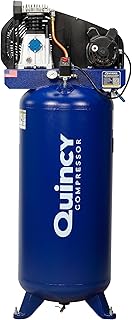
Quincy Q13160VQ 60-Gallon Vertical Air Compressor
Quincy’s Q13160VQ pairs a 3.5-horsepower motor with a 220-volt connection and 60-gallon vertical tank. It is particularly appealing to buyers who prioritize long-term mechanical dependability and a serviceable, traditional compressor layout over the lowest initial price or the smallest possible footprint.
Frequently Asked Questions
Is a 60-gallon compressor suitable for home use?
Yes, provided the workshop has adequate space, ventilation, and electrical service. A 60-gallon tank is useful for reducing cycling and supporting demanding tools, but it is excessive for occasional inflation or short bursts with a brad nailer.
What tools can a 60-gallon compressor run?
These compressors can support many impact wrenches, ratchets, blow guns, nailers, and some sanders or spray guns. Always compare the tool’s required SCFM at its working pressure with the compressor’s delivered SCFM, allowing extra capacity for comfortable continuous operation.
Do stationary compressors need a dedicated circuit?
Typically, yes. Most models in this class use 220- or 230-volt power and should be connected to a properly sized dedicated circuit by a qualified electrician. Never rely on an improvised extension cord for a large stationary compressor.
How should a 60-gallon compressor be maintained?
Drain condensation regularly, inspect hoses and fittings, clean or replace intake filters, and check the oil level when applicable. Periodically inspect belts, guards, pressure-switch operation, and tank condition, and follow the manufacturer’s schedule for oil changes and fastener checks.
Final Thoughts
The Klutch is a strong all-around pick for demanding home workshops, while the Campbell Hausfeld offers a sensible balance of pressure and usability. For heavier continuous airflow, the VEVOR 5HP model deserves attention; buyers seeking a long-service, traditional design should also consider the Quincy Q13160VQ.