Key takeaways
- Length: Match the blade length specified for your saw, not merely the wheel diameter. Even a small discrepancy can prevent correct tensioning.
- Width: Wider blades generally track more steadily for resawing and straight cuts; narrower blades turn more easily for curves.
- Tooth pitch: Lower TPI removes waste quickly from thick stock, while higher TPI produces a finer cut in thinner boards. Aim for at least three teeth in the material throughout the cut.
- Tooth construction: Hardened or premium alloy teeth can extend service life, especially when cutting abrasive hardwoods, reclaimed lumber, or occasional dirty stock.
- Work posture: A blade that feeds smoothly reduces pushing force and hand fatigue. Correct tension, clean guides, and a suitable tooth pattern matter as much as the blade itself.
What's inside
Choosing a wood-cutting band saw blade is less straightforward than it looks. A blade can fit the wheel diameter yet still perform poorly if its length, width, tooth pitch, or tooth set does not suit the saw or the stock. The wrong match may wander in straight cuts, clog in resinous timber, or fatigue quickly under furniture-making workloads.
This guide compares blades for benchtop and portable band saws from an ergonomics-and-durability perspective. The focus is practical: dependable tracking, manageable feed effort, clean cuts, tooth life, and compatibility with common machines. Always verify your saw’s exact blade length and the manufacturer’s recommended width before ordering.
As an Amazon Associate we earn from qualifying purchases.

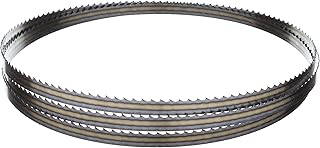


How to Choose a Band Saw Blade For Wood (2026)
- Length: Match the blade length specified for your saw, not merely the wheel diameter. Even a small discrepancy can prevent correct tensioning.
- Width: Wider blades generally track more steadily for resawing and straight cuts; narrower blades turn more easily for curves.
- Tooth pitch: Lower TPI removes waste quickly from thick stock, while higher TPI produces a finer cut in thinner boards. Aim for at least three teeth in the material throughout the cut.
- Tooth construction: Hardened or premium alloy teeth can extend service life, especially when cutting abrasive hardwoods, reclaimed lumber, or occasional dirty stock.
- Work posture: A blade that feeds smoothly reduces pushing force and hand fatigue. Correct tension, clean guides, and a suitable tooth pattern matter as much as the blade itself.
The Best Band Saw Blade For Wood (2026)s Reviewed
AYAO 70-1/2-Inch 4 TPI Blade
Designed for compatible 10-inch saws such as the Craftsman 921400 and Rikon 10-305/10-3061, this 1/2-inch blade offers a useful balance of stability and waste removal. Its hardened teeth make it a sensible choice for routine furniture parts and thicker hardwood, provided the listed length matches your machine.
Timber Wolf 72-Inch 4 TPI Blade
This 1/2-inch, 4 TPI blade is aimed at users who value a steady, relatively low-effort feed through substantial wood. The coarse tooth spacing is better suited to ripping and resaw-style work than delicate curves, where a narrower or finer blade will be easier to control.
FOXBC 72-Inch 6 TPI Blades, 2-Pack
For compatible WEN 3962 and Delta 28-140 10-inch saws, this two-pack provides a useful general-purpose setup. The 1/2-inch width supports straight tracking, while 6 TPI is a more versatile compromise than an especially coarse blade for mixed furniture stock.
LENOX Tools 44-7/8-Inch 14 TPI Blades, 5-Pack
Made for compatible portable band saws, this 1/2-inch-wide blade uses a fine 14 TPI pattern suited to thinner wood and controlled cuts. The five-pack is particularly practical for workshop users who want replacements on hand rather than stretching one blade past its comfortable working life.
FOXBC 44-7/8-Inch 10/14 TPI Blades, 3-Pack
Compatible with specified Milwaukee and DeWalt portable band saw models, these variable-pitch blades are designed to balance cutting speed with a smoother finish across changing material thicknesses. Their .020-inch thickness favors portable use, where low cutting resistance helps reduce awkward wrist and shoulder loading.
Frequently Asked Questions
What TPI is best for cutting wood?
For thicker boards, 3–4 TPI clears chips quickly and helps prevent heat buildup. Around 6 TPI is a versatile choice for general furniture work, while 10–14 TPI is better for thinner pieces and cleaner, slower cuts.
Is a wider band saw blade better for wood?
A wider blade is usually more resistant to deflection during straight cuts and resawing. It is not automatically better, however: narrow blades are easier to steer around curves and may be more appropriate for smaller saws.
How do I know whether a blade will fit my band saw?
Check the saw’s required blade length first, then confirm the maximum and minimum blade widths permitted by its guides and wheel design. Compare those specifications with the complete blade listing, including length, width, thickness, and tooth pitch.
Why does my new blade wander while cutting?
Wandering can result from insufficient or excessive tension, misaligned guides, dull teeth, an incorrect tooth pattern, or forcing the workpiece. Recheck setup and feed pressure before assuming the blade is defective.
Final Thoughts
For steady general-purpose work, the FOXBC 72-inch 6 TPI two-pack is a balanced starting point, while the AYAO 70-1/2-inch 4 TPI blade suits compatible saws handling thicker stock. Portable-saw owners should consider the LENOX 14 TPI pack or FOXBC variable-pitch blades for controlled, lower-effort cutting.