Key takeaways
- Airflow: Look for a strong published CFM rating, but match fan diameter to the room rather than choosing the largest model automatically. Oversized fans can be inefficient in cramped spaces, while undersized fans may leave work areas stagnant.
- Ceiling height: Select the correct downrod length so the blades sit safely above people, vehicles, and raised equipment. For sloped or unusually high ceilings, included downrods and compatible mounting hardware add practical flexibility.
- Motor and controls: A reversible DC motor typically offers fine speed adjustment and quieter operation than a basic single-speed design. Remote or app control is especially useful when the wall switch is distant from a workbench or vehicle bay.
- Construction: Metal or aluminum blades and a well-finished housing are sensible choices for workshops that see temperature swings, dust, and occasional bumps during maintenance. Check the rating carefully if the garage is humid or partially open to weather.
- Lighting and maintenance: A lighted fan can improve visibility, but it should not replace dedicated task lighting over benches. Choose a model whose blades, controls, and light assembly can be reached and cleaned without creating an unnecessary service chore.
What's inside
A garage needs more than a decorative breeze. Concrete floors, tall ceilings, open doors, vehicles, tools, and occasional dust create a demanding environment where a poorly chosen fan can feel ineffective, collect grime, or become awkward to service. The right model should move substantial air at working height while remaining stable, quiet enough for conversation, and suited to the garage’s moisture exposure.
This guide evaluates large ceiling fans through an ergonomics-and-durability lens: airflow relative to room size, motor control, blade construction, mounting flexibility, noise, lighting, and everyday usability. The recommendations below are intended for garages, workshops, covered patios, gyms, and similar spaces—not merely standard-height living rooms.
As an Amazon Associate we earn from qualifying purchases.



How to Choose a Ceiling Fan For Garage (2026)
- Airflow: Look for a strong published CFM rating, but match fan diameter to the room rather than choosing the largest model automatically. Oversized fans can be inefficient in cramped spaces, while undersized fans may leave work areas stagnant.
- Ceiling height: Select the correct downrod length so the blades sit safely above people, vehicles, and raised equipment. For sloped or unusually high ceilings, included downrods and compatible mounting hardware add practical flexibility.
- Motor and controls: A reversible DC motor typically offers fine speed adjustment and quieter operation than a basic single-speed design. Remote or app control is especially useful when the wall switch is distant from a workbench or vehicle bay.
- Construction: Metal or aluminum blades and a well-finished housing are sensible choices for workshops that see temperature swings, dust, and occasional bumps during maintenance. Check the rating carefully if the garage is humid or partially open to weather.
- Lighting and maintenance: A lighted fan can improve visibility, but it should not replace dedicated task lighting over benches. Choose a model whose blades, controls, and light assembly can be reached and cleaned without creating an unnecessary service chore.
The Best Ceiling Fan For Garage (2026)s Reviewed
72-Inch Black Garage Fan with App Control
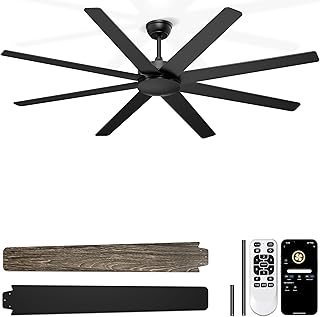
This 72-inch, eight-blade fan is a practical choice for medium-to-large garages where controllable airflow matters more than integrated lighting. Its advertised 7,138 CFM, quiet DC motor, reversible airflow, remote, and app control give users useful flexibility when moving between a workbench, storage area, and vehicle bay.
ZMISHIBO 65-Inch Garage Ceiling Fan
The 65-inch ZMISHIBO is a balanced option for garages that need serious circulation without the visual and physical scale of a 96-inch industrial fan. It offers six speeds, a reversible DC motor, and a stated 6,116 CFM, while its indoor/covered-outdoor positioning makes it suitable for appropriately protected installations.
ZMISHIBO 80-Inch Fan with 24W LED Light
For a garage that doubles as a workshop, the 80-inch ZMISHIBO adds a 24W LED with three color-temperature settings to substantial overhead airflow. Its damp rating, quiet DC motor, remote, and dual-finish design make it versatile, although task lights should still handle detailed bench work.
ZMISHIBO 96-Inch Industrial Fan
With eight aluminum blades, six speeds, a reversible DC motor, and three downrods, this 96-inch ZMISHIBO is designed for large, open spaces such as warehouses, farms, and high-ceiling garages. The extra mounting options are valuable for installation planning, particularly where a flat or sloped ceiling complicates blade clearance.
96-Inch Industrial HVLS Shop Fan
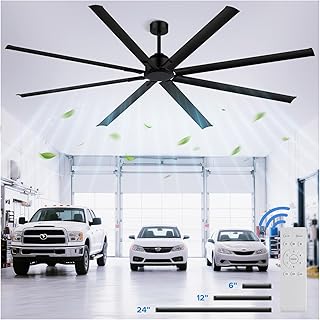
This 96-inch commercial-style fan uses eight metal blades and a quiet, reversible DC motor to circulate air across broad garage or gym floors. Its six-speed remote control should make adjustment straightforward from a distance, while the substantial diameter is best reserved for spacious areas with generous clearance around vehicles and people.
Frequently Asked Questions
What size ceiling fan is best for a garage?
Room dimensions and ceiling height matter more than the garage label itself. A 65- to 80-inch fan can suit many larger residential garages, while 96-inch models are better considered for wide, open spaces with enough clearance for their blade sweep and mounting height.
Should a garage ceiling fan have a light?
Choose a lighted model if the existing overhead illumination is weak and you want general ambient lighting. For repairs, woodworking, or detailed projects, dedicated task lights remain more useful because they can be aimed directly at the work surface.
Are these fans suitable for an unconditioned garage?
They can be useful in an unconditioned garage, but installation conditions matter. Verify the product’s damp or dry rating, protect the fan from direct rain, and avoid assuming that a covered outdoor rating makes it appropriate for fully exposed weather.
What should I check before installing a large garage fan?
Confirm ceiling structure, electrical compatibility, blade clearance, downrod length, and the location of garage doors, vehicle roofs, storage racks, and lights. A large fan should be mounted securely to suitable structural support rather than simply attached to a standard electrical box.
Final Thoughts
The 72-inch fan is a strong all-around pick for app-based control and high airflow, while the ZMISHIBO 80-inch model is the better fit when integrated lighting is useful. For expansive garages, workshops, or agricultural spaces, the ZMISHIBO 96-inch industrial fan offers the most compelling combination of scale, aluminum blades, speed control, and mounting flexibility.