Key takeaways
- Tooth count: Lower counts remove material quickly for ripping, while higher counts generally produce smoother crosscuts and cleaner results in plywood or veneered panels.
- Tooth geometry: Alternate-top-bevel teeth are versatile for crosscutting; flatter or combination profiles are often better suited to ripping and general-purpose work.
- Arbor fit: Confirm the blade’s arbor diameter before buying. A 5/8-inch arbor is common on many 10-inch saws, while larger blades may use a 1-inch opening.
- Kerf and saw power: A thinner kerf can reduce strain on compact saws, but the blade must remain stable and compatible with the riving knife or throat plate.
- Durability: Carbide-tipped teeth and a rigid plate are valuable for repeated furniture work. Clean pitch from the teeth periodically to preserve cutting performance and reduce feed effort.
What's inside
A table-saw blade can make the difference between a clean, furniture-grade edge and a cut that needs hours of sanding. Buyers often focus on tooth count alone, but arbor size, kerf, tooth geometry, material compatibility, and the saw’s available power matter just as much. A blade that excels at crosscutting may struggle to remove waste during a long rip, while an ultra-fine blade can cut slowly and build unnecessary heat.
This guide evaluates the best table-saw blades for 2026 from an ergonomics-and-durability perspective. The emphasis is on predictable feed pressure, reduced tear-out, practical blade life, and matching each blade to real workshop tasks such as breaking down sheet goods, sizing hardwood parts, and making final furniture cuts.
As an Amazon Associate we earn from qualifying purchases.



How to Choose a Saw Blade For Table Saw (2026)
- Tooth count: Lower counts remove material quickly for ripping, while higher counts generally produce smoother crosscuts and cleaner results in plywood or veneered panels.
- Tooth geometry: Alternate-top-bevel teeth are versatile for crosscutting; flatter or combination profiles are often better suited to ripping and general-purpose work.
- Arbor fit: Confirm the blade’s arbor diameter before buying. A 5/8-inch arbor is common on many 10-inch saws, while larger blades may use a 1-inch opening.
- Kerf and saw power: A thinner kerf can reduce strain on compact saws, but the blade must remain stable and compatible with the riving knife or throat plate.
- Durability: Carbide-tipped teeth and a rigid plate are valuable for repeated furniture work. Clean pitch from the teeth periodically to preserve cutting performance and reduce feed effort.
The Best Saw Blade For Table Saw (2026)s Reviewed
FOXBC 10-Inch 80-Tooth Ultra-Finish Blade
This FOXBC blade is aimed at clean crosscuts and final sizing in hardwood, softwood, plywood, and trim stock. Its 80-tooth layout favors a smooth finish over rapid stock removal, making it a sensible choice when minimizing sanding is more important than cutting speed.
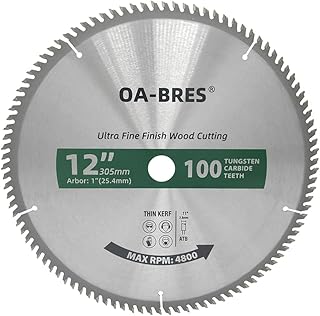
12-Inch 100-Tooth ATB TCT Fine-Finish Blade
With 100 ATB teeth and a 1-inch arbor, this larger blade is designed for very fine wood cutting on compatible 12-inch saws. It suits furniture makers who regularly work with broad panels or demand polished crosscut edges, though the high tooth count is not the efficient choice for aggressive ripping.
FOXBC 8-1/4-Inch 60-Tooth Fine-Finish Blade
This compact FOXBC blade is a practical match for smaller table saws and portable setups, provided the saw accepts an 8-1/4-inch blade. Its 60-tooth configuration balances finish quality and cutting efficiency, while the diamond knockout detail helps accommodate compatible equipment.
10-Inch 80T Carbide-Tipped Wood and Composite Blade
Designed for wood, plastic, and composite materials, this 80-tooth blade offers useful versatility for workshops that cut more than solid lumber. The carbide-tipped teeth support repeat use, and the fine-tooth pattern is particularly appropriate for visible edges where tear-out would be costly.
10-Inch Three-Pack: 32T, 60T, and 80T
This three-blade set is the most adaptable option for a mixed furniture workflow. The 32-tooth blade handles faster framing and rough cuts, the 60-tooth blade covers general fine work, and the 80-tooth blade is suited to ultra-fine finishing; changing blades takes more time, but it is ergonomically preferable to forcing one blade through every task.
Frequently Asked Questions
What tooth count is best for a table saw?
For general furniture work, 40 to 60 teeth is a useful middle ground. Choose around 24 to 32 teeth for efficient ripping and 80 to 100 teeth when a very smooth crosscut or finished edge is the priority.
Can a table-saw blade be used for plywood?
Yes, provided the blade is rated for wood and fits the saw correctly. Higher-tooth ATB blades generally reduce splintering in plywood, especially when paired with a suitable throat plate and steady feed rate.
Should I use an 80-tooth blade for ripping?
Usually not. An 80-tooth blade removes less material per revolution, so ripping can become slower, hotter, and more physically demanding. A lower-tooth or combination blade is typically better for long rip cuts.
How often should a table-saw blade be replaced?
Replace or sharpen it when cuts become noticeably harder to feed, edges burn despite correct setup, or tear-out increases after cleaning. A quality carbide blade can last a long time when protected from nails, adhesive residue, and abrasive debris.
Final Thoughts
For smooth furniture-grade crosscuts, the FOXBC 10-inch 80-tooth blade is a strong all-around pick, while the 12-inch 100-tooth model is better for compatible larger saws and demanding finish work. If versatility matters most, the 10-inch three-pack provides the practical advantage of using the right tooth pattern instead of asking one blade to perform every job.