Key takeaways
- Airflow: Compare CFM at 90 PSI rather than relying on maximum PSI alone. Airflow determines whether a compressor can sustain nailers, blow guns, sanders, or spray equipment.
- Tank capacity: A larger tank stores more usable air and reduces immediate cycling, but it also adds weight and takes up more floor space. Small tanks suit short bursts and inflation.
- Ergonomics: Look for a stable base, accessible drain, readable gauges, practical hose routing, and handles or wheels that make relocation manageable without lifting strain.
- Durability: Oil-free pumps are convenient for occasional household use, while cast-iron and oil-lubricated designs generally favor demanding, repeated operation when properly maintained.
- Noise and placement: Pancake compressors are convenient but can be sharp and loud indoors. Check the intended workspace, vibration transfer, and whether the unit can be positioned away from living areas.
What's inside
Choosing an air compressor for furniture work, home repairs, or vehicle maintenance is less about chasing the highest PSI number and more about matching airflow, tank behavior, noise, and physical handling to the job. A compressor that looks powerful on paper can still be frustrating if it cycles constantly, vibrates across the floor, or forces you to work around an awkward hose outlet.
This guide compares leading air compressor brands and models from an ergonomics-and-durability perspective. The selection spans compact cordless inflators, portable pancake compressors, larger home-shop units, and a serious stationary machine, with attention to controls, maintenance, mobility, duty cycle, and the tools each compressor can realistically support.
As an Amazon Associate we earn from qualifying purchases.



How to Choose a/an Air Compressor Brands (2026)
- Airflow: Compare CFM at 90 PSI rather than relying on maximum PSI alone. Airflow determines whether a compressor can sustain nailers, blow guns, sanders, or spray equipment.
- Tank capacity: A larger tank stores more usable air and reduces immediate cycling, but it also adds weight and takes up more floor space. Small tanks suit short bursts and inflation.
- Ergonomics: Look for a stable base, accessible drain, readable gauges, practical hose routing, and handles or wheels that make relocation manageable without lifting strain.
- Durability: Oil-free pumps are convenient for occasional household use, while cast-iron and oil-lubricated designs generally favor demanding, repeated operation when properly maintained.
- Noise and placement: Pancake compressors are convenient but can be sharp and loud indoors. Check the intended workspace, vibration transfer, and whether the unit can be positioned away from living areas.
The Best Air Compressor Brands (2026)s Reviewed
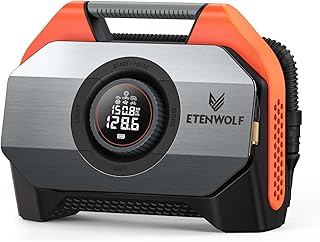
ETENWOLF VORTEX S6 Portable Inflator
The ETENWOLF VORTEX S6 is best understood as a high-capacity cordless inflator rather than a workshop compressor. Its 19,200mAh battery, dual-cylinder design, LED backlight, and stated 100% duty cycle make it a practical choice for repeated tire, bicycle, and inflatable maintenance where portability matters more than running pneumatic tools.
Metabo HPT 6-Gallon Pancake Compressor
Metabo HPT’s EC914S combines a compact pancake format with a 200 PSI maximum rating and 4 CFM flow rate, giving it useful headroom for framing, siding, roofing, and brad-nailing tasks. Its job-site orientation is evident in the portable footprint, though users should still place it on a level surface to limit vibration and avoid dragging the hose across finished furniture.
Craftsman 26-Gallon Portable Compressor
The Craftsman CMXECXA3332643 is a substantial step up for a home garage or dedicated workshop. Its 26-gallon tank, 1.8HP oil-free induction motor, and listed 5.0 CFM at 90 PSI provide a better reserve for extended fastening and general shop work than compact pancake units, while the larger chassis demands deliberate positioning and clear access around the drain and controls.
Ingersoll Rand 2340N5-V Two-Stage Compressor
For demanding, stationary use, the Ingersoll Rand 2340N5-V is the durability-focused choice, pairing a 5 HP motor with an 80-gallon tank, two-stage compression, and a cast-iron pump. Its stated output of up to 14.3 CFM at 90 PSI is suited to sustained air supply, but installation, electrical requirements, ventilation, and floor loading deserve careful planning before purchase.
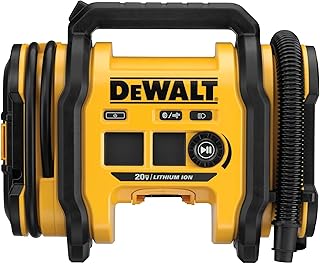
DEWALT DCC020IB 20V MAX Tire Inflator
The DEWALT DCC020IB is a convenient vehicle-side inflator for drivers already invested in DEWALT 20V MAX batteries. Automatic shutoff, an LED light, and a compact form reduce handling friction during roadside or garage use; because this is a tire inflator rather than a tank compressor, it is not intended to power nailers or continuous-use air tools.
Frequently Asked Questions
Which compressor is best for furniture projects?
For trim, upholstery, and intermittent brad-nailing, a portable pancake model such as the DEWALT DWFP55126 or Metabo HPT EC914S is usually sufficient. Choose based on the nailer’s required CFM, not simply the compressor’s maximum PSI.
Is a larger tank always better?
No. A larger tank provides a useful air reserve and can reduce cycling, but it increases weight, footprint, and recovery time after the stored air is depleted. For inflation and occasional fastening, portability may be more valuable than capacity.
What is the difference between an inflator and an air compressor?
An inflator, such as the ETENWOLF VORTEX S6 or DEWALT DCC020IB, is optimized for tires and inflatables. A workshop compressor stores compressed air and is designed to supply pneumatic tools, often through a regulator, hose, and quick-connect fitting.
Do oil-free compressors require maintenance?
Oil-free models avoid oil changes and are convenient for household users, but they still need basic care. Drain tank moisture when appropriate, keep intake filters clear, inspect hoses and fittings, and follow the manufacturer’s guidance for cooling and storage.
Final Thoughts
The Metabo HPT EC914S is a strong all-around portable choice for tool users, while the Craftsman 26-gallon model offers more reserve for a home workshop. For serious sustained air demand, the Ingersoll Rand 2340N5-V is the durability-led pick; for straightforward tire maintenance, the DEWALT DCC020IB keeps the equipment compact and easy to handle.