Key takeaways
- Cutting capacity: Match blade size and slide travel to your material. An 8-1/2-inch saw is easier to handle, while a 12-inch model offers more room for wide boards and substantial trim.
- Bevel and miter adjustment: Smooth, clearly marked detents reduce setup errors. A double-bevel design is especially useful when making repeated opposing cuts without flipping the workpiece.
- Ergonomics: Look for a comfortable trigger handle, accessible locking controls, stable feet, and practical carrying points. Lower weight matters when the saw must be moved frequently.
- Dust and visibility: A usable dust port, effective collection path, and bright shadow or laser guide can improve both accuracy and cleanup, although no miter saw captures every chip.
- Durability and serviceability: Rigid fences, dependable stops, a robust slide mechanism, and readily available blades matter more over time than headline motor speed alone.
What's inside
Buying a slide compound miter saw can look straightforward until the differences start affecting real work: a saw that feels manageable on a store shelf may become tiring during a day of trim installation, while a powerful 12-inch model can consume valuable bench space and demand better dust control. Cutting capacity, fence alignment, bevel access, vibration, and the quality of the included blade all influence whether a saw produces clean, repeatable joints or merely makes rough cuts quickly.
This guide evaluates the leading options from an ergonomics-and-durability perspective. We focus on controls that are easy to reach, support for long or awkward workpieces, portability, likely maintenance demands, and the kind of furniture or home-improvement work each saw suits best. Specifications can vary by retailer or package, so confirm the current listing before purchasing.
As an Amazon Associate we earn from qualifying purchases.




How to Choose a Slide Compound Miter Saw (2026)
- Cutting capacity: Match blade size and slide travel to your material. An 8-1/2-inch saw is easier to handle, while a 12-inch model offers more room for wide boards and substantial trim.
- Bevel and miter adjustment: Smooth, clearly marked detents reduce setup errors. A double-bevel design is especially useful when making repeated opposing cuts without flipping the workpiece.
- Ergonomics: Look for a comfortable trigger handle, accessible locking controls, stable feet, and practical carrying points. Lower weight matters when the saw must be moved frequently.
- Dust and visibility: A usable dust port, effective collection path, and bright shadow or laser guide can improve both accuracy and cleanup, although no miter saw captures every chip.
- Durability and serviceability: Rigid fences, dependable stops, a robust slide mechanism, and readily available blades matter more over time than headline motor speed alone.
The Best Slide Compound Miter Saw (2026)s Reviewed
Makita LS1110F 10-Inch Slide Compound Miter Saw
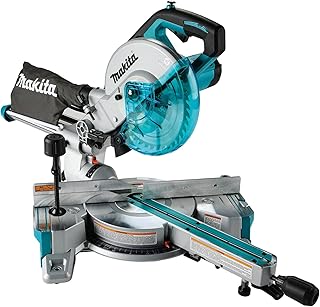
The Makita LS1110F is a well-balanced choice for furniture builders who want useful capacity without the bulk of a typical 12-inch machine. Its 10-inch format should be easier to position on a compact bench, while the design emphasizes controlled movement and repeatable setup. It is a strong all-around option for trim, shelving components, framing stock, and moderate-size furniture parts.
Makita LS0816F 8-1/2-Inch Slide Compound Miter Saw
The LS0816F makes sense when portability and operator fatigue are higher priorities than maximum cutting width. Its smaller footprint is friendlier to apartment workshops, mobile repair work, and occasional DIY projects, and a lighter saw is less awkward to lift onto a stand. Choose it for clean, manageable stock rather than oversized beams or unusually wide boards.
VEVOR 12-Inch Sliding Compound Miter Saw
VEVOR’s 12-inch model targets buyers who want broad cutting capacity and a substantial motor at a comparatively accessible level. The LED alignment feature can make positioning easier, especially for users still developing a reliable marking routine. Its larger format is best on a dedicated stand or sturdy work surface; buyers should pay close attention to fence squareness, slide smoothness, and dust collection after setup.
DEWALT DWS780 12-Inch Double-Bevel Sliding Compound Miter Saw
The DEWALT DWS780 is built for demanding repeat work, with a double-bevel arrangement and XPS LED shadow system that helps show the blade’s cut line without relying on a laser beam. Its substantial construction favors stability and long-term jobsite use, though the extra size and weight make it less convenient to carry. It is a compelling pick for professionals and serious remodelers who value fast, consistent alignment.
NOVORIK 10-Inch Single-Bevel Sliding Miter Saw
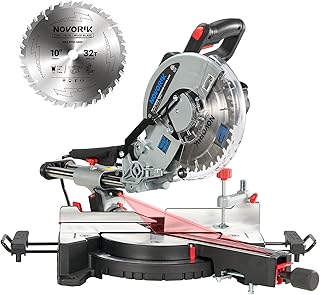
NOVORIK’s 10-inch saw offers a practical combination of sliding capacity, a 15-amp motor, laser guidance, and a TCT blade for general woodworking. The single-bevel layout is less flexible than a double-bevel saw, so plan on repositioning or flipping stock for some opposing cuts. It is most attractive to budget-conscious users who want a capable home workshop saw and are willing to verify alignment carefully before precision projects.
Frequently Asked Questions
Is a 10-inch or 12-inch miter saw better?
Neither size is universally better. A 10-inch model is often easier to store, carry, and operate, while a 12-inch saw generally handles wider or thicker material. For furniture and household trim, 10 inches is frequently the more comfortable compromise; choose 12 inches when capacity is a recurring requirement.
Do I need a double-bevel miter saw?
A double-bevel saw saves time when creating matching left- and right-hand bevel cuts because the workpiece does not need to be turned over. A single-bevel saw can still produce accurate results, but it may require more repositioning and increases the chance of orientation mistakes.
Are laser guides or LED shadow lines more useful?
Both can help, but a shadow line is often easier to interpret because it indicates the blade’s actual kerf position. A laser can be useful for quick layout, yet it may need calibration and can be harder to see in bright light. Whichever system is included, confirm cuts with a test piece.
Can a cordless saw replace a corded model?
For trim, small furniture components, and mobile punch-list work, a cordless saw such as the SEESII 8-Inch model can be convenient. Corded saws remain preferable for extended cutting sessions because they avoid battery changes and usually suit continuous workshop use better.
Final Thoughts
The Makita LS1110F is the most balanced choice for many home furniture workshops, while the Makita LS0816F is appealing when portability and limited space come first. For maximum capacity and demanding repeat work, the DEWALT DWS780 is the stronger upgrade; the VEVOR and NOVORIK models offer more budget-oriented paths when careful setup and inspection are part of the plan.