Key takeaways
- Lumbar support: Look for a backrest that fills the lower-back gap without forcing your pelvis forward. Adjustable lumbar positioning is especially useful when household members differ in height.
- Seat fit: Your feet should rest securely on the floor when upright, with roughly two to three fingers between the seat edge and the backs of your knees. Avoid seats that are too deep or soft to support neutral posture.
- Recline mechanics: Independent back, footrest, and headrest controls allow finer positioning than a single synchronized mechanism. A near-flat or zero-gravity setting can reduce sustained pressure, but it should not replace good everyday alignment.
- Standing assistance: Power-lift models are worthwhile for users who find low seating difficult. Check the chair’s width, lift path, and remote simplicity before prioritizing extra features.
- Construction: Inspect the frame, motor capacity, upholstery, stitching, and footrest structure. Durable materials matter, but a well-fitted fabric chair may outperform leather if it provides better grip and temperature comfort.
What's inside
Back pain can turn an otherwise comfortable chair into a daily source of strain. A recliner that sits too shallow, lacks lumbar support, or leaves the legs unsupported may encourage slouching rather than relieving pressure. The right design should help you maintain a balanced posture while making sitting down, reclining, and standing up less demanding.
This guide evaluates recliners through an ergonomics-and-durability lens: lumbar geometry, seat dimensions, control independence, upholstery, footrest reach, transfer assistance, and long-term practicality. The best choice depends on your height, mobility, preferred seating position, and whether heat, massage, or powered adjustment genuinely improves your routine.
As an Amazon Associate we earn from qualifying purchases.


How to Choose a Recliner for Back Pain (2026)
- Lumbar support: Look for a backrest that fills the lower-back gap without forcing your pelvis forward. Adjustable lumbar positioning is especially useful when household members differ in height.
- Seat fit: Your feet should rest securely on the floor when upright, with roughly two to three fingers between the seat edge and the backs of your knees. Avoid seats that are too deep or soft to support neutral posture.
- Recline mechanics: Independent back, footrest, and headrest controls allow finer positioning than a single synchronized mechanism. A near-flat or zero-gravity setting can reduce sustained pressure, but it should not replace good everyday alignment.
- Standing assistance: Power-lift models are worthwhile for users who find low seating difficult. Check the chair’s width, lift path, and remote simplicity before prioritizing extra features.
- Construction: Inspect the frame, motor capacity, upholstery, stitching, and footrest structure. Durable materials matter, but a well-fitted fabric chair may outperform leather if it provides better grip and temperature comfort.
The Best Recliner for Back Pain (2026)s Reviewed
EDILLY Genuine Leather Power Lift Recliner
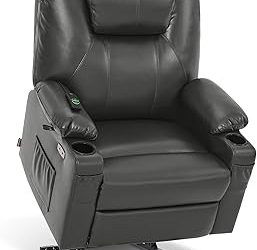
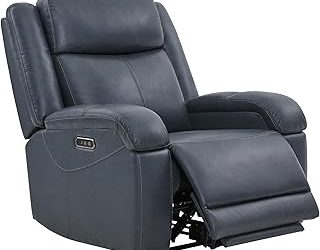
The EDILLY combines dual-motor adjustment with a lift function, double lumbar cushioning, heat, and massage. Its independent controls make it easier to fine-tune the back and leg positions, while the extended footrest is helpful for taller users. The leather surface is easy to wipe clean, though buyers in cooler or drier rooms may prefer a breathable fabric cover. USB and USB-C charging add convenience without changing the chair’s core ergonomic value.
EONIX Triple Motor Lay-Flat Recliner
The EONIX is the most adjustability-focused option in this group. Separate backrest, footrest, and headrest controls let you support the pelvis, torso, and neck more precisely, while the lay-flat and zero-gravity positions provide useful alternatives for reading, resting, or changing pressure points. Its eight-zone massage and lumbar heat are attractive extras, but the chair’s strongest advantage is mechanical positioning rather than massage intensity.
MCombo Oversized Power Lift Recliner
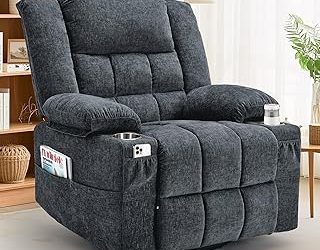
For larger users, the MCombo R7289 addresses a common problem: a chair can be supportive yet still feel cramped. Its 26-inch seat width, extended footrest, 150-degree recline, and power-lift function create a more accommodating platform for sitting and standing. The medium-wide format should still be matched carefully to body size; excessive width can reduce side support for smaller users. Fabric upholstery, cup storage, USB ports, and straightforward assembly make it a practical everyday choice.
Ketaiyou Power Swivel Rocker Recliner
The Ketaiyou adds swivel and gliding movement to an infinite-position power recliner, making it appealing for living rooms, reading corners, or nursing-style seating. Massage, heat, USB, and Type-C ports broaden its comfort package, while the powered mechanism avoids the abrupt leg thrust sometimes found in manual recliners. Because rocking can encourage movement, it may feel more natural than a rigid chair, although users seeking maximum spinal stability may prefer a stationary base.
Classic Leather Manual Recliner
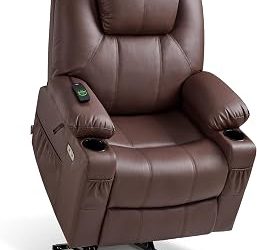
This traditional nut-brown leather recliner is the simplest option and therefore the least dependent on motors, remotes, and electronic components. Its value rests on basic fit: supportive arms, a stable frame, a comfortable back, and a manual mechanism that can be operated without power. It lacks lift assistance, heat, and powered lumbar adjustment, so it is better suited to users with adequate leg strength who want a durable, low-complexity chair.
Frequently Asked Questions
Can a recliner actually help back pain?
It can reduce discomfort by distributing body weight and limiting prolonged upright loading, particularly when the lumbar area and feet are supported. A recliner should complement movement, strength work, and professional medical advice rather than serve as a treatment for an unexplained or worsening condition.
Is a lift recliner better for older adults?
Often, yes. A lift mechanism raises the seat and tilts the user forward, reducing the force required to stand. Measure the available floor space and verify that the chair’s lift path will not interfere with nearby tables, walls, or mobility aids.
Is massage or heat necessary for back support?
No. These features may feel soothing, but they do not correct poor seat depth or inadequate lumbar geometry. Prioritize fit and positioning controls first, then treat massage and heat as comfort features.
Are manual recliners more durable than power recliners?
They can be simpler to maintain because they have fewer electrical parts, but durability depends on the frame, mechanism, upholstery, and usage. A quality power recliner may be the better long-term choice when independent positioning or lift assistance is important.
Final Thoughts
The EDILLY is a strong all-rounder for users who want lift assistance and built-in lumbar-focused comfort, while the EONIX offers the finest positioning control for those who value independent adjustment. Larger users should consider the MCombo, and anyone prioritizing simplicity may prefer the classic manual leather recliner.