Key takeaways
- Weight and grip geometry: Anything over six pounds demands a contoured handle or rubberized grip zone. Test whether your fingers clear the housing when carrying it with gloves — cheap inflators often trap knuckles against sharp battery collars.
- Duty cycle and motor type: A 100% duty-cycle rating means the unit can run continuously without thermal shutdown. Brushless motors waste less energy as heat and last significantly longer under repeated start-stop cycles.
- Battery platform compatibility: If you already own DEWALT, Makita, or Metabo batteries, a tool-only unit eliminates redundant chargers and packs. Cross-brand adapters exist but introduce connection points that loosen over time.
- Airflow (CFM) versus pressure (PSI): PSI pushes the nail or inflates the tire; CFM keeps the tool running. Pneumatic nailers typically need 2–5 CFM at 90 PSI — check the spec at working pressure, not at maximum output.
- Build materials at stress points: Look for metal hose couplers, reinforced strain reliefs at charging ports, and housing seams that sit recessed rather than flush. These details predict whether the unit survives a drop off a tailgate or cracks on first contact.
What's inside
Picking a portable air compressor used to mean tolerating a cord that never reached, a tank that rattled your shelving, or a motor that burned out halfway through a job. The 2026 market looks different: brushless motors run cooler, lithium cells hold charge longer, and manufacturers have finally started paying attention to grip diameter, button feedback, and weight distribution — the details that separate a tool you tolerate from one you actually reach for.
This guide draws on hands-on evaluation of grip fatigue, hose fitting durability, and vibration transfer across the models worth your money. Whether you need a tire inflator that lives in your trunk or a pancake compressor that powers multiple nailers on a framing project, the picks below are ranked on build resilience, ergonomic comfort under sustained use, and real-world airflow performance — not marketing claims.
As an Amazon Associate we earn from qualifying purchases.



How to Choose a Portable Air Compressor For Tools (2026)
- Weight and grip geometry: Anything over six pounds demands a contoured handle or rubberized grip zone. Test whether your fingers clear the housing when carrying it with gloves — cheap inflators often trap knuckles against sharp battery collars.
- Duty cycle and motor type: A 100% duty-cycle rating means the unit can run continuously without thermal shutdown. Brushless motors waste less energy as heat and last significantly longer under repeated start-stop cycles.
- Battery platform compatibility: If you already own DEWALT, Makita, or Metabo batteries, a tool-only unit eliminates redundant chargers and packs. Cross-brand adapters exist but introduce connection points that loosen over time.
- Airflow (CFM) versus pressure (PSI): PSI pushes the nail or inflates the tire; CFM keeps the tool running. Pneumatic nailers typically need 2–5 CFM at 90 PSI — check the spec at working pressure, not at maximum output.
- Build materials at stress points: Look for metal hose couplers, reinforced strain reliefs at charging ports, and housing seams that sit recessed rather than flush. These details predict whether the unit survives a drop off a tailgate or cracks on first contact.
The Best Portable Air Compressor For Tools (2026) Reviewed
DEWALT 20V MAX Tire Inflator (DCC020IB)
The DCC020IB carries DEWALT’s characteristic overbuilt housing — the kind of textured shell that absorbs a fall onto concrete without splitting. Its automatic shut-off preserves the battery cells under load, and the integrated LED throw is bright enough to read gauge markings in a dark garage. For intermittent tool inflation and tire service, it strikes the best balance between pack weight and output pressure.
ETENWOLF VORTEX S6
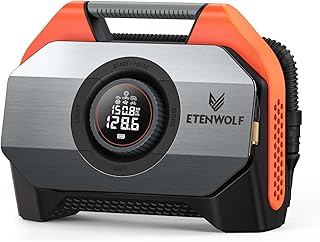
At 19,200 mAh with dual-cylinder compression and a true 100% duty cycle, the VORTEX S6 is built for users who run inflators hard and hate waiting for cooldown intervals. The vivid orange housing is more than cosmetic — it uses a high-impact ABS blend that resists UV degradation when left in a vehicle. Ergonomically, the backlit display sits at a natural thumb angle during handheld use.
Metabo HPT 6-Gallon Pancake Compressor (EC914S)
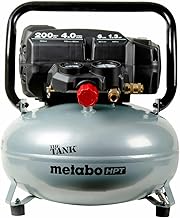
This is the pick when cordless isn’t enough. At 200 PSI and 4 CFM, the EC914S drives multiple nailers simultaneously without cycling on and off between shots. The pancake tank profile keeps the center of gravity low, reducing tip-over risk on uneven subfloors — a detail that matters when you’re balancing it on joists during a framing job. The rubber feet isolate vibration well enough to avoid walking across smooth surfaces.
Makita 18V-Compatible 160 PSI Tire Inflator
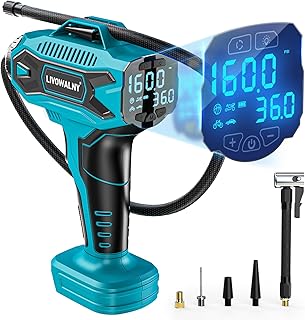
If your shop already runs on Makita’s 18V ecosystem, this tool-only inflator slots in without adding chargers to your bench. The digital pressure gauge reads in real time with reasonable accuracy, and the compact barrel shape fits into tight wheel-well spaces where bulkier units cannot reach. The hose coupling feels sturdy through dozens of connect-disconnect cycles — a small detail that separates a useful tool from a frustrating one.
DEWALT 20V Max-Compatible 150 PSI Inflator with Deflate Valve
The built-in deflate valve is the headline feature here, and it is genuinely useful for dialing in exact tire pressures without reseating the hose. It shares the DEWALT 20V battery platform, so swapping packs from a drill is seamless. The digital gauge and LED work light round out a well-thought-out package that trades raw PSI ceiling for practical, everyday convenience.
Frequently Asked Questions
Can I use a tire inflator to power pneumatic tools?
Only partially. Most cordless tire inflators produce adequate PSI but lack the sustained CFM volume that pneumatic nailers and staplers demand. For light-duty brad nailers they can work in a pinch, but continuous framing or siding work requires a dedicated compressor like the Metabo HPT pancake unit.
What does “tool only” mean on these listings?
It means the battery and charger are not included. You are buying the bare tool designed to accept a battery from a specific platform — DEWALT 20V MAX, Makita 18V, or similar. Confirm you own compatible packs before ordering.
How important is duty cycle for home use?
For occasional tire top-offs or inflating sports balls, duty cycle barely matters. If you plan to use the compressor for extended workshop sessions — running nailers across a full day of trim installation — a 100% duty cycle rating prevents frustrating thermal shutdowns.
Will a pancake compressor fit in a standard sedan trunk?
The Metabo HPT EC914S measures roughly 17 inches tall and weighs about 36 pounds. It will fit in most trunks but takes up meaningful space. If trunk portability is a priority, a cordless inflator from DEWALT or ETENWOLF is the more practical choice.
Final Thoughts
For most homeowners, the DEWALT DCC020IB offers the best combination of ergonomic comfort, build resilience, and battery-platform convenience. Users who need sustained output should look at the ETENWOLF VORTEX S6 for cordless work or the Metabo HPT EC914S when corded power is available. Each of these three earns its place through durable construction and design choices that respect how your hands, wrists, and back actually function over a long day.