Key takeaways
- Closed: most extendable desks are 40 to 55 inches wide and 20 to 24 inches deep, which fits a bedroom wall, an alcove or a living-room corner.
- Open as an L: a rolling return usually adds 30 to 40 inches perpendicular to the desk. Leave 30 to 36 inches of clear space behind your chair in both directions so you can roll between surfaces.
- Open as a straight run: 70 to 90 inches total. Check that a window, radiator or doorway does not sit where the extension lands.
An extendable computer desk with a pull-out secondary desk gives you a compact main desk and a second work surface that slides, rolls or swings out when you need it. In practice it turns a 40- to 48-inch desk into an L-shape or a long straight run of 70 to 90 inches. The most useful version for most homes is a rolling return that nests under the main top. Slide-out and swivel designs save more floor space but carry much less weight.
Four ways desks extend, and what each is good for
“Pull-out secondary desk” covers several mechanisms. They behave very differently once you load them with a monitor, printer or a second laptop.

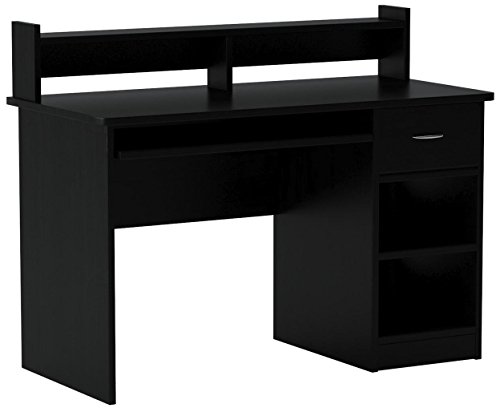
GIANTEX Small Computer Desk with Hutch & Drawers, Extendable Writing Desk w/Pull Out Secondary Table, Monitor Stand & Rolling Wheels, Console Table, Compact Desk for Small Spaces, Home Office (Black)
Included for 'Extendable Computer Desk With a Pull-Out Second Desk: Mechanisms, Load Limits and Layouts' because the listing specifies Extendable Writing Desk w/Pull Out Secondary Table and Monitor Stand & Rolling Wheels, details this guide uses to compare options.
View on Amazon
Tangkula Extendable Computer Desk with 2 Drawers, Small Writing Desk with Pull Out Secondary Desk, Console Table, Wood Study Workstation, Laptop Desk for Small Space Home & Office (Natural)
Included for 'Extendable Computer Desk With a Pull-Out Second Desk: Mechanisms, Load Limits and Layouts' because the listing specifies Small Writing Desk with Pull Out Secondary Desk and Console Table, details this guide uses to compare options.
View on AmazonRolling (nesting) return
A separate small desk on casters tucks under the main desk and rolls out to form an L or a straight extension. It is the sturdiest option because the second desk carries its own weight on its own legs. The trade-off is height. To nest, the return is usually 1 to 3 inches lower than the main top, so the two surfaces are rarely flush.
Slide-out extension on drawer runners
A second panel slides out of the desk body like a large drawer, sometimes with a fold-down support leg. It is flush with or just below the main surface and is great for a laptop or paperwork. Without a support leg, though, it is a cantilever, and the runners set the load limit.
Swivel or pivot return
A panel rotates out from one corner on a pivot post, from 90 up to 180 degrees. This is common on small home-office and student desks. It is quick to deploy but tends to have the lowest weight limit and the most bounce at the far tip.
Telescoping or expanding frame
The whole frame stretches, often from about 40 inches to 60 to 70 inches, with a center insert or a second sliding top. You get one continuous surface, but the joint line in the middle can be slightly uneven and is the weak spot.
| Mechanism | Added width | Typical load on extension | Height vs main top | Best for |
|---|---|---|---|---|
| Rolling nesting return | 30 – 48 in | 40 – 100 lb | 1 – 3 in lower | Second monitor, printer, daily L-desk use |
| Slide-out with support leg | 18 – 30 in | 25 – 50 lb | Flush or 1 in lower | Laptop, writing, paperwork |
| Slide-out, no leg (cantilever) | 12 – 20 in | 10 – 25 lb | Under main top | Keyboard, notebook, phone |
| Swivel / pivot return | 20 – 36 in | 15 – 35 lb | Flush | Occasional second workspace |
| Telescoping frame | 16 – 30 in | Same as main top, often 80 – 150 lb total | Flush | Craft or long straight setups |
Treat manufacturer load figures as static loads spread evenly across the surface. Leaning on the far corner of a slide-out panel concentrates the force and can exceed the rating at a single point.
Floor space: closed vs open
The whole point is to save room when the extension is stowed, so plan around both states.
- Closed: most extendable desks are 40 to 55 inches wide and 20 to 24 inches deep, which fits a bedroom wall, an alcove or a living-room corner.
- Open as an L: a rolling return usually adds 30 to 40 inches perpendicular to the desk. Leave 30 to 36 inches of clear space behind your chair in both directions so you can roll between surfaces.
- Open as a straight run: 70 to 90 inches total. Check that a window, radiator or doorway does not sit where the extension lands.
Example: in a 10 x 11 ft bedroom with a bed on one wall, a 48-inch desk with a 36-inch rolling return can run as an L into a corner while still leaving a 36-inch walkway past the bed.
Height, ergonomics and the step between surfaces
Standard desk height is 28 to 30 inches, and a good typing height for most adults is 25 to 28 inches with relaxed shoulders. A return that sits 2 inches lower than the main top can actually be the better place for a keyboard. Plan which surface is “the work surface” and which is overflow.
- Put your main monitor and keyboard on the main desk if the surfaces are not flush. A keyboard straddling a 2-inch step is unusable.
- Rolling returns with locking casters stay put. If two of four casters do not lock, the return will creep away when you type on it.
- For dual monitors spanning both surfaces, use a clamp arm on the main desk only. Most extension panels are 5/8 inch particleboard, too thin and too unsupported for a clamp.
Materials and what wears first
| Part | Common material | What tends to fail | What to look for |
|---|---|---|---|
| Main top | Laminated particleboard, 5/8 – 1 in | Edge banding peeling near the chair | 1 in thickness or MDF core with full edge banding |
| Slide runners | Steel ball-bearing or nylon roller | Nylon rollers loosen and drop the panel | Full-extension ball-bearing runners |
| Casters | Plastic twin-wheel, 1.5 – 2 in | Mark hardwood floors, lose locks | Rubber-tread casters with at least 2 locking |
| Pivot post | Steel tube with plastic bushing | Bushing wears, tip starts to sag | Metal-on-metal pivot or a drop-down support foot |
| Frame | Steel or particleboard panels | Cam locks loosen after a move | Steel frame or bolt-through joints |
Which style suits your situation
| Your situation | Pick |
|---|---|
| Work from home daily with two monitors | Rolling nesting return, or a fixed L-desk if you never close it |
| Student who sometimes needs space for books | Slide-out with a support leg |
| Living-room desk that must look tidy at night | Swivel return or closed slide-out |
| Two people sharing one desk occasionally | Rolling return used as a second desk; each person needs at least 30 in of width |
| Crafts, sewing, large drawings | Telescoping frame for one flat surface |
Assembly and moving notes
These desks usually arrive in one or two boxes weighing 50 to 110 pounds, with assembly times of 1.5 to 3 hours. The slide or pivot hardware is the fiddly part. Align runners precisely before tightening, or the panel will bind. If you move often, avoid desks where the extension mechanism is screwed directly into particleboard. Those holes strip on the second assembly. A steel frame with a bolt-on return survives moves much better.
Prices vary widely by build. Swivel and slide-out student desks usually run $100 to $250, rolling-return sets $180 to $450, and steel-frame or solid-top versions $400 and up.
Bottom line
If the second surface will hold real equipment every day, choose a rolling return with its own legs and locking casters and accept the small height step. If you only need extra room for a laptop or notes now and then, a slide-out with a support leg keeps the footprint smallest. Skip cantilevered panels for anything heavier than a keyboard.