Key takeaways
- 24 inches deep: workable for two 24-inch monitors on slim stands; tight with 27-inch screens.
- 27 to 30 inches deep: the sweet spot for two 27-inch monitors, a full-size keyboard and a notebook.
- Under 22 inches deep: only works with monitor arms clamped to the back edge, which pull the stands off the surface entirely.
A computer desk for two screens needs to be at least 48 inches wide for two 24-inch monitors and 55 to 60 inches wide for two 27-inch monitors, with a depth of 24 to 30 inches so your eyes sit a comfortable arm’s length from the panels. Width gets the screens onto the desk; depth and height decide whether you can actually work there for eight hours. The rest of this guide is the math behind those numbers and how to pick a desk type around it.
Step 1: Add Up the Width Your Screens Need
Monitor sizes are measured diagonally, so the width of the panel is what matters. Add the two widths, then allow 4 to 8 inches for a slight angle, bezels and breathing room, plus space for speakers or a lamp if you use them.
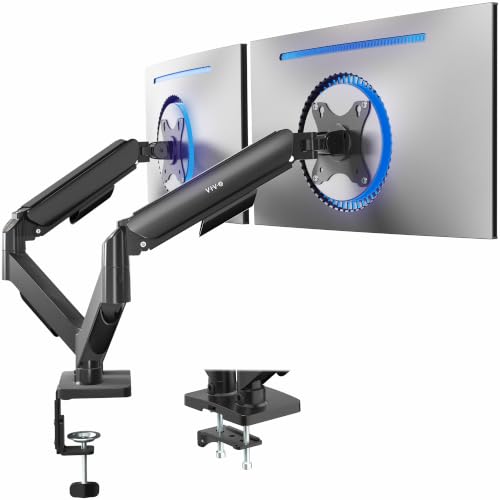
VIVO Dual Monitor Stand, Fully Adjustable Arms for 17 to 32 inch Screens, Mechanical Articulating Desk Mount, Gaming and Office Setups, VESA 75x75, 100x100, Max 19.8 lbs, Classic, Black, STAND-V002O
Included for 'Computer Desk for Two Screens: Width, Depth and Monitor Arm Math by Screen Size' because the listing specifies Fully Adjustable Arms for 17 to 32 inch Screens and Mechanical Articulating Desk Mount, details this guide uses to compare options.
View on Amazon
VIVO Dual Monitor Desk Mount, Holds 2 Computer Screens up to 30 inches and 22lbs Each, Heavy Duty Fully Adjustable Steel Stand with C-Clamp and Grommet, Black, STAND-V002
Included for 'Computer Desk for Two Screens: Width, Depth and Monitor Arm Math by Screen Size' because the listing specifies Holds 2 Computer Screens up to 30 inches and 22lbs Each and Black, details this guide uses to compare options.
View on Amazon
VIVO 17 to 32 inch Dual Mechanical Monitor Mount, 2 Tension Spring Arms, Adjustable Swivel, Rotation, Heavy Duty VESA Desk Stand with C-clamp, Grommet, Max VESA 100x100, Black, STAND-V002K
Included for 'Computer Desk for Two Screens: Width, Depth and Monitor Arm Math by Screen Size' because the listing specifies 2 Tension Spring Arms and Adjustable Swivel, details this guide uses to compare options.
View on Amazon
VIVO Dual Pneumatic Arm Ultra-Wide Monitor Mount for up to 35 inch Screens, Holds 26.4 lbs per Arm, Desk Mount Monitor Stand for 2 Ultrawides, Black, STAND-V200O
Included for 'Computer Desk for Two Screens: Width, Depth and Monitor Arm Math by Screen Size' because the listing specifies Holds 26.4 lbs per Arm and Desk Mount Monitor Stand for 2 Ultrawides, details this guide uses to compare options.
View on Amazon| Monitor pair | Panel width each (approx.) | Combined width | Minimum desk width | Comfortable desk width |
|---|---|---|---|---|
| 2 x 22 in (16:9) | 19.5 in | 39 in | 44 in | 48 in |
| 2 x 24 in (16:9) | 21.5 in | 43 in | 48 in | 55 in |
| 2 x 27 in (16:9) | 24 in | 48 in | 55 in | 60–63 in |
| 2 x 32 in (16:9) | 28 in | 56 in | 63 in | 70 in+ |
| 1 x 34 in ultrawide + 1 x 24 in vertical | 32 in + 13.5 in | 45.5 in | 52 in | 60 in |
Angling the two screens toward you in a shallow V reduces the straight-line width they take up but pushes their outer corners back, so you need more depth. That is why depth is the next calculation.
Step 2: Get the Depth Right
Ergonomic guidance generally puts the screen about 20 to 30 inches from your eyes, roughly an arm’s length, with larger screens needing the farther end of that range. On a desk, you also need room in front of the monitor bases for a keyboard and wrist space.
- 24 inches deep: workable for two 24-inch monitors on slim stands; tight with 27-inch screens.
- 27 to 30 inches deep: the sweet spot for two 27-inch monitors, a full-size keyboard and a notebook.
- Under 22 inches deep: only works with monitor arms clamped to the back edge, which pull the stands off the surface entirely.
If you love a narrow desk for a small room, a dual monitor arm is the single best upgrade: it frees 8 to 10 inches of depth that stand bases otherwise occupy.
Step 3: Set the Height
A fixed desk is usually about 28 to 30 inches tall, which suits people roughly 5’8″ to 6’1″ with a properly adjusted chair. Shorter users often need a keyboard tray or footrest; taller users may find their knees hit a drawer. With two screens, the top edge of each monitor should sit at or slightly below eye level. If you are on a fixed-height desk, you will typically raise the screens on their stands or an arm rather than change the desk itself.
Which Desk Type Fits Your Setup
| Your situation | Best desk type | Typical size | Typical price range |
|---|---|---|---|
| Small bedroom or apartment, two 24-inch screens | Straight writing desk + dual arm | 48 x 24 in | $100–$250 plus $40–$120 arm |
| Full-time home office, two 27-inch screens | Large straight desk or standing desk | 60 x 30 in | $250–$800 |
| Corner of a room, lots of paperwork | L-shaped desk | 60 x 60 in footprint | $150–$600 |
| Back or hip pain, long sitting days | Dual-motor standing desk | 55–72 in wide | $350–$900 |
| Gaming plus work | Wide desk with cable tray, deep top | 55–63 x 27–30 in | $150–$500 |
Straight desk vs L-shaped desk for two monitors
A straight desk keeps both screens on one plane so you are not twisting. An L-shaped desk only helps dual-monitor work if both screens sit on the same leg; splitting them around the corner forces a 90-degree head turn, which is uncomfortable for constant switching. The second leg is better for a laptop, printer or paperwork.
Standing desks and two screens
Two monitors plus arms can easily total 30 to 45 lb. Most dual-motor standing desks list capacities well above that, often 200 lb or more, but single-motor budget frames are more likely to wobble at full height with a heavy dual-arm setup pushed to the back edge. Wobble at standing height is the most common complaint with wide, inexpensive frames, so a crossbar or dual-motor frame is worth paying for if you stand often.
Materials and What They Mean for Monitor Arms
If you plan to clamp a dual arm to the desk, the top material matters as much as the size.
| Desktop material | Typical thickness | Monitor arm clamp | Notes |
|---|---|---|---|
| Particleboard with laminate | 0.6–1 in | OK with a reinforcement plate | Can crush or crack under clamp pressure over time |
| MDF with laminate or veneer | 0.7–1 in | OK with a plate | Denser and steadier than particleboard |
| Solid wood or butcher block | 1–1.5 in | Excellent | Heavier, costs more, may need sealing |
| Tempered glass | 0.2–0.4 in | Not recommended | Clamps can crack glass; use freestanding stand |
| Metal frame with thin top | Varies | Check for a rear lip | A rear crossbar can block the clamp |
Cable and Power Planning
Two screens mean at least two power cords, two video cables and often a dock or USB hub. A desk with a rear cable tray or grommet hole keeps the floor clear. If the desk lacks one, an under-desk cable tray screwed to the underside costs little and makes the setup look tidy. Leave 2 to 3 inches between the wall and the desk back so cables are not pinched.
Quick Checklist Before You Buy
- Measure your two monitors’ actual panel widths, not their diagonal size.
- Pick a desk at least 6 inches wider than the combined width.
- Choose 27 to 30 inches of depth for 27-inch screens, or plan on a monitor arm.
- Check whether the top can take a clamp, and whether a rear crossbar blocks it.
- Confirm the room fits the desk plus about 36 inches behind it for your chair.
- For standing desks, look for a dual-motor frame if your screens and arms are heavy.
Frequently Asked Questions
Can two monitors fit on a 40-inch desk?
Two 22-inch screens barely fit side by side, with no room left for anything else. Two 24-inch screens generally need a monitor arm that lets them overhang slightly, or a stacked arrangement with one screen above the other.
Is a stacked setup better than side by side?
Stacking saves width but makes you tilt your head up for the top screen. It works for a secondary screen you glance at, like chat or monitoring dashboards, less well for two screens you use equally.