Key takeaways
- Every bookcase taller than about 30 inches should be anchored to wall studs with the included anti-tip kit or a metal strap. A wall unit loaded with books and a monitor can weigh several hundred pounds.
- Locate studs (typically 16 inches on center) before choosing the final position; the anchor points on the unit should align with at least one stud per section.
- Baseboards push the unit 1/2–3/4 inch away from the wall. Either notch the back of the unit, remove baseboard behind it, or use shims at the top so it leans slightly back, not forward.
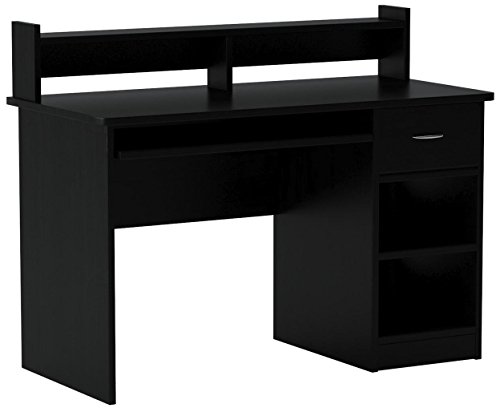
A wall unit with desk and bookcases is a single run of shelving with a built-in or bridged work surface, and it works best on a wall at least 7 to 8 feet wide with a ceiling of 8 feet or more, where it can replace a separate desk, bookcase and filing cabinet while using less floor space than all three. The key decisions are the overall width, the desk depth, how the bookcases attach to each other and the wall, and whether you are buying a modular system or a fixed one-piece unit.
Common Configurations
Bridge style: bookcase, desk, bookcase
Two tall bookcases flank a desk, often with a hutch or open shelves running across above the work surface. This is the most common layout and suits a wall 84–120 inches wide.

Sauder Palladia Bookcase with Doors, Multiroom Storage, Library Bookcase, Vintage Oak Finish
Included for 'Wall Unit With Desk and Bookcases: Layouts, Sizes and Shelf Loads That Work' because the listing specifies Multiroom Storage and Library Bookcase, details this guide uses to compare options.
View on Amazon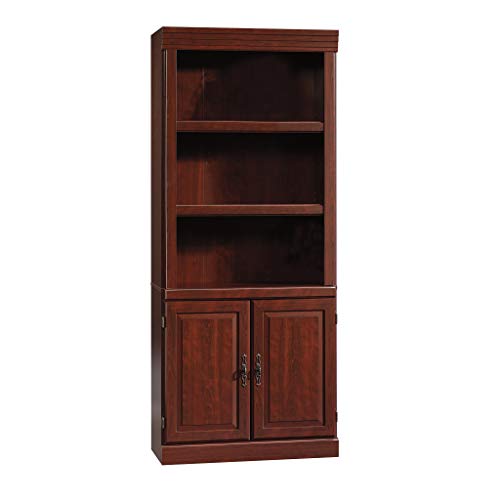
Sauder Heritage Hill Library With Doors/ Book shelf, Classic Cherry finish
Included for 'Wall Unit With Desk and Bookcases: Layouts, Sizes and Shelf Loads That Work' because the listing specifies Classic Cherry finish, details this guide uses to compare options.
View on AmazonOffset desk with bookcase tower
A desk on one side, a single tall bookcase on the other. Good for walls 60–84 inches wide or rooms where a window sits off-center.
Library wall with pull-out or drop-down desk
Mostly shelving, with a fold-down secretary panel or slide-out work surface. Ideal for guest rooms and living rooms where the desk should disappear after work.
Corner wall unit
An L-shaped run wrapping a corner, with the desk on one leg. Uses the dead corner space but needs careful planning so the corner shelves remain reachable.
Sizing: Wall Width, Height and Desk Depth
| Component | Typical dimension | Comfortable working range | Notes |
|---|---|---|---|
| Overall width (bridge style) | 84–120 in | Leave 3–6 in to side walls for trim and moving | Measure at floor and at ceiling; old walls are rarely square |
| Bookcase height | 72–84 in | Keep 4–6 in below ceiling for tipping clearance during assembly | Units close to ceiling height must be stood up before the top is fixed, or tilted |
| Bookcase depth | 12–16 in | 12 in for paperbacks, 14–16 in for binders and art books | |
| Desk height | 29–30 in | 28–30 in depending on user height | Not adjustable on most wall units; plan the chair instead |
| Desk depth | 20–24 in | 24 in minimum for a monitor; 30 in for comfortable dual monitors | Shallow desks force monitors too close to the eyes |
| Desk width between bookcases | 36–60 in | 48 in for a laptop + monitor; 60 in for two monitors | |
| Hutch clearance above desk | 15–20 in | 18 in or more for a 27 in monitor on a stand | Measure your monitor at its highest position |
Room fit check: a 10 x 11 ft bedroom with a 96 inch wall unit on the long wall, desk depth 24 inches, still leaves about 7.5 ft of floor in front for a chair (allow 36 inches behind the desk) and a twin or full bed along the opposite wall.
Modular vs Fixed One-Piece Units
| Factor | Modular system | Fixed one-piece unit |
|---|---|---|
| Fit to your wall | Add or remove sections to fit width | Fixed width; leaves gaps or does not fit |
| Moving house | Breaks down into manageable pieces | Heavy; may need disassembly that loosens joints |
| Future changes | Swap shelves for doors, drawers or file storage | Limited to the original design |
| Visual result | Visible seams between sections | Cleaner, furniture-like look |
| Price | Usually $400–$2,000 depending on sections | Usually $300–$1,500 |
Well-known modular shelving systems such as IKEA’s BILLY and PAX lines are often combined into desk walls using a separate desktop bridged between bookcases; if you go that route, the desktop must be supported by brackets or a leg, not just friction against the bookcase sides.
Materials and Shelf Load
| Material | Safe load per 30–36 in shelf | Sag risk | Durability | Typical cost |
|---|---|---|---|---|
| Particleboard with laminate (5/8 in) | 25–40 lb | High over 30 in spans | Edges chip; holes strip if re-assembled | Lowest |
| MDF with veneer or paint (3/4 in) | 35–50 lb | Moderate | Smooth finish; swells if wet | Low to mid |
| Plywood (3/4 in) | 50–80 lb | Low | Strong screw holding; edges need banding | Mid |
| Solid hardwood (3/4–1 in) | 60–100 lb | Low | Refinishable; can move with humidity | High |
A full 36 inch shelf of hardcover books weighs roughly 40–60 lb, which already pushes past what thin particleboard shelves handle without bowing. If the unit will hold a large book collection, look for shelves at least 3/4 inch thick, spans no wider than 32 inches, or a center support.
Safety: Anchoring Is Not Optional
- Every bookcase taller than about 30 inches should be anchored to wall studs with the included anti-tip kit or a metal strap. A wall unit loaded with books and a monitor can weigh several hundred pounds.
- Locate studs (typically 16 inches on center) before choosing the final position; the anchor points on the unit should align with at least one stud per section.
- Baseboards push the unit 1/2–3/4 inch away from the wall. Either notch the back of the unit, remove baseboard behind it, or use shims at the top so it leans slightly back, not forward.
Cable Management and Lighting
A desk boxed in by bookcases traps cables. Plan for a grommet hole in the desktop (2–3 inch diameter) or a gap at the back edge, a power strip mounted under the desk or on a bookcase side, and a route for cables behind the bookcases to the nearest outlet. For lighting, an under-shelf LED strip on the hutch bottom puts light right on the work surface without taking desk space.
Assembly and Delivery Realities
- Flat-pack wall units commonly ship in 4–8 boxes with a combined weight of 150–350 lb. Check that individual boxes will make it up stairs and around corners.
- Assembly time ranges from 3 hours for a simple three-piece set to a full day for a large modular system. Two people are needed to raise tall bookcases.
- Assemble tall pieces lying down near their final location; an 84 inch bookcase stood up in a room with an 8 ft ceiling needs to be tilted carefully to avoid hitting the ceiling.
Which Setup Suits You
| Situation | Recommended approach |
|---|---|
| Small bedroom office | Offset desk with one bookcase tower, 60–72 in wide |
| Dedicated home office | Bridge style 96–120 in, plywood or solid wood shelves, 24–30 in deep desk |
| Guest room or living room | Library wall with drop-down or pull-out desk |
| Renter who moves often | Modular system with removable desktop |
| Heavy book collection | 3/4 in plywood or hardwood shelves, spans 32 in or less |