Key takeaways
- Passive posture correction. The forward tilt makes slouching physically awkward, so you hold a neutral lumbar curve without effort or reminders.
- Relief from sitting-related lower back ache. Opening the hip angle reduces the compressive load that a 90-degree seated posture places on the lumbar discs.
- Engages the core. Without a backrest doing the work, your trunk muscles stay lightly active, which many users find reduces end-of-day stiffness.
- Small footprint. Typically 25 to 28 inches long and 18 to 20 inches wide, and it tucks fully under a standard 29-inch desk.
- Works well with a standing desk. Sitting height of 21 to 28 inches pairs with desks set between 28 and 34 inches, giving you a third position between sitting and standing.
What's inside
The Short Answer
It depends, and the one condition is whether you are willing to use it for 20 to 60 minutes at a time rather than all day. A kneeling chair tilts your pelvis forward and takes the curve of your lower back out of the slump that a conventional chair encourages, which is why many people with dull, sitting-related lumbar ache feel relief within the first week. But it moves the load to your shins and knees, and almost nobody tolerates that for eight hours. As a second seat you rotate into for focused work, a kneeling chair in the $100 to $130 range is worth it for lower back stiffness. As your only office chair, it is not.
What You Actually Get
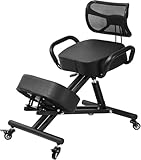
A kneeling chair is a steel or wood frame with a padded seat angled forward at roughly 20 to 30 degrees and a lower shin pad set 12 to 16 inches ahead of it. You sit with your hips open to about 110 degrees instead of 90, which lets the lumbar spine hold its natural inward curve without you thinking about it. Models sold for office use are usually height adjustable from about 21 to 28 inches at the seat, roll on four or five casters with brakes, and weigh 20 to 30 pounds. Weight ratings run 250 to 300 pounds. Cushions are 3 to 4 inches of molded foam covered in PU leather or mesh. The two main variants are the classic open frame with no back and the newer style with a small backrest, such as the Kneeling Chair with Backrest Ergonomic Adjustable Office Kneel Chair at about $119.99 or the Ergonomic Kneeling Chair with Back Support with brake casters at about $115.99. The backrest versions let you lean back briefly to rest your shins, which extends comfortable sessions noticeably. Expect assembly to take 15 to 30 minutes with the included tools.
As an Amazon Associate we earn from qualifying purchases at no extra cost to you. Product prices and availability are accurate as of the date shown and are subject to change.

Pros
- Passive posture correction. The forward tilt makes slouching physically awkward, so you hold a neutral lumbar curve without effort or reminders.
- Relief from sitting-related lower back ache. Opening the hip angle reduces the compressive load that a 90-degree seated posture places on the lumbar discs.
- Engages the core. Without a backrest doing the work, your trunk muscles stay lightly active, which many users find reduces end-of-day stiffness.
- Small footprint. Typically 25 to 28 inches long and 18 to 20 inches wide, and it tucks fully under a standard 29-inch desk.
- Works well with a standing desk. Sitting height of 21 to 28 inches pairs with desks set between 28 and 34 inches, giving you a third position between sitting and standing.
Cons
- Shin and knee pressure. Even with 4-inch cushions, most people feel it after 30 to 45 minutes. Anyone with knee injuries or circulation problems should avoid it.
- Getting in and out is awkward. There is a learning curve, and the wheeled versions roll away as you kneel onto them unless the brakes are set.
- No armrests and, usually, no real backrest. Shoulders and neck carry more load if your desk and monitor are not at the right height.
- Height mismatch with standard desks. Fixed kneeling chairs set your elbows too low for a 29- to 30-inch desk; you need an adjustable model or a lower desk.
- Not a fix for structural problems. Herniated discs, sciatica, and stenosis are not posture issues and may get worse with the forward tilt.
Who Should Buy It
Buy a kneeling chair if your lower back ache is the dull, stiff kind that shows up after two or three hours in a regular chair and eases when you stand up. It is also a good fit for people who already own an adjustable desk and want a mid-height seat for typing-heavy tasks, for anyone who slouches despite a good ergonomic chair, and for small home offices where a full task chair crowds the room. Choose an adjustable-height model with brake casters and a backrest if you expect to use it more than half an hour at a stretch.
Who Should Skip It
Skip it if you have diagnosed disc, nerve, or knee problems, if you weigh more than the 250- to 300-pound ratings, or if you need to sit continuously for long meetings. It is also the wrong buy for someone who cannot adjust their desk height, since a fixed kneeling seat under a 30-inch desk puts the keyboard at shoulder level. And if your pain is sharp, radiates down a leg, or wakes you at night, see a clinician before buying furniture.
Cheaper Alternatives
| Option | Cost | Trade-off |
|---|---|---|
| Wedge seat cushion (forward-tilt foam) | $20 to $40 | Gives the pelvic tilt on your existing chair but no shin support, so you slide forward over time |
| Adjustable lumbar support pillow | $15 to $35 | Supports the curve you already have rather than encouraging it; helps in a slumped chair, does nothing for hip angle |
| Saddle stool | $60 to $150 | Same open hip angle without knee pressure, but no back and a steeper learning curve for the inner thighs |
| Under-desk footrest with tilt | $20 to $40 | Improves leg angle in a regular chair; small posture effect for the price |
| Timer and standing breaks | Free | Standing 5 minutes every 30 relieves the same disc load, but relies on discipline |
FAQ
How long should I sit in a kneeling chair each day?
Start with 20-minute sessions two or three times a day and build toward 45 to 60 minutes as your shins adapt. Alternate with a conventional chair or standing. Total daily use of 2 to 4 hours is realistic for most people.
Do kneeling chairs actually help lower back pain?
They help the type caused by prolonged slumped sitting by keeping the pelvis tilted forward and the lumbar curve intact. They do not treat disc herniations, sciatica, or arthritis, and can aggravate some of those conditions. If pain is severe or radiating, get it assessed first.
What desk height works with a kneeling chair?
Seat heights of 21 to 28 inches suit desks between about 27 and 34 inches, depending on your torso length. If your desk is a fixed 29 to 30 inches, choose a kneeling chair that adjusts to at least 26 inches at the seat.
Kneeling chair or ergonomic office chair?
For a single, all-day chair, a well-adjusted ergonomic task chair with lumbar support wins. A kneeling chair is a specialized second seat. In 2026 a decent adjustable kneeling chair costs $100 to $130, which is about half the price of a mid-range ergonomic chair, so many people end up with both.