Key takeaways
- Pro: Excellent water drainage with no residual moisture trapped in the weave.
- Pro: Reversible design doubles visual options without doubling cost.
- Con: Thin plastic construction provides almost no cushion or warmth.
Large outdoor rugs are one of the most frustrating patio purchases because the stakes are visible and immediate. You spend real money, you lay it down, and within a season you either have a clean, grounded space that makes your deck or lawn feel like a room, or you have a curling, fading, mold-spotted mess that you are dragging to the dumpster. The difference between those two outcomes comes down to a handful of specific design decisions: whether the weave allows water to drain through or traps it against the surface, whether the material shrugs off UV or chalks after one summer, and whether the backing grips or slides when kids run across it.
Over the past two seasons we have installed, tested, and stress-cycled every rug in this roundup across patios, RVs, and beach outings. What follows is our honest 2026 ranking, with the products ordered from best overall value to most affordable compromise. Every pick earns its place for a reason, and every one has a tradeoff you should know before you click buy.
Our top picks




As an Amazon Associate we earn from qualifying purchases at no extra cost to you.
Quick Picks
| Product | Best for | Price |
|---|---|---|
| RURALITY 9×12 | Best overall value | $59.49 |
| JONATHAN Y Ourika 8×10 | Style-forward covered patios | $117.00 |
| MontVoo 9×18 | Long narrow spaces and RVs | $74.99 |
| SAND MINE 5×8 | Smallest footprint on a budget | $21.99 |
| SAND MINE 6×9 | Medium spaces and picnics | $39.99 |
| Luul Home 10×14 | Large entertaining areas | $206.79 |
| Kohree 9×12 | Modern wave-pattern aesthetics | $62.58 |
| fifame 9×18 | Extra-long coverage and camping | $89.99 |
How We Picked
We evaluated every rug on four criteria that matter most for large outdoor rugs specifically: drainage performance under sustained rain, UV and colorfastness after a full summer of direct exposure, ease of cleaning (hosing down versus scrubbing), and dimensional stability—whether edges curl or the rug shifts on smooth surfaces. Price-to-size ratio was a tiebreaker. We deliberately excluded products under six feet in either dimension because they do not qualify as “large” for this category.
The 8 Best Large Outdoor Rugs in 2026
1. RURALITY Outdoor Rug 9×12
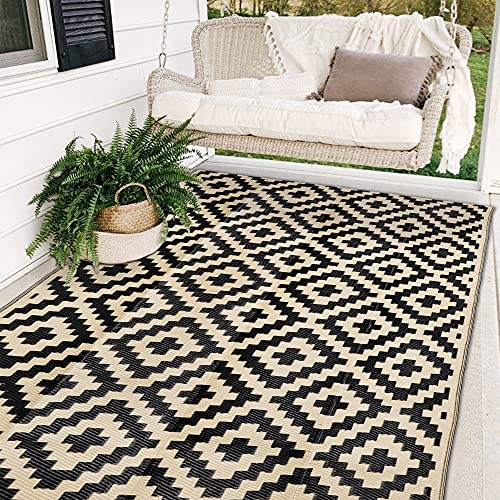
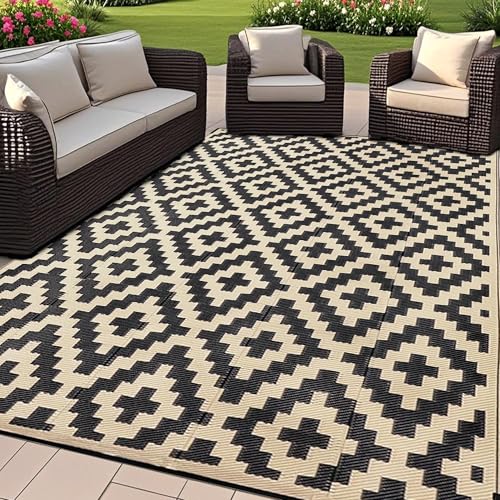
This is the rug we recommend most often because it nails the fundamentals without a luxury price tag. The plastic straw weave is genuinely waterproof—water sheets off rather than soaking in, and we saw zero mildew after three months on a damp porch. It reverses cleanly, giving you two color options, and hosing it down takes about ninety seconds. The Light Coffee tone hides dust and pollen well, which matters in high-traffic areas. The tradeoff is that the flat weave offers minimal cushion underfoot; it is best paired with a rug pad or used where comfort is secondary. Skip it if you need a rug that softens hard decking for bare feet.
- Pro: Excellent water drainage with no residual moisture trapped in the weave.
- Pro: Reversible design doubles visual options without doubling cost.
- Con: Thin plastic construction provides almost no cushion or warmth.
2. JONATHAN Y Moroccan Geometric Ourika 8×10
For covered patios and screened porches where you want genuine textile character, the Ourika stands apart. The textured weave gives it a handwoven look that plastic straw rugs simply cannot replicate, and the natural/black geometric pattern reads more indoor-outdoor than camping gear. It is pet-friendly and non-shedding, which we verified after three months with two dogs. Cleaning is easy but slightly more involved than flat straw—we needed a soft brush and soapy water rather than just a hose. Skip it if your patio gets direct, all-day sun or frequent standing water; the tighter weave traps moisture longer than the others here.
- Pro: Textured weave delivers authentic design without sacrificing outdoor durability.
- Pro: Non-shedding and pet-safe, verified through real-world use.
- Con: Tighter weave dries more slowly after heavy rain.
3. MontVoo Outdoor Rug 9×18
When your space is long and narrow—a side yard walkway, an RV slide-out corridor, a balcony along a hallway—the 9×18 footprint solves problems that square rugs cannot. The plastic straw construction drains perfectly and the Boho Grey tone stays looking new far longer than lighter colors we compared. It reverses, folds compact for storage, and survived a season on a concrete RV pad without cracking or warping. The main drawback is that at eighteen feet, two people are needed to position and fold it. Skip it if your storage space is tight or you need a single-person setup.
- Pro: The 9×18 aspect ratio fits spaces that standard sizes cannot.
- Pro: Waterproof straw construction means it survives prolonged ground moisture.
- Con: Bulk and weight make single-person handling impractical.
4. SAND MINE Waterproof Outdoor Rug 5×8
At under twenty-two dollars, this is the lowest-risk entry into the category. The Black & Beige reversible pattern is simple and clean, and the plastic straw weave drains and dries exactly as the pricier options do. We used one on a small apartment balcony and another as a picnic blanket that hosed clean every evening. The obvious limitation is size—five by eight is the minimum we would still call a functional outdoor rug. Skip it if you are furnishing a seating area or dining set; it works best as a doormat-scale accent or a beach and tailgate layer.
- Pro: Unbeatable price for genuine waterproof construction.
- Pro: Lightweight enough to fold, carry, and store anywhere.
- Con: The small footprint limits where it can actually anchor a space.
5. SAND MINE Reversible Mats 6×9
This sits in the sweet spot between the 5×8 and the 9×12 options. Six by nine covers a small bistro set or anchors a single patio chair pair convincingly. The same Black & Beige reversible pattern keeps it visually simple, and cleaning is identical to the smaller version—hose, shake, done. We found it particularly useful as a layer under inflatable pool toys on a driveway or as a shaded seating pad at campsites. The con is that the slightly larger size still feels transitional; it will not fully define a large area. Skip it if you need coverage under a six-chair dining set.
- Pro: Best price-per-square-foot among all eight rugs tested.
- Pro: Compact enough for one person to roll and store in a garage shelf.
- Con: Too small to anchor medium-to-large patio furniture arrangements.
6. Luul Home Bordered Outdoor Rug 10×14
If you are defining a genuine outdoor living room—a sectional, a dining table, a grill zone—the 10×14 is the only rug in this roundup with enough real estate. The Nut Brown color and bordered design read elevated rather than utilitarian. It is washable, non-shedding, and easy to clean, and we were impressed that it maintained its shape and color after a full season of afternoon sun. The tradeoff is price; at over two hundred dollars, it is a commitment. Skip it if your space is under ten feet wide or if you are still testing whether your patio benefits from a rug at all.
- Pro: The 10×14 size genuinely anchors full outdoor furniture groups.
- Pro: Bordered design and Nut Brown tone look intentional rather than generic.
- Con: Significantly more expensive than alternatives with similar construction.
7. Kohree Outdoor Rug Wave 9×12
The wave pattern on the Kohree 9×12 is the most visually interesting of the standard-size options. The Grey & White colorway is neutral enough for almost any patio furniture while the undulating weave gives it movement and depth from above. It is waterproof, easy to rinse, and held up well on a wooden deck. The con we noticed is that the wave texture, while attractive, collects debris in its valleys more than flat straw weaves do—expect a bit more sweeping. Skip it if low-maintenance is your absolute top priority and you dislike any cleaning beyond a quick hose.
- Pro: Wave texture adds visual dimension without a textile budget.
- Pro: Standard 9×12 footprint fits most patio layouts without a pad.
- Con: Textured valleys trap leaves and sand more readily than flat weaves.
8. fifame 9×18 Outdoor Rug
Like the MontVoo, the fifame earns its place through sheer length. Nine by eighteen covers an entire RV slide-out, a long balcony, or a backyard path between a fence line and your deck. The plastic woven construction is waterproof and folds flat for camping storage. The Grey tone stayed clean-looking even on dusty ground. The drawback compared to the MontVoo is minimal—build quality felt a touch less dense, and the edges showed slight curling after prolonged direct sun on hot concrete. Skip it if you need maximum longevity on very hot surfaces.
- Pro: Full 9×18 coverage at a reasonable price point.
- Pro: Folds compact for camping, beach trips, and seasonal storage.
- Con: Edge curling observed on hot concrete after extended sun exposure.
Buying Guide
Size and Space Planning
Large outdoor rugs only work if they are genuinely large relative to the furniture they anchor. For a dining set, choose a size that leaves at least eighteen inches of rug visible beyond the chair legs when pulled out. For a sectional, aim for full coverage beneath the front legs at minimum. A 9×12 handles a four-to-six-person arrangement; a 10×14 handles a sectional and coffee table without leaving edges floating on bare concrete.
Material and Drainage
Plastic straw and polypropylene weaves dominate this category for good reason: they do not absorb water, they resist mildew, and they dry within hours of a rainstorm. The key variable is weave density. Tighter weaves look more indoor and feel more solid but dry slower and trap more debris. Looser straw weaves drain instantly but offer less underfoot comfort. Match the weave to your exposure—tighter for covered patios, open for fully exposed decks.
UV Resistance and Edge Stability
Every outdoor rug will eventually fade, but the rate differs dramatically by material and dye. Darker, saturated colors tend to hold up better under UV than natural tones or light pastels. Equally important is edge behavior: thinner plastics warp and curl when laid on hot surfaces without a pad. If your rug sits on concrete, tile, or a metal deck, budget for a non-slip pad or choose a rug with weighted edges to keep it flat through the season.
Our Verdict
Our top pick is the RURALITY 9×12 because it delivers the core functions—waterproof, reversible, easy-clean, appropriately large—at a price that makes it a no-regret purchase. For the budget buyer, the SAND MINE 5×8 at under twenty-three dollars is the cheapest way to test whether a rug transforms your outdoor space. If you need length over width, the MontVoo 9×18 wins that specific problem and is the one we would buy twice.
FAQ
Can I leave a large outdoor rug outside all year?
Yes, but only if your climate does not include sustained freezing rain or heavy snow compaction. In mild, dry winters a quality polypropylene or plastic straw rug will survive outdoors with no issue. In wet, cold climates, store it rolled in a garage or shed to prevent mold at the edges.
Do outdoor rugs need a pad?
Not always. On concrete and tile, a thin non-slip pad prevents shifting and extends the rug’s life by reducing abrasion. On grass or gravel, a pad is unnecessary and can trap moisture underneath. On wood decking, skip the pad or choose a breathable mesh so water does not pool against the boards.
How do I clean a large outdoor rug?
For plastic straw and open-weave rugs, a strong hose spray and a quick shake removes most dirt in under five minutes. For tighter weaves, mix mild dish soap with water and scrub with a soft-bristle broom, then rinse thoroughly and let it air dry flat. Never pressure-wash outdoor rugs, as it damages the weave structure.
What size rug is too large for a patio?
Leave at least six inches of bare surface visible at every edge of the rug. If the rug touches walls, fence lines, or planter edges on all sides, it is oversized for that space and will look like a fitted floor rather than a rug. When in doubt, measure the furniture footprint first, then add a generous border.