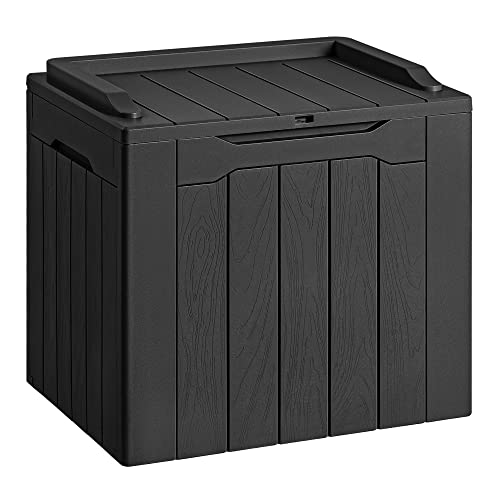
The Keter Westwood 150 Gallon is the best outdoor storage box overall, with the Keter Westwood 150 Gallon in Dark Grey as the runner-up. Both pair a wood-look resin shell with the piston-assisted lid geometry that separates boxes you’ll actually use daily from the ones you stop opening by August.
Most outdoor storage boxes fail in one of two ways: the hinge or lid becomes a two-handed wrestling match, or the resin chalks, warps and cracks after two summers of UV and freeze-thaw cycling. Neither shows up in a product photo. This guide evaluates the leading deck boxes the way a durability tester would — lid lift geometry, wall stiffness, hinge cycle life, drainage paths and seating load — so you can buy once for cushions, pool chemicals, tools or firewood.
Our top picks


As an Amazon Associate we earn from qualifying purchases at no extra cost to you.
Quick Comparison
| Product | Best For | Standout Feature | Rating |
|---|---|---|---|
| Keter Westwood 150 Gal | Full cushion sets and pool gear | Piston-assisted lid, 500 lb bench rating | Excellent |
| Keter Westwood 150 Gal, Dark Grey | Value on a large-capacity box | Same proven shell in a low-glare finish | Excellent |
| Keter City 30 Gal | Balconies and small patios | Doubles as a flat-top side table | Very Good |
| Devoko 78 Gal Deck Box | Rainy, exposed locations | Waterproof resin with sealed lid lip | Very Good |
| Keter Kentwood 92 Gal | Seating plus storage in one footprint | Contoured bench-height lid | Very Good |
How to Choose an Outdoor Storage Box
- Lid ergonomics: Look for gas-piston or damped hinges. An unassisted 150-gallon lid demands an awkward bent-back lift, and that single motion is why big boxes get abandoned. Lids that stay open unaided let you load with both hands.
- Capacity versus footprint: Measure your longest item, not just your volume. Standard 24-inch seat cushions need roughly 45 inches of internal length; 70–90 gallons suits tools and toys, while 150 gallons swallows a full sofa cushion set.
- Resin quality and UV stability: Polypropylene with UV inhibitors resists the chalking and brittleness that kill cheap boxes. Textured wood-grain surfaces also hide the micro-scratching that makes gloss finishes look aged in one season.
- Water management: “Weather resistant” means an overlapping lid lip and floor ribs that keep contents off any moisture that does enter. Fully sealed boxes can trap humidity, so plan on airing cushions periodically regardless.
- Seating load and base rigidity: If you’ll sit on it, check the stated lid rating and whether the base has cross-ribbing. A stiff floor prevents the sidewall bow that eventually misaligns the lid and strains the hinges.
The Best Outdoor Storage Boxs Reviewed
Best Overall: Keter Westwood 150 Gal Outdoor Storage Box
The Westwood combines genuinely useful capacity with the best lid mechanics in the category, so loading a stack of damp cushions is a one-motion job rather than a balancing act. It’s the right pick for homeowners with a full patio set who also want a resilient bench near the pool.
Best Budget: Keter Westwood 150 Gallon, Dark Grey
Mechanically identical to our top pick, the dark grey colorway frequently lists for less and hides pollen, dust and scuffing better than lighter finishes. Choose it if you want maximum capacity per dollar and a box that disappears against modern decking.
Best Premium: Keter City 30 Gallon Resin Storage Box
The City earns a premium recommendation on space efficiency rather than size: its flat, furniture-grade top works as a legitimate side table while holding cushions, hose fittings or garden tools underneath. Ideal for balconies and narrow patios where every piece must justify its footprint twice.
Best for Wet, Exposed Patios: Devoko 78 Gallon Deck Box
Devoko’s sealed lid lip and reinforced resin panels are aimed squarely at driving rain and snow load, making it a strong choice for uncovered decks in the Pacific Northwest or Northeast. Best for buyers storing moisture-sensitive items like grill covers, chemicals or electronics.
Best for Seating and Storage: Keter Kentwood 92 Gal Outdoor Storage Box
At bench height with a contoured, load-rated lid, the Kentwood works as real seating for two adults while storing toys, tools or firewood. It suits smaller decks where an extra chair simply won’t fit. The narrower Keter Marvel 71 Gal is the alternative when depth is tight against a wall.
Frequently Asked Questions
Are outdoor storage boxes truly waterproof?
Most are weather resistant rather than submersion-proof. Overlapping lids shed rain effectively, but wind-driven moisture and internal condensation still occur, so store cushions dry and elevate anything sensitive.
Do I need to anchor my deck box?
Yes, if it sits in an exposed or coastal location. An empty resin box catches wind like a sail; most models include tie-down points or can be secured to decking with brackets.
How long should a resin storage box last?
A UV-stabilized polypropylene box typically holds up 8–12 years. Failures usually start at the hinges, so avoid slamming the lid and keep the closing surfaces free of grit.
Can I leave it outside through winter?
Generally yes, but clear snow off the lid to prevent flex and creep, and avoid opening a frozen lid forcefully, since cold resin is significantly more brittle.
Final Thoughts
For most patios, the Keter Westwood 150 Gal delivers the best balance of capacity, lid ergonomics and long-term durability, with the Dark Grey Westwood offering the same build at better value. If space is tight, the Keter Kentwood 92 Gal gives you seating and storage in a single, load-rated footprint.