Key takeaways
- Use high fan on the initial dry-down, then drop to low or sleep mode for maintenance. Low fan means longer, steadier cycles and less thermal stress.
- Don’t set the target within 5% of ambient. A tight differential guarantees short-cycling. Give the machine room to actually do work.
- Sleep mode is a durability feature, not just a quiet one. The ToLife Dehumidifier’s sleep mode and the KNKA’s equivalent both stretch cycles out while dimming displays — kinder to the compressor and to your bedroom.
What's inside
Humidity is the one variable in a room that quietly touches everything else: the glue in your dresser joints, the foam in your sofa cushions, the finish on a walnut tabletop, and how tired you feel by nine at night. Push past roughly 60% relative humidity and wood swells, drawers bind, upholstery holds odors, and mold spores find the conditions they have been waiting for. Drop below about 35% and the opposite failure appears — panel shrinkage, hairline cracks in veneer, static, dry sinuses. A dehumidifier is not a gadget you set to “maximum” and forget. It is a calibration tool, and the dial position you choose is the difference between furniture that ages gracefully and furniture that warps in its third summer.
This guide covers the specific setting to target and why, how to shift it across seasons and room types, what fan speed and sleep mode actually do to the compressor’s lifespan, and the drainage choice that determines whether you’ll be hauling a sloshing tank up basement stairs twice a day. You’ll finish knowing exactly which numbers to enter and which features are worth paying for.
As an Amazon Associate we earn from qualifying purchases.


The Target: 45–50% Relative Humidity
For living spaces holding solid wood or upholstered furniture, set the humidistat to 45%. That single number sits comfortably inside the 40–55% band that furniture makers assume when they cut joinery, and it is below the ~60% threshold where dust mites and mold become active. If your unit adjusts in 5% steps, 45% is the sweet spot; if it offers finer control, 47% gives you a small buffer without overworking the compressor. Basements and garages without fine furniture can run at 50%, which still prevents musty air while using noticeably less electricity. Models with genuine humidistats — the Waykar 34 Pint with its 30%–80% range, or the KNKA Energy Star unit’s smart humidity control — let you set a number and walk away, which matters far more than raw pint capacity.
Adjust For Season, Not For Impatience
The instinct in a damp July is to crank the setting to 35% and get it over with. Resist it. Aggressive drying pulls moisture out of wood faster than the wood can equalize, and uneven moisture loss across a panel is precisely what causes cupping and split tabletops. Instead, hold 45% year-round in furnished rooms and let the machine work steadily. In winter, cold outdoor air already lowers indoor humidity, so many homes need the unit off entirely from December through February. If you do run one in cold weather, automatic defrost is non-negotiable — the Waykar and the 5500 sq ft Energy Star model both include it, which keeps coils from icing over and stalling the compressor.
Fan Speed And Sleep Mode: The Durability Angle
Compressors wear out from starting and stopping, not from running. A machine that short-cycles — kicking on for four minutes, off for six, all night — will fail years earlier than one that runs longer, gentler cycles. Two practical consequences:
- Use high fan on the initial dry-down, then drop to low or sleep mode for maintenance. Low fan means longer, steadier cycles and less thermal stress.
- Don’t set the target within 5% of ambient. A tight differential guarantees short-cycling. Give the machine room to actually do work.
- Sleep mode is a durability feature, not just a quiet one. The ToLife Dehumidifier’s sleep mode and the KNKA’s equivalent both stretch cycles out while dimming displays — kinder to the compressor and to your bedroom.
Drainage: The Setting That Protects Your Back
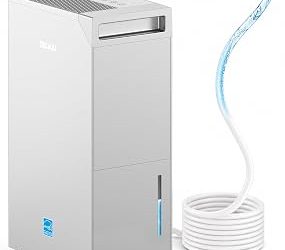
A full 0.66-gallon tank weighs roughly five and a half pounds; an 80-pint unit’s reservoir can hit fifteen. Carrying that at arm’s length, twisted sideways down a stairwell, is one of the most common ways people injure themselves maintaining a healthy home. If your unit sits near a floor drain, sink, or sump, run the included hose for continuous gravity drainage and never lift a tank again. The KNKA, Waykar, 5500 sq ft, and 4500 sq ft quiet compressor models all ship with drain hoses. Where continuous drainage isn’t possible — a bedroom, a home office — choose a compact tank unit with a top-mounted handle and a spill-resistant lid, like the 95 oz Dehumidifier or the ToLife, and empty it at waist height rather than reaching down to the floor.
Placement, Clearance, And Filter Access
Set the unit at least 6–12 inches from walls and away from curtains so intake and exhaust aren’t blocked; restricted airflow forces longer runtimes and cooks the motor. Keep it off carpet if possible, or on a hard mat, so the base plate can shed condensation. Just as important: check that you can reach the filter without moving furniture. A washable filter you can slide out in five seconds gets cleaned monthly. One buried behind a rear panel gets ignored, and a clogged filter is the single most common cause of a dehumidifier that “stopped working.”
Tips
- Buy an inexpensive standalone hygrometer and place it across the room from the unit — onboard sensors read the air they just dried and often report 3–5% low.
- Keep the dehumidifier at least a few feet from solid wood pieces so no single panel sits in a dry jet of exhaust air.
- Rinse the filter monthly and wipe the tank with diluted white vinegar to stop biofilm before it smells.
- Run a hose downhill in one continuous slope with no dips; a sagging loop traps water and backs the tank up.
Frequently Asked Questions
Is 30% ever the right setting?
Only for short, targeted drying — a flooded basement or post-leak remediation with no furniture present. Sustained 30% risks shrinkage cracks in wood and dried-out leather, and it raises your electricity bill for no health benefit.
Should I leave it running continuously?
Leave it plugged in and set to a target; let the humidistat decide. Continuous mode ignores humidity entirely and is meant for drying-out jobs, not everyday climate control.
Does a bigger unit dry too aggressively?
No, and oversizing is usually the smarter buy. A 4500 or 5500 sq ft model in a 1200 sq ft basement simply reaches the target sooner and then idles, running fewer, longer cycles — easier on the compressor than a small unit straining nonstop.
Why is my humidity still high with the unit running?
Check three things in order: filter cleanliness, clearance around the intake, and room temperature. Compressor dehumidifiers lose efficiency below roughly 65°F, so a cold garage may need a model with strong defrost handling.
Conclusion
Set it to 45%, run low fan for maintenance, plumb the drain hose if you possibly can, and verify with a separate hygrometer — that combination protects your furniture, your comfort, and the machine itself. The rest is just choosing a unit sized generously for the space with a filter you can actually reach.