Key takeaways
- For reduced vision: increase text size and display zoom, then enable bold text or high contrast where available.
- For hand tremors: use a sturdy case, a stand, and a stylus with a thicker grip; a stable surface is easier than holding the tablet in midair.
- For hearing difficulty: select a tablet with strong built-in speakers, captions, hearing-device compatibility, and adjustable balance.
- For memory or attention concerns: keep only essential apps on the home screen and use large, clearly labeled widgets.
The best tablets for seniors are the Apple iPad (A16) for the simplest long-term choice, the Samsung Galaxy Tab S10 FE for a larger screen and flexible accessibility settings, and the Lenovo Tab Plus for seniors who prioritize loud, clear speakers and entertainment.
Quick picks by situation
| Situation | Best fit | Why it makes sense | Typical price range |
|---|---|---|---|
| Wants the least complicated everyday tablet | Apple iPad (A16), 11-inch | Clear interface, strong video calling, broad accessory support, and dependable software updates | Usually $350–$500 |
| Needs bigger text and a bright, roomy display | Samsung Galaxy Tab S10 FE, 10.9-inch | Excellent display visibility, Android accessibility tools, and optional S Pen support | Usually $450–$650 |
| Often watches television or listens without headphones | Lenovo Tab Plus, 11.5-inch | Eight-speaker audio system and a built-in stand make hands-free use easier | Usually $300–$400 |
| Already uses an iPhone or has family who uses Apple devices | Apple iPad (A16), 11-inch | FaceTime, shared support, and familiar account and photo syncing | Usually $350–$500 |
| Already uses a Samsung phone | Samsung Galaxy Tab S10 FE | Familiar Android menus and convenient Samsung-to-Samsung features | Usually $450–$650 |
What matters most when choosing a senior-friendly tablet
Screen size, weight, and viewing distance
An 11-inch tablet is a useful middle ground: large enough for enlarged text and video calls, but still manageable on a lap or small side table. A tablet with a 10.9- to 11.5-inch display generally measures about 10 to 11 inches wide and weighs roughly 1.1 to 1.5 pounds before adding a case.
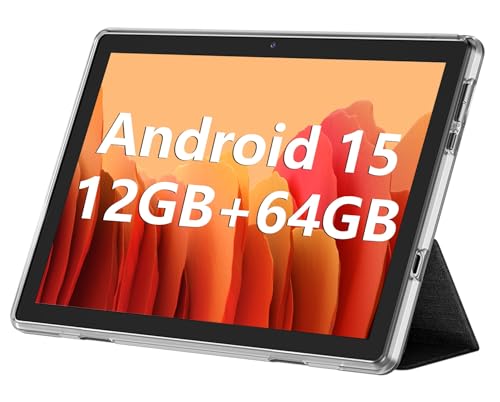
ECOPAD 10.1 Inch Tablet, Android 15 Tablets 12GB(4+8) RAM / 64GB ROM / 1TB SD Card Expansion, 1280x800 IPS HD Touchscreen, 6000mAh Battery, Bluetooth 5.0, Dual Cameras, GMS, Dual Band WiFi, Black
Included for 'Best Tablets for Seniors: Easy, Reliable Picks' because the listing specifies 1280x800 IPS HD Touchscreen and 6000mAh Battery, details this guide uses to compare options.
View on Amazon
COLORROOM 2026 Android16 Tablet 11inch, Face Unlock, 18W Fast Charge,Blue
Included for 'Best Tablets for Seniors: Easy, Reliable Picks' because the listing specifies Face Unlock and 18W Fast Charge, details this guide uses to compare options.
View on Amazon
COLORROOM 2026 Android16 Tablet 11inch, Face Unlock, 18W Fast Charging,Gray
Included for 'Best Tablets for Seniors: Easy, Reliable Picks' because the listing specifies Face Unlock and 18W Fast Charging, details this guide uses to compare options.
View on AmazonFor reading in a recliner, keep the tablet about 16 to 24 inches from the face. At that distance, a 10-inch-class display is usually more comfortable than a compact 8-inch model, especially when text is enlarged. The trade-off is portability: an 11-inch tablet may need a 12- to 13-inch-wide space when placed in a protective case and stand.
Look for a sharp display with good brightness rather than simply choosing the largest screen. A matte or low-reflection screen protector can help near a window, although glossy displays may look more vivid indoors.
Font size and accessibility controls
Before buying, confirm that the operating system offers adjustable text size, display scaling, bold text, magnification, larger touch targets, and spoken-content features. Apple iPadOS and Samsung’s version of Android both provide extensive accessibility menus. The exact names and locations can change with software updates, but the controls are built into the system rather than requiring separate apps.
- For reduced vision: increase text size and display zoom, then enable bold text or high contrast where available.
- For hand tremors: use a sturdy case, a stand, and a stylus with a thicker grip; a stable surface is easier than holding the tablet in midair.
- For hearing difficulty: select a tablet with strong built-in speakers, captions, hearing-device compatibility, and adjustable balance.
- For memory or attention concerns: keep only essential apps on the home screen and use large, clearly labeled widgets.
Battery life and charging
Most current tablets can provide a full day of mixed use, but battery life varies substantially with brightness, video streaming, cellular connectivity, and battery age. A practical target is at least 8 hours of active mixed use, with a battery capacity around 7,000 to 10,000 mAh on many Android models. Apple usually emphasizes estimated usage time rather than publishing a directly comparable capacity figure.
Charging convenience can matter more than the final few hours of battery life. Keep a USB-C charger beside the favorite chair or bed, and choose a case that leaves the charging port accessible. A short charging cable can be frustrating when the tablet is used on a bedside table; a 6-foot cable is often more useful. Avoid leaving a tablet under pillows or blankets while charging, because heat can shorten battery life.
Speakers and video calling
Video calls are easier when the camera is sharp enough for faces, the microphones reject ordinary room noise, and the speakers are positioned so they are not blocked by a lap or case. The iPad A16 and Galaxy Tab S10 FE are strong general-purpose choices for FaceTime, Zoom, Google Meet, and similar services. The Lenovo Tab Plus is particularly appealing for music, television, and spoken content because its eight-speaker design is unusually substantial for a tablet in this price range.
For regular calls, landscape orientation is often more stable. A case with a built-in stand should hold the tablet at approximately a 60- to 70-degree angle and be wide enough not to tip when a charging cable is connected. A separate Bluetooth keyboard is optional; most seniors who mainly read, call, browse, and watch video do not need one.
Head-to-head: Apple iPad A16 vs. Samsung Galaxy Tab S10 FE
Choose the iPad for simplicity and family support
The 11-inch Apple iPad with the A16 chip is a strong default when the buyer wants a tablet that feels consistent, responsive, and easy for relatives to troubleshoot. Its interface is relatively controlled, the App Store has mature versions of common communication and health-related apps, and FaceTime is convenient for households already using Apple devices.
Its limitations are also worth noting. iPadOS can feel restrictive for people who want to customize the home screen extensively, and accessories such as a keyboard or stylus add to the total cost. The base storage option should be considered carefully if the owner plans to keep many photos or download videos.
Choose the Galaxy Tab S10 FE for flexibility and visibility
The Samsung Galaxy Tab S10 FE offers a bright 10.9-inch display, Android’s extensive accessibility options, expandable storage through a microSD card, and an included S Pen in many configurations. The pen can be useful for tapping small controls, writing reminders, or signing simple documents.
Android gives users more freedom to arrange apps and files, but that flexibility can create more setup decisions. Unwanted notifications, duplicate apps, and promotional prompts may need to be reduced during initial setup. For a family member providing support, creating a short list of approved apps and turning off nonessential notifications can make the tablet feel much simpler.
Where the Lenovo Tab Plus fits
The Lenovo Tab Plus is best viewed as an entertainment and communication tablet rather than the universal choice for every senior. Its standout feature is the speaker system, and its integrated kickstand makes it convenient on a kitchen counter, coffee table, or bedside surface. It is a good fit for podcasts, television, music, recipes, and occasional video calls.
Its larger 11.5-inch body takes more room than a compact tablet and may feel less convenient to hold for a long reading session. It also does not provide the same ecosystem advantages as an iPad for Apple households. Buy it when audio quality and hands-free viewing matter more than the simplest possible family support.
Setup details that make the biggest difference
- Complete updates before giving it to the owner. Install the latest operating-system and app updates while the tablet is connected to Wi-Fi and power.
- Use one clear account. Write down the account recovery method and avoid sharing passwords in a visible note.
- Enlarge the interface. Set text size, display zoom, pointer size, touch-and-hold timing, and caption preferences during setup.
- Reduce clutter. Put phone, video calling, photos, weather, web browser, and camera apps on the first screen. Move everything else to a second page or app library.
- Prepare video calling. Add trusted contacts, test the front camera, and show the owner how to answer and end a call.
- Add physical support. Use a protective case with a raised edge and a stand. A stable stand often improves comfort more than a lighter tablet.
Software support and long-term ownership
Software support is one reason to prefer a mainstream iPad or Galaxy Tab over an unfamiliar bargain tablet. Updates improve security, app compatibility, accessibility, and battery management. Before purchase, check the manufacturer’s current support policy for the exact model, not merely the brand. Also confirm that the tablet can still run the video-calling, banking, medical-portal, and library apps the owner needs.
Plan for a replacement or battery assessment after roughly four to six years, depending on use and charging habits. A tablet may remain physically usable longer, but an aging battery, unsupported software, or a cracked charging port can make it unreliable. A case, screen protector, and careful charging routine are inexpensive protection for the first parts that typically wear out: the corners, screen surface, charging port, and battery.
Bottom line
For most households, the Apple iPad A16 is the safest all-around recommendation for the best tablets for seniors, especially when relatives already use Apple devices. Choose the Samsung Galaxy Tab S10 FE when enlarged viewing, Android flexibility, expandable storage, or an included stylus matters more. Choose the Lenovo Tab Plus when loud speakers and hands-free entertainment are the deciding features. Whichever model you select, the right setup, a stable stand, readable text, and a simple home screen will have as much impact as the tablet’s specifications.