Our Top Picks
 Presto 01781 23-Quart Pressure Canner and Cooker23 Quarts13.5 x 17.5 x 15.5 inches12 poundsCheck on Amazon
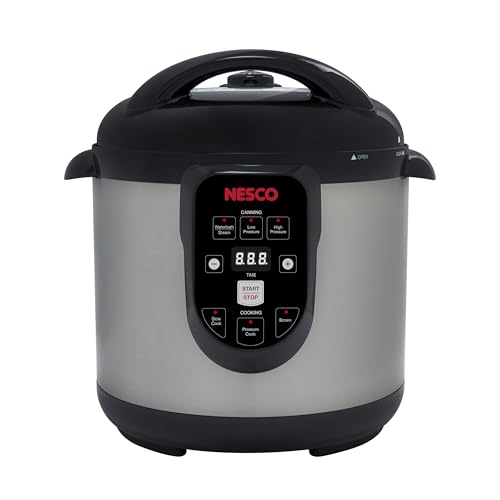 NESCO NPC‑9 Smart Electric Pressure Canner and Cooker9 Quarts14 x 15 x 14.5 inches22 poundsCheck on Amazon
 T-fal 22-Quart Aluminum Pressure Canner22 Quarts19.33 x 15.39 x 16.26 inches14.77 poundsCheck on Amazon
The best pressure canners for most home canners are the Presto 23-Quart (01781) for versatility and low weight, and the All-American 921 or 925 for heavy-duty, gasket-free durability, with your choice depending on gauge type, stove, and storage space.
Pressure canners are the only safe option for low-acid foods like vegetables, meats, soups, and stocks. Unlike pressure cookers or water-bath canners, they reach and hold 240°F at 10-15 PSI to eliminate botulism spores. Choosing the right model is less about brand loyalty and more about matching capacity to your batch size, gauge to your altitude and experience, and dimensions to your kitchen.
Presto 01781 23-Quart Pressure Canner and Cooker
Picked as a relevant option in this category.
View on AmazonNESCO NPC‑9 Smart Electric Pressure Canner and Cooker for Home Food Preservation, 9.5‑Quart Stainless Steel with Digital Controls
Chosen because it specifies 9.5‑Quart Stainless Steel with Digital Controls.
View on AmazonT-fal 22-Quart Aluminum Pressure Canner, 3 PSI Settings, Home Canning, Includes Racks & Canning Guide, Large Capacity, Pressure & Water Bath Canning for Vegetables, Meats, Seafood & Fruits, Silver
Chosen because it specifies 3 PSI Settings and Home Canning.
View on Amazon
Presto 02153 23-Quart Digital Pressure Canner
Picked as a relevant option in this category.
View on AmazonHow to Choose: The 4 Decision Criteria
Before comparing models, narrow your options with these four factors:
- Capacity: Measured in liquid quarts, but what matters is jar capacity. A 16-quart canner holds 7 pint jars but often cannot double-stack quarts. A 23-quart holds 7 quart jars in a single layer or 20 pints double-stacked.
- Gauge Type: Dial gauge vs. weighted gauge (or both). This affects accuracy, altitude adjustments, and how closely you need to monitor the canner.
- Stovetop Compatibility: Not all canners work on glass-top, ceramic, or induction ranges. Weight and bottom diameter are critical.
- Storage Needs: Pressure canners are tall, heavy, and wide. You need to plan for cabinet clearance, shelf weight limits, and where you will cool and unload jars.
Capacity and Jar Yield: What Size Do You Actually Need?
Bigger is not always better. A large canner saves time if you can large batches from a garden, but it requires more water, longer heat-up and cool-down times, and more storage space.
| Model (Type) | Liquid Capacity | Jar Capacity (Regular Mouth) | Interior Height / Diameter | Empty Weight | Overall Height with Lid |
|---|---|---|---|---|---|
| Presto 16-Quart (01755) | 16 qt | 7 pints (single layer), 10 pints (stacked*) | 11.5 in / 12.5 in | 7.5 lbs | 14.5 in |
| Presto 23-Quart (01781) | 23 qt | 7 quarts or 20 pints (double-stacked) | 13.0 in / 12.5 in | 8.5 lbs | 15.5 in |
| All-American 921 | 21.5 qt | 7 quarts or 19 pints (double-stacked) | 12.25 in / 12.25 in | 15.5 lbs | 16.5 in |
| All-American 925 | 25 qt | 7 quarts or 19 pints (double-stacked) | 14.75 in / 12.25 in | 17.5 lbs | 18.5 in |
| All-American 930 | 30 qt | 7 quarts or 19 pints (double-stacked) | 16.75 in / 12.25 in | 20.5 lbs | 20.5 in |
*Presto 16-quart can double-stack pints only with a second rack and only for certain small pint jars; quart jars cannot be double-stacked in this model.
For context on time: A 23-quart canner loaded with 7 quarts needs about 3 quarts of water (per USDA guidelines) and takes 25-35 minutes to vent and come to pressure on a standard 7,000 BTU gas burner, plus 45-60 minutes to depressurize naturally. A 16-quart heats faster by about 8-10 minutes but requires two batches to process 14 quarts, so total workflow is longer.
How Much Food Does That Equal?
A practical rule: 1 bushel of green beans (about 30 lbs) yields roughly 14 quart jars. That is two full loads in a 23-quart/21.5-quart canner, or three loads in a 16-quart. If you can in small batches from a farmers market (7-10 jars per weekend), a 16-quart is sufficient. If you harvest and can 30+ jars in a day, a 23-quart or larger saves hours.
Gauge Type: Dial vs. Weighted Gauge
This is the most important usability difference.
| Feature | Dial Gauge (e.g., Presto) | Weighted Gauge / Regulator (e.g., All-American, Presto 3-piece regulator) | Dual System (Dial + Weighted) |
|---|---|---|---|
| How it holds pressure | Needle shows exact PSI; you adjust burner to hold pressure | Weight jiggles/rocks at 5, 10, or 15 PSI; audible cue | Dial for reference, weight for control |
| Accuracy | Accurate but must be tested annually at extension office | Very consistent, no calibration needed | Best of both; check dial yearly |
| Altitude adjustment | Precise: e.g., 11 PSI at 0-2,000 ft, 12 PSI at 2,001-4,000 ft for dial | Fixed increments: must use 15 PSI weight above 1,000 ft for many recipes | Use dial to fine-tune, weight as safety |
| Monitoring | Requires watching dial constantly | Listen for jiggle 3-4 times per minute | Less active monitoring |
| Who it suits | Canners at high altitude or who want exact control | Beginners, those who prefer auditory cues | Most versatile for beginners to advanced |
In 2026, most Presto models ship with both a dial gauge and a 3-piece weighted regulator (5-10-15 PSI), so you can use either method. All-American models use a weighted gauge only, with a dial on some models as an optional add-on. The weighted system is often recommended for beginners because you do not need to calibrate it, while dial gauges can drift by 1-2 PSI after a season of use.
Stovetop Compatibility and Kitchen Clearance
A pressure canner that does not fit your stove is unusable, regardless of capacity.
Stovetop Rules by Model Type
- Gas and Electric Coil: All Presto and All-American canners work. Center the canner over the burner; on coil stoves, the canner bottom should not extend more than 2 inches beyond the burner diameter to avoid heat loss.
- Glass / Ceramic Smooth Top: Presto stainless-clad and aluminum canners (01781, 01755) are approved if the bottom is flat and the manufacturer states smooth-top compatibility. All-American recommends against glass tops for the 25-quart and larger due to weight – a 925 loaded with 7 quarts, water, and food weighs 42-45 lbs, which can crack glass and triggers auto-shutoff sensors on some ranges.
- Induction: Standard aluminum Presto and All-American models will not work unless labeled induction-compatible. Presto’s induction-compatible line (e.g., Presto 01784 23-Quart Induction) has a stainless steel base. Most All-American aluminum canners are not induction-ready.
Clearance Measurements to Check Before You Buy
- Height under microwave / hood: A Presto 23-quart needs 16-17 inches of vertical clearance above the burner to lift the lid straight up. An All-American 930 needs 21-22 inches. Measure from grate to bottom of hood. Standard 18-inch over-range microwave clearance will not fit a 30-quart model on a gas range.
- Burner to countertop depth: Canner diameter is 13-15 inches with handles. Leave 3 inches on each side for steam venting and handle overhang. On a 24-inch deep apartment stove, a large canner will overhang the front edge.
- Sink clearance: You will lift a hot, heavy canner to empty water. A standard 25-inch kitchen sink can accommodate a 16-quart for dumping, but a 23-quart+ must be bailed out with a pitcher or siphoned.
Material and Construction Trade-offs
| Construction | Example | Weight & Heat-Up | Durability & Maintenance | Seal Type |
|---|---|---|---|---|
| Light Aluminum with Gasket | Presto 01781, Mirro 22-Quart | Lightest (7-9 lbs empty), heats fastest | Gasket needs replacement every 2-3 years, lid can warp if overheated dry | Rubber gasket |
| Heavy Cast Aluminum, Metal-to-Metal Seal | All-American 921, 925, 930 | Heavy (15-20 lbs empty), slower to heat/cool but retains heat evenly | No gasket to replace; lasts decades; lugs need light oil | Precision-ground metal seal, 6 wing nuts |
| Stainless Steel / Induction-Ready Base | Presto Induction models | Moderate weight (10-12 lbs), works on all stoves | More expensive, resists pitting from hard water | Rubber gasket |
The practical difference: A Presto-style gasket seal closes with a simple twist and is easier for hands with limited strength. An All-American metal seal requires tightening 6 wing nuts in opposite pairs and more hand strength, but you will never need to source a replacement gasket during canning season.
Storage, Weight Limits, and Workflow Realities
For homebestfurniture.com readers, storage is often the deciding factor. A pressure canner is not a pot you can nest inside another pot.
- Cabinet storage: Upper cabinets are typically 12 inches deep. No pressure canner fits inside. Base cabinets are 24 inches deep and 34.5 inches high with shelf. A 23-quart (15.5 in tall) fits on a base shelf, but a 30-quart (20.5 in tall) does not fit under a fixed 16-inch shelf. Measure shelf height and remove an intermediate shelf if needed.
- Pantry / utility shelf: Wire pantry shelving is usually rated for 100-150 lbs per shelf when anchored to studs. A loaded canner is 40-50 lbs, plus 14-18 lbs of jars stored inside it (many people store spices or lids inside). Keep total under 50 lbs per shelf and place on the lowest shelf for safety.
- Moving and assembly: Box weight is 11 lbs (Presto 16-qt) to 24 lbs (All-American 930). Box dimensions are roughly 15x15x16 inches to 16x16x22 inches. All doorways (28-30 inches) clear the box, but narrow galley kitchens with islands need 36 inches of aisle to turn with the box.
- What wears first: On gasket models, the rubber gasket and overpressure plug; on metal-seal models, the pressure gauge and vent pipe. Store gaskets flat, not folded, and never store the canner with the lid locked.
Decision Matrix: Which Canner Fits Your Situation?
| Your Situation | Best Fit | Why |
|---|---|---|
| Small apartment, glass-top stove, limited storage | Presto 16-Quart (01755) or 23-Quart Induction | Fits under standard hood, approved for glass/induction, lightest to lift and store in base cabinet |
| Beginner canner, nervous about pressure control | Presto 23-Quart with dial + 3-piece weight | Audible weighted regulator + visual dial for learning; lowest cost to start, usually $130–$220 |
| Large garden, batch canning 20+ jars per day | Presto 23-Quart or All-American 925 | Double-stack pints, 7 quarts per load; cuts batches by half vs. 16-quart |
| Canning meat, stock, or low-acid foods weekly; want buy-it-for-life | All-American 921 or 925 | No gasket to replace, heavy walls hold pressure steady, usually $340–$550 range |
| Low strength in hands / older adult living alone | Presto 23-Quart | Twist-lock lid vs. 6 wing nuts; 8.5 lbs vs. 17+ lbs empty |
| Off-grid, high-altitude, or extension-service access limited | All-American with weighted gauge | No annual dial testing needed; weight is accurate at altitude when using 15 PSI |
Workflow Tips That Save Space and Time
- Stage jars on a heat-proof surface: A 23-quart canner plus 7 hot quart jars needs a 24×30 inch landing zone of wood or laminate countertop with trivets. Granite can handle heat but avoid thermal shock on cold stone; use a towel-lined baking sheet.
- Cool jars 12-24 hours undisturbed in a draft-free spot. Do not move the canner to a pantry shelf until pressure is zero and the lid lifts freely.
- Store the canner with lid inverted on top, with a paper towel between lid and pot to prevent odor and gasket compression. Tuck the rack and weights inside to reclaim vertical space.
- If you rent, check lease and stove manual: Many rental glass-top ranges cap weight at 50 lbs and require flat-bottom cookware. Keep the manual’s BTU and weight page for the inspection.
What to Avoid
- Do not use a pressure cooker (typically 6-10 quarts) as a pressure canner. USDA requires a canner that holds at least 4 quart jars; smaller cookers heat and cool too quickly for safe processing times.
- Do not can on an outdoor propane burner unless it is rated to hold low, steady heat. High-BTU turkey fryer burners (50,000+ BTU) can warp thin aluminum bases and make pressure control impossible.
- Do not force-cool a canner under water. It causes liquid loss from jars (siphoning) and can buckle the lid seal.