Key takeaways
- Caster diameter and swivel range: Small hard wheels bind on rug edges and gouge soft flooring. Look for four independently swiveling casters with a wide track — they let you steer the unit with one hand instead of dragging it. Units that require lifting to reposition are the ones that stop getting repositioned.
- Handle placement relative to center of mass: A grip mounted high on the fin stack tips the radiator toward you when pulled. Recessed side handles near the vertical midpoint keep the load balanced and spare your wrist and lower back.
- Control height and feedback: Knobs at ankle level mean kneeling on a cold floor every adjustment. Top-mounted panels, digital readouts, or a remote eliminate the crouch. If you choose knobs, favor detented ones with clear tactile stops over smooth-sweep dials you cannot set by feel.
- Fin construction and finish: Fewer, thicker steel fins with clean continuous welds resist seepage far better than thin stamped panels. A baked powder-coat finish matters too — it fends off the humidity and scuffing that come with attic or garage storage between seasons.
- Cord length, strain relief, and storage: Six feet is the practical minimum; anything shorter forces extension cords, which is the leading fire risk with these appliances. Check for a molded strain relief at the base and an integrated cord wrap so the cable is not repeatedly kinked at the same point.
What's inside
Oil-filled radiators solve a problem most portable heaters create: they warm a room without the roar of a fan or the scorched-dust smell of exposed coils. But the category hides a trap. These units are heavy — 15 to 25 pounds of steel and sealed diathermic oil — and most shoppers compare wattage while ignoring the things that actually determine whether the heater gets used or shoved into a closet by February. Caster quality, handle geometry, control height, and the gauge of the fin welds decide whether you move it easily and whether it survives a decade of seasonal storage.
This guide evaluates the leading oil space heaters through an ergonomics-and-durability lens. I looked at how each unit rolls across carpet transitions, whether you have to crouch or squint to adjust settings, how cords are anchored and stowed, and which build details predict long service life. Wattage is essentially fixed at 1500W across the category, so the real differences lie in handling, control interfaces, and construction.
As an Amazon Associate we earn from qualifying purchases.




How to Choose an Oil Space Heater (2026)
- Caster diameter and swivel range: Small hard wheels bind on rug edges and gouge soft flooring. Look for four independently swiveling casters with a wide track — they let you steer the unit with one hand instead of dragging it. Units that require lifting to reposition are the ones that stop getting repositioned.
- Handle placement relative to center of mass: A grip mounted high on the fin stack tips the radiator toward you when pulled. Recessed side handles near the vertical midpoint keep the load balanced and spare your wrist and lower back.
- Control height and feedback: Knobs at ankle level mean kneeling on a cold floor every adjustment. Top-mounted panels, digital readouts, or a remote eliminate the crouch. If you choose knobs, favor detented ones with clear tactile stops over smooth-sweep dials you cannot set by feel.
- Fin construction and finish: Fewer, thicker steel fins with clean continuous welds resist seepage far better than thin stamped panels. A baked powder-coat finish matters too — it fends off the humidity and scuffing that come with attic or garage storage between seasons.
- Cord length, strain relief, and storage: Six feet is the practical minimum; anything shorter forces extension cords, which is the leading fire risk with these appliances. Check for a molded strain relief at the base and an integrated cord wrap so the cable is not repeatedly kinked at the same point.
The Best Oil Space Heaters Reviewed (2026)
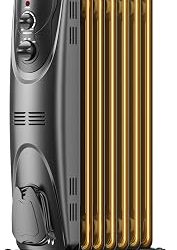
Pelonis Oil Filled Radiator Heater, 2025 Upgraded
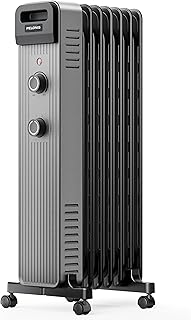
The updated Pelonis strikes the best balance of handling and build in the category, with a stable wide-track caster set and an adjustable thermostat that holds temperature without the cycling drift you get from cheaper bimetallic controls. Fin welds are clean and the powder coat has held up well through repeated storage cycles.
DREO Oil Filled Radiator Heater with Remote
The strongest ergonomic case here: a digital thermostat, four modes, a 24-hour timer, and a remote mean you never crouch to adjust it, plus a child lock that prevents accidental setting changes. ECO mode modulates output rather than hard-cycling, which reduces thermal stress on the internal components over time.
Amazon Basics Portable Oil Space Heater, 7 Fins
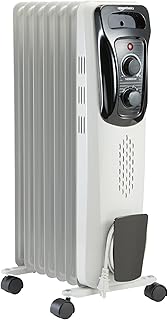
A no-nonsense workhorse with seven oil-filled steel fins, three heat settings, and ETL certification covering both tip-over and overheat cutoffs. The knobs sit low, so it suits a set-it-and-leave-it spot more than a heater you fiddle with nightly.
PELONIS Radiator Heater with Dual Knobs
The dual-knob layout separates mode from thermostat, giving satisfying tactile detents you can set in the dark without reading a display. It runs genuinely quiet, and the compact fin stack fits alongside furniture where wider units would not.
CAYNEL Oil Filled Radiator Heater
A well-finished option for home offices, with a 24-hour timer, three modes, and a matte black shell that resists visible scuffing. The slim footprint tucks under a desk return without blocking legroom.
Frequently Asked Questions
Do oil-filled heaters need refilling?
No. The diathermic oil is permanently sealed at the factory and never burns off. If a unit ever seeps, that indicates a failed weld and the heater should be retired, not topped up.
How hot do the fins get?
Surface temperatures typically reach 150 to 190°F — hot enough to cause a burn on sustained contact. Keep at least three feet of clearance from furniture and fabrics, and place the unit where pets and children will not brush against it.
Are they cheaper to run than fan heaters?
Not per hour. At 1500W both draw identical power. Oil radiators tend to cost less overall because their retained heat lets the thermostat cycle off for longer stretches once a room reaches temperature.
Can I use one overnight?
Yes, provided it is plugged directly into a wall outlet, sits on a hard level surface, and has functioning tip-over and overheat protection. Never run one on an extension cord or power strip.
Final Thoughts
For most rooms, the 2025 upgraded Pelonis offers the soundest combination of solid fin construction and easy handling. If you want to skip the crouch entirely, the DREO’s digital panel, remote, and child lock make it the most ergonomic pick available, while the 7-fin Amazon Basics remains the sensible choice for a fixed-position heater where simplicity and certified safety cutoffs matter most.