Key takeaways
- Real thermal range, not marketing range: Most units in this class are thermoelectric (Peltier), meaning they cool relative to the room rather than to a fixed setpoint. A unit advertising “fast cooling” in a 68°F office may sit well above the 36–46°F band in an 80°F summer bedroom. Models with an explicit temperature dial and readout give you something to verify against.
- Door hardware and swing arc: A vial cooler gets opened far more often than a beverage fridge. Look for a full-height hinge with a positive detent rather than a friction fit, and measure the arc before you commit shelf space — a door that fouls a monitor arm or wall trim will eventually wear its own hinge out.
- Gasket quality over gasket thickness: Compression set is the quiet failure mode in small coolers. A firm, resilient seal that springs back after being held open beats a soft foam strip that flattens permanently within a year and lets the interior creep upward.
- Interior layout you can reach into one-handed: Removable shelves, no sharp molded edges, and enough vertical clearance for upright vials matter more than headline liter capacity. Deep single-cavity boxes force you to unload the front to reach the back.
- Cord entry, ventilation, and noise floor: Check for molded strain relief where the DC lead meets the housing, and give the rear heatsink two to three inches of clear air. On a nightstand, fan pitch matters more than measured decibels — a low, steady hum disappears; a whine does not.
What's inside
Anyone who keeps reconstituted peptides, prescription refills, or high-cost actives at home runs into the same wall: a kitchen refrigerator is the wrong instrument for the job. Every door swing dumps cold air, the crisper drawer swings several degrees across a day, and a 2 mL vial inevitably migrates behind the condiments. Compact coolers solve the location problem, but the units that survive daily handling are not always the ones that photograph well. Hinges loosen, foam gaskets take a permanent set, and thermoelectric modules drift as the room warms.
This guide looks at desktop refrigerators through two lenses that matter over a multi-year ownership window: ergonomics — how the unit behaves when you reach into it half-awake at 6 a.m. — and durability, meaning gasket recovery, hinge geometry, cord strain relief, and how gracefully the cooling system handles a hot afternoon. Below you’ll find the picks, then a buying framework and reviews of the five strongest options for temperature-sensitive storage in a bedroom, office, or home study.
As an Amazon Associate we earn from qualifying purchases.


How to Choose a Mini Fridge For Peptides (2026)
- Real thermal range, not marketing range: Most units in this class are thermoelectric (Peltier), meaning they cool relative to the room rather than to a fixed setpoint. A unit advertising “fast cooling” in a 68°F office may sit well above the 36–46°F band in an 80°F summer bedroom. Models with an explicit temperature dial and readout give you something to verify against.
- Door hardware and swing arc: A vial cooler gets opened far more often than a beverage fridge. Look for a full-height hinge with a positive detent rather than a friction fit, and measure the arc before you commit shelf space — a door that fouls a monitor arm or wall trim will eventually wear its own hinge out.
- Gasket quality over gasket thickness: Compression set is the quiet failure mode in small coolers. A firm, resilient seal that springs back after being held open beats a soft foam strip that flattens permanently within a year and lets the interior creep upward.
- Interior layout you can reach into one-handed: Removable shelves, no sharp molded edges, and enough vertical clearance for upright vials matter more than headline liter capacity. Deep single-cavity boxes force you to unload the front to reach the back.
- Cord entry, ventilation, and noise floor: Check for molded strain relief where the DC lead meets the housing, and give the rear heatsink two to three inches of clear air. On a nightstand, fan pitch matters more than measured decibels — a low, steady hum disappears; a whine does not.
The Best Mini Fridge For Peptides (2026)s Reviewed
Classic Compact Portable Mini Fridge with Lock
This is the only unit here designed around the actual use case: a 37–64°F control range, removable shelving, and a smoked glass door with a lock, which solves both light exposure and household access in one component. The glass door adds weight the hinge must carry, so mount it on a level surface and avoid using the door as a leverage point when it’s loaded.
Antarctic Star 10L Compact Mini Fridge
At 10 liters, this is the pick when you’re storing kits rather than a single vial — the extra depth lets you keep vials, syringes, and bacteriostatic water organized in trays instead of stacked. The dual AC/DC input is genuinely useful for moving supplies without a warm gap, and the same chassis is offered in white if the black finish clashes with your desk.
Cooluli 4L Mini Fridge
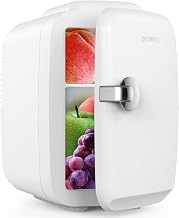
Cooluli has the most refined ergonomics in the 4L category: a well-damped door, a clean interior with no snagging edges, and three power options including USB. The cool-and-warm switch is a real durability consideration, though — leave it in cooling mode permanently, since repeated mode cycling stresses the Peltier junction more than continuous operation does.
CROWNFUL 4L Portable Cooler and Warmer
The ETL listing is worth noting on a device that runs unattended around the clock, and CROWNFUL’s housing feels denser than its price suggests, with a cord entry that resists the flex fatigue that kills cheaper units. Capacity is modest at six cans, so treat it as a dedicated single-purpose cabinet rather than shared cold storage.
BEICHEN 4L Mini Refrigerator
BEICHEN’s draw is a genuinely low noise floor, which makes it the most livable option within arm’s reach of a bed. Pull-down speed is competitive, but as with all thermoelectric units in this size, verify interior temperature with an independent probe before you trust it with anything expensive.
Frequently Asked Questions
Will a thermoelectric mini fridge hold 2–8°C reliably?
Not on its own specification alone. These units cool by a fixed differential below ambient, so a stable room is part of the system. Keep the room climate-controlled, position the unit away from sunlight and radiators, and confirm with a min/max thermometer inside the cavity.
Does a locking door actually matter?
If there are children, houseguests, or shared roommates in the space, yes. A lock also discourages casual door-opening by others, which is the most common cause of temperature excursions in a small cavity.
How long do these units typically last?
Thermoelectric coolers have no compressor to fail, so lifespan usually comes down to the fan bearing and the gasket. Expect three to five years of continuous service, and vacuum the rear heatsink every few months to keep the fan from working harder than it needs to.
Can I run one in a car or during a move?
The AC/DC models here are built for it, but cabin temperatures are the limiting factor. In a hot vehicle, supplement with an insulated bag and a cool pack rather than relying on the fridge alone.
Final Thoughts
For dedicated peptide storage, the Classic Compact with its temperature control and locking smoked glass door is the most purpose-built option, and the one I’d hand to someone who wants to buy once. Choose the Antarctic Star 10L if you need room for full kits and supplies, and the Cooluli 4L if desk footprint and daily door feel matter most. Whichever you pick, add an independent thermometer — it’s the cheapest durability insurance in this category.