Key takeaways
- Room size and ceiling height: Match blade span and airflow to the space. Very large HVLS fans suit high, open interiors; smaller industrial fans are easier to control in garages, workshops, and utility areas.
- Airflow pattern: CFM indicates air volume, but distribution matters just as much. Large slow-moving blades generally create broad circulation, while compact fans deliver a more concentrated stream.
- Mounting and clearance: Check the included downrods, ceiling angle compatibility, blade-to-wall clearance, and distance from lights, doors, shelving, and moving equipment.
- Motor and controls: DC and PMSM motors can offer efficient speed adjustment and reversing, while remote or wall controls make changes safer and more convenient from floor level.
- Durability and environment: Look for metal blades or housing, a suitable location rating, and construction appropriate for dust, moisture, temperature changes, and frequent operation.
What's inside
Choosing an industrial ceiling fan is less about finding the largest blade span and more about matching airflow to the room, mounting height, electrical setup, and daily workload. A fan that moves impressive air in a warehouse may be excessive in a garage, while a compact industrial model can leave a tall, open space feeling stagnant.
This guide evaluates the listed fans through an ergonomics-and-durability lens: usable airflow, control convenience, installation flexibility, motor design, noise considerations, and suitability for demanding spaces. Product specifications can vary by installation, so verify clearance, ceiling structure, damp-location requirements, and electrical compatibility before purchasing.
As an Amazon Associate we earn from qualifying purchases.


![[HVLS]96 Inch Industrial Ceiling Fan, Extra Large Commercial Big Assed Ceiling Fan, 8 Aluminum Blades, Reversible DC Motor, Remote Control with 6 Speeds, 3 Downrods, for Shop, Garage, Gym, Black](https://m.media-amazon.com/images/I/71sFsM+09vL._AC_UL320_.jpg)
How to Choose an Industrial Ceiling Fan (2026)
- Room size and ceiling height: Match blade span and airflow to the space. Very large HVLS fans suit high, open interiors; smaller industrial fans are easier to control in garages, workshops, and utility areas.
- Airflow pattern: CFM indicates air volume, but distribution matters just as much. Large slow-moving blades generally create broad circulation, while compact fans deliver a more concentrated stream.
- Mounting and clearance: Check the included downrods, ceiling angle compatibility, blade-to-wall clearance, and distance from lights, doors, shelving, and moving equipment.
- Motor and controls: DC and PMSM motors can offer efficient speed adjustment and reversing, while remote or wall controls make changes safer and more convenient from floor level.
- Durability and environment: Look for metal blades or housing, a suitable location rating, and construction appropriate for dust, moisture, temperature changes, and frequent operation.
The Best Industrial Ceiling Fan (2026)s Reviewed
ZMISHIBO 96-Inch Industrial Ceiling Fan
This broad-bladed ZMISHIBO model is a practical choice for garages, barns, workshops, and other open rooms that need wide circulation without a built-in light. Its eight aluminum blades, DC motor, six speeds, reversing function, remote, and three downrods give buyers useful control over seasonal airflow and mounting height. The damp rating is helpful in semi-exposed areas, although it should not be treated as a fully weatherproof outdoor fixture.
AA-Orion 120-Inch HVLS Ceiling Fan
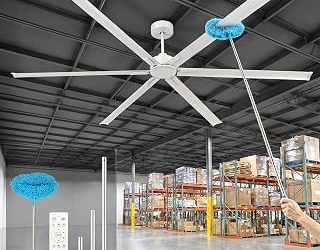
The AA-Orion is the strongest candidate here for large commercial interiors, where its 120-inch span and stated 28,000 CFM capacity are intended to move air across substantial floor areas. Its PMSM motor, six speeds, reversing operation, and remote support efficient adjustment from below. Because of its scale, installation planning is especially important: structural support, clearances, and professional mounting deserve more attention than they would with a residential-size fan.
Air King 9718 18-Inch Industrial Ceiling-Mount Fan
Air King takes a different approach with this compact, industrial-grade ceiling-mount fan. Its smaller footprint makes it easier to place where a large rotating canopy would interfere with lighting, storage, or overhead work, while its focused airflow can suit workshops and utility rooms. It is best viewed as a targeted circulation tool rather than an HVLS replacement for a warehouse or gym.
100-Inch Industrial HVLS Ceiling Fan
This 100-inch model combines eight aluminum blades with a stated 15,000 CFM output, six-speed reversible DC operation, and remote control. It offers a sensible middle ground for a shop, garage, or commercial room that needs broad airflow but cannot accommodate a 120-inch fan. Confirm the indoor/outdoor installation instructions and location rating carefully, particularly if the fan will face humidity, dust, or temperature swings.
Westinghouse 56-Inch Industrial Ceiling Fan
The Westinghouse 7861400 is the most conventional option in this group, with a 56-inch span, three steel blades, brushed-nickel finish, and included wall control. That familiar format can be easier to integrate into a finished workshop, utility room, or indoor commercial space where a very large HVLS fan would look disproportionate. Its indoor designation is a key limitation: it is not the right pick for exposed damp locations or expansive high-bay circulation.
Frequently Asked Questions
What size industrial ceiling fan do I need?
Measure the room’s floor area, ceiling height, and obstructions before choosing. Large, open spaces with tall ceilings generally benefit from 96- to 120-inch HVLS fans, while a 56-inch or 18-inch model may provide better control in smaller rooms.
Are industrial ceiling fans suitable for garages?
Yes, provided the fan is rated and mounted appropriately for the garage environment. Check the ceiling structure, door clearance, dust and moisture exposure, and whether the selected model is damp rated or intended only for indoor use.
Are HVLS fans quiet?
Noise depends on motor quality, speed, balance, mounting, and the room’s acoustics. Larger fans often circulate air at lower rotational speeds, but an improperly secured mount, loose hardware, or high-speed setting can create noticeable vibration or sound.
Should I install an industrial ceiling fan myself?
Only if you are qualified to handle the electrical and structural requirements. Large fans place meaningful loads on their mounting points, so a licensed electrician or experienced installer is the safer choice when ceiling reinforcement, sloped mounting, or new wiring is involved.
Final Thoughts
The AA-Orion 120-inch model is the standout for genuinely large commercial spaces, while the ZMISHIBO 96-inch fan is a more versatile choice for garages, barns, and workshops. For smaller indoor areas, the compact Air King 9718 or the conventional Westinghouse 56-inch fan should be easier to position and control.