Key takeaways
- Blade span: Choose a span that suits the room rather than automatically buying the largest fan. Fans from 65 to 84 inches are generally best reserved for broad living areas, great rooms, workshops, and covered patios.
- Downrod and angle compatibility: A cathedral ceiling usually needs a longer downrod to place the blades at a practical height. Confirm that the fan supports an angled ceiling adapter and that the mounting box can carry the assembly securely.
- Airflow and control: High CFM is valuable in large rooms, but multiple speed settings make the fan more comfortable for everyday use. A remote with independent light and fan controls is especially helpful when the wall switch is far from the seating area.
- Motor durability: A reversible DC motor typically offers quiet operation, efficient speed changes, and useful winter circulation. Look for smooth starting, minimal vibration, and a motor housing appropriate to the installation environment.
- Location and maintenance: Damp-rated models are suitable for covered, protected areas but not directly exposed installations. Also consider blade cleaning, LED replacement or serviceability, remote storage, and whether the fan can be safely reached for maintenance.
What's inside
Cathedral ceilings create an impressive sense of space, but they also complicate ceiling-fan selection. A fan mounted too high may move air inefficiently, wobble under an unsuitable downrod, or become difficult to service. The right model needs more than a large blade span: it must match the room’s scale, ceiling angle, mounting hardware, airflow needs, and exposure to moisture.
This guide evaluates large ceiling fans through an ergonomics-and-durability lens. The focus is on usable airflow, motor behavior, controls, lighting, blade materials, installation flexibility, and suitability for indoor or covered-outdoor spaces. Because cathedral-ceiling installations vary, verify the included downrod and angled-mount compatibility before ordering.
As an Amazon Associate we earn from qualifying purchases.



How to Choose a Ceiling Fan For Cathedral Ceiling (2026)
- Blade span: Choose a span that suits the room rather than automatically buying the largest fan. Fans from 65 to 84 inches are generally best reserved for broad living areas, great rooms, workshops, and covered patios.
- Downrod and angle compatibility: A cathedral ceiling usually needs a longer downrod to place the blades at a practical height. Confirm that the fan supports an angled ceiling adapter and that the mounting box can carry the assembly securely.
- Airflow and control: High CFM is valuable in large rooms, but multiple speed settings make the fan more comfortable for everyday use. A remote with independent light and fan controls is especially helpful when the wall switch is far from the seating area.
- Motor durability: A reversible DC motor typically offers quiet operation, efficient speed changes, and useful winter circulation. Look for smooth starting, minimal vibration, and a motor housing appropriate to the installation environment.
- Location and maintenance: Damp-rated models are suitable for covered, protected areas but not directly exposed installations. Also consider blade cleaning, LED replacement or serviceability, remote storage, and whether the fan can be safely reached for maintenance.
The Best Ceiling Fan For Cathedral Ceiling (2026)s Reviewed
ZMISHIBO 84-Inch Industrial Ceiling Fan
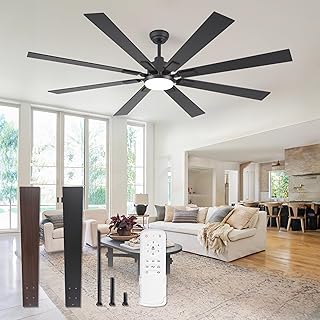
The ZMISHIBO 84-inch fan is a strong choice for expansive cathedral-ceiling rooms where broad, steady circulation matters more than a compact visual profile. Its eight aluminum blades, industrial-grade construction, reversible DC motor, six speeds, and damp rating make it well suited to great rooms, garages, shops, and protected outdoor spaces. The aluminum blade material should also resist humidity better than many wood-look alternatives, although the large span makes careful balancing and solid ceiling support essential.
84-Inch Three-Blade Propeller Fan
This no-light 84-inch model takes a deliberately simple approach: three wood-finish blades, a high-airflow DC motor, and remote control. It is a sensible pick when the cathedral-ceiling room already has adequate lighting and the priority is unobstructed air movement. With fewer blades and no integrated light assembly, it may look cleaner overhead, but buyers should confirm that the deep-walnut finish and outdoor rating suit the intended location.
72-Inch Modern Eight-Blade Fan with Light
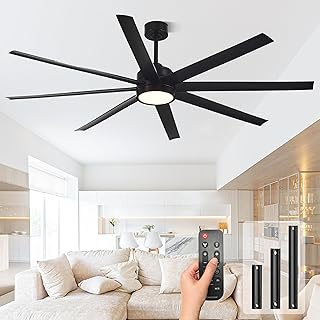
The 72-inch modern fan offers a useful balance between scale and everyday versatility. Its eight blades, quiet reversible DC motor, six speeds, and 24-watt six-color-temperature LED make it practical for a large living room, library, or similarly tall space where layered lighting is welcome. The broad blade layout should distribute air smoothly, while the dimmable light and remote improve comfort from seating level.
72-Inch Modern Farmhouse Wood-Blade Fan
For interiors that favor warmer materials, this six-blade modern farmhouse fan pairs solid wood blades with a high-CFM DC motor and dimmable lighting. Its damp rating expands its usefulness to covered porches and patios, but its appearance is particularly well matched to indoor great rooms with exposed beams or rustic finishes. The main installation consideration is the blade clearance: measure nearby beams, pendants, and upper cabinetry before committing to the 72-inch span.
ZMISHIBO 72-Inch Dual-Finish Fan
The ZMISHIBO 72-inch model is a versatile middle-ground option for cathedral ceilings that need substantial airflow without the visual mass of an 84-inch fan. It combines a powerful quiet DC motor, six speeds, a 24-watt three-color-temperature LED, and a damp rating for indoor or covered outdoor use. Its dual-finish design can coordinate with changing décor, while the remote makes speed and lighting adjustments easier in a tall room.
Frequently Asked Questions
Do cathedral ceilings require a special ceiling fan?
Not always, but most cathedral-ceiling installations require an angled-ceiling adapter and an appropriately sized downrod. The fan should hang level, with the blades positioned at a safe and effective height rather than tucked close to the peak.
What size ceiling fan works best in a great room?
Large rooms often benefit from a 65- to 84-inch fan, depending on floor area, ceiling height, and the desired visual balance. An oversized fan can work well, but only if the room has adequate blade clearance and the mounting structure is properly reinforced.
Are DC ceiling fans worth choosing?
Usually, yes. DC motors tend to offer quiet operation, efficient energy use, smooth speed control, and convenient reverse functions. Their electronics can be more complex, so use the supplied controls and protect damp-rated models from direct weather exposure.
How far should a fan hang below a cathedral ceiling?
There is no single measurement for every room. Aim for a position that keeps blades clear of people and fixtures while placing them low enough to circulate air effectively. A qualified installer can calculate the downrod length and verify the ceiling angle, box, and structural support.
Final Thoughts
The ZMISHIBO 84-inch industrial fan is the strongest choice for maximum coverage and durable damp-rated construction, while the 72-inch modern eight-blade model is more adaptable when integrated lighting matters. For a warmer interior style, the 72-inch farmhouse fan is a compelling alternative; whichever you choose, treat the downrod, ceiling support, and angled-mount hardware as equally important as the fan itself.