Key takeaways
- Span before speed: Match sweep to floor area, not to how hard the motor can push. Rooms over 400 square feet generally want 62 inches minimum; 72 to 84 inches covers open-plan living areas and wide patios. A large fan loafing at speed two moves more air, more quietly, than a small fan straining at speed six — and low-load operation is what preserves bearings.
- DC motors for thermal and acoustic headroom: Brushless DC units draw roughly a third of the power of comparable AC motors, run cooler, and offer six or more genuinely distinct speeds. Cooler windings mean slower insulation aging, which is the quiet variable behind long-term reliability.
- Blade material and hub rigidity: Aluminum resists warping in heat and humidity; solid or engineered wood damps vibration and looks right in residential spaces; ABS is lightest on the motor but can flex at long spans. Whatever the material, the blade-to-bracket joint and downrod fit determine whether the fan stays balanced.
- Lighting ergonomics: Selectable color temperature (3CCT or 6CCT) plus real dimming lets one fixture serve morning tasks and late evenings. Look for diffused lenses rather than bare arrays — at large spans, the fixture sits in your sightline more often than you’d expect.
- Mounting and moisture rating: Confirm your box is fan-rated for the fixture’s weight, use the downrod length that puts blades 8 to 9 feet off the floor, and insist on a damp rating for porches, sunrooms, and garages.
What's inside
Big rooms defeat ordinary fans. A 52-inch blade span that feels perfectly adequate over a bed becomes almost decorative once you put it in a great room with 14-foot ceilings, an open stairwell, or a vaulted patio ceiling. Air leaves the blade tip, loses velocity within a few feet, and never reaches the far seating group. Owners compensate by running the fan flat out, which is where the real problems start: motor whine at the frequency your ear tracks all evening, blade flutter, a wobble that grows over two summers, and a light kit that glares because it sits closer to eye level in a room where you actually look up.
This guide approaches large-room fans the way I evaluate any object people live under daily — through comfort load and service life. That means blade sweep matched to room volume, airflow you can feel at seated height rather than only directly beneath the hub, control layouts your hands understand in the dark, light temperature that suits the hour, and construction that stays true after thousands of start-stop cycles. Below are six large-span fans worth considering in 2026, followed by the criteria that separate the ones that age well from the ones that get replaced.
As an Amazon Associate we earn from qualifying purchases.


How to Choose a Ceiling Fan For Big Room (2026)
- Span before speed: Match sweep to floor area, not to how hard the motor can push. Rooms over 400 square feet generally want 62 inches minimum; 72 to 84 inches covers open-plan living areas and wide patios. A large fan loafing at speed two moves more air, more quietly, than a small fan straining at speed six — and low-load operation is what preserves bearings.
- DC motors for thermal and acoustic headroom: Brushless DC units draw roughly a third of the power of comparable AC motors, run cooler, and offer six or more genuinely distinct speeds. Cooler windings mean slower insulation aging, which is the quiet variable behind long-term reliability.
- Blade material and hub rigidity: Aluminum resists warping in heat and humidity; solid or engineered wood damps vibration and looks right in residential spaces; ABS is lightest on the motor but can flex at long spans. Whatever the material, the blade-to-bracket joint and downrod fit determine whether the fan stays balanced.
- Lighting ergonomics: Selectable color temperature (3CCT or 6CCT) plus real dimming lets one fixture serve morning tasks and late evenings. Look for diffused lenses rather than bare arrays — at large spans, the fixture sits in your sightline more often than you’d expect.
- Mounting and moisture rating: Confirm your box is fan-rated for the fixture’s weight, use the downrod length that puts blades 8 to 9 feet off the floor, and insist on a damp rating for porches, sunrooms, and garages.
The Best Ceiling Fan For Big Room (2026)s Reviewed
ZMISHIBO 72″ Ceiling Fan with Lights
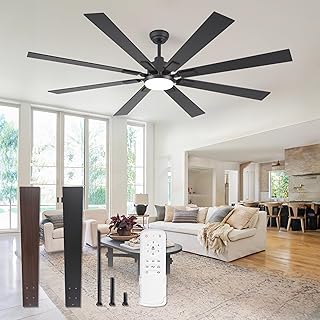
The most balanced pick here: high-CFM output from a quiet DC motor, a dual-finish body that reads as intentional rather than utilitarian, and 24W 3CCT LED lighting that dims without flicker. Damp-rated construction makes it equally at home over a covered patio or a two-story living room.
62″ Large Ceiling Fan, Brushed Nickel
A sensible choice for rooms in the 350 to 450 square foot range where an 84-inch span would overwhelm the ceiling plane. The memory function is the underrated feature — it returns to your last speed and color temperature, which removes the nightly fiddling that wears out remotes and patience alike.
84″ Ceiling Fan No Light, Deep Walnut
Three long wood blades on a DC motor deliver a broad, slow-moving column of air that feels like natural breeze rather than a draft. Skipping the light kit reduces hub weight and eliminates a failure point, making this the durability specialist’s pick for bedrooms and shaded patios that already have ambient lighting.
ZMISHIBO 84″ 8-Blade Aluminum Fan
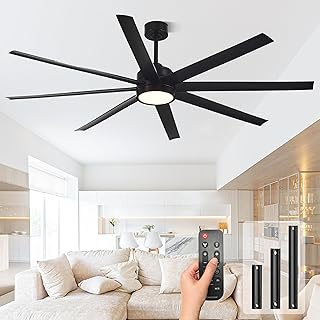
Eight reversible aluminum blades on an industrial-grade motor give this the highest sustained output of the group, with six speeds to keep it off the top setting. Aluminum’s dimensional stability in heat and humidity makes it the right call for shops, garages, and gazebos.
Modern 72″ 8-Blade Fan, 6CCT
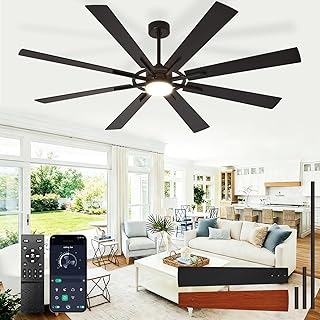
Six color-temperature steps and a fully reversible DC motor make this the most adaptable option across seasons and room functions. The eight-blade layout trades a little peak airflow for noticeably smoother, quieter movement at mid speeds — where most people actually live.
Frequently Asked Questions
What size fan does a 500-square-foot room need?
Plan on 72 inches or larger. Two smaller fans spaced across the room are also valid, particularly in long rectangular spaces or rooms with a structural beam interrupting the ceiling.
Do more blades mean better cooling?
Not directly. Additional blades usually lower noise and smooth the airflow while slightly reducing peak CFM. Span, blade pitch, and motor torque matter more to actual cooling than blade count.
How far below the ceiling should a big fan hang?
Aim for at least 10 to 12 inches of clearance above the blades and 8 to 9 feet below them. On vaulted ceilings, use an extended downrod and an appropriate sloped-ceiling adapter rather than mounting flush.
Is app control worth having?
It’s genuinely useful for fans you can’t easily reach, and for scheduling reverse mode seasonally. Just make sure the fan retains a working RF remote and wall control so it stays operable if the app or network changes.
Final Thoughts
For most large living rooms, the ZMISHIBO 72″ hits the best balance of airflow, quiet operation, and lighting flexibility. Choose the ZMISHIBO 84″ 8-blade aluminum model when the space is genuinely cavernous or exposed to humidity, and the 84″ wood-blade fan when you want a broad, gentle breeze and one less component that can eventually fail.