Key takeaways
- Weight at full extension: A duster that feels light in your hand can feel like a crowbar at 90 inches. Total mass under one pound is the practical ceiling for overhead work, and every ounce near the head multiplies the torque your wrist absorbs.
- Pole flex and lock design: Thin-wall aluminum whips at extension and makes precise blade contact impossible. Look for stainless or thick-wall aluminum with twist-lock collars that bite under load rather than friction fittings that creep and collapse mid-stroke.
- Head geometry: A U-shaped or dual-sided pocket sleeve captures both blade faces in one pass, cutting your total arm-raise count roughly in half. Bendable gooseneck necks matter more for reaching over furniture than for fans themselves.
- Fiber quality and washability: Cheap split microfiber sheds within a few laundry cycles and starts pushing dust instead of trapping it. Chenille and dense woven microfiber survive machine washing; check whether the sleeve seams are stitched or heat-bonded, since bonded seams fail first.
- Grip ergonomics: A handle around one inch in diameter with a slight taper lets you hold a neutral wrist. Bare narrow tubing forces a pinch grip that fatigues the forearm fast, so foam or textured overmolding is worth paying for.
What's inside
Dust on fan blades behaves differently than dust anywhere else in a house. Static charge and the rotational airflow bake it into a felted gray layer that resists a dry swipe, and the blades themselves sit at the one height where your shoulder has the least leverage. Most people solve this with a step stool and an old t-shirt, which is how a routine chore becomes a rotator-cuff strain or a fall. The tool matters here more than the technique.
This guide looks at ceiling fan dusters through two lenses that catalog copy tends to skip: how the tool loads your body across a full ten-minute cleaning session, and how the parts hold up after fifty wash cycles. Pole flex, grip diameter, head attachment method, and microfiber density all determine whether a duster is still useful next spring. Below are the models worth considering in 2026, with notes on who each one actually suits.
As an Amazon Associate we earn from qualifying purchases.



How to Choose a Ceiling Fan Duster
- Weight at full extension: A duster that feels light in your hand can feel like a crowbar at 90 inches. Total mass under one pound is the practical ceiling for overhead work, and every ounce near the head multiplies the torque your wrist absorbs.
- Pole flex and lock design: Thin-wall aluminum whips at extension and makes precise blade contact impossible. Look for stainless or thick-wall aluminum with twist-lock collars that bite under load rather than friction fittings that creep and collapse mid-stroke.
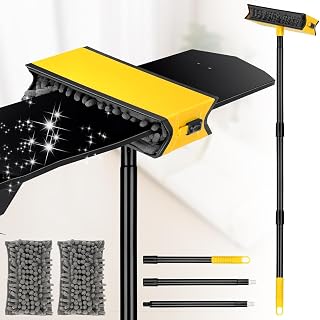
- Head geometry: A U-shaped or dual-sided pocket sleeve captures both blade faces in one pass, cutting your total arm-raise count roughly in half. Bendable gooseneck necks matter more for reaching over furniture than for fans themselves.
- Fiber quality and washability: Cheap split microfiber sheds within a few laundry cycles and starts pushing dust instead of trapping it. Chenille and dense woven microfiber survive machine washing; check whether the sleeve seams are stitched or heat-bonded, since bonded seams fail first.
- Grip ergonomics: A handle around one inch in diameter with a slight taper lets you hold a neutral wrist. Bare narrow tubing forces a pinch grip that fatigues the forearm fast, so foam or textured overmolding is worth paying for.
The Best Ceiling Fan Dusters Reviewed
DRQ Reusable Microfiber Fan Duster
The 13-to-48-inch pole keeps the load close to your center of mass, which makes this the least fatiguing option for standard eight-foot ceilings where you don’t need extreme reach. The removable microfiber sleeve washes well and the sheathed head slips over blade tips cleanly, though very wide blades will need a second angled pass.
Eyliden 68″ Adjustable Fan Duster
At 0.75 pounds this is the standout for anyone with shoulder or wrist sensitivity, and the 360-degree dual-sided head means you clean top and bottom without repositioning. The tradeoff for that low mass is modest pole rigidity, so use smooth controlled strokes rather than scrubbing pressure.
DELUX Extendable Microfiber Duster
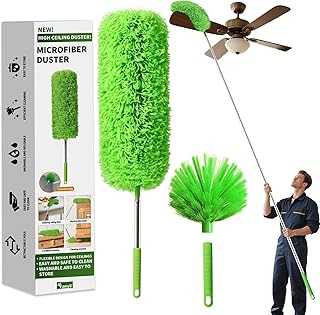
The 100-inch pole and bendable head make this the pick for vaulted ceilings and awkward angles where a straight tool simply cannot reach the blade surface. Keep both hands on the pole at full extension; the leverage is significant, and the bendable neck should be set before you raise it, not adjusted overhead.
CLDREAM Fan Blade Cleaner with 3Ft Pole
The chenille pads are the durability story here, holding their loft and grabbing greasy kitchen-adjacent dust better than flat microfiber. The three-foot pole limits it to lower ceilings, but for renters and apartment fans it’s a compact, well-built choice that stores in a closet gap.
12pcs Microfiber Duster Set with Stainless Pole
The stainless telescoping pole extends from 30 to 100 inches with noticeably less whip than aluminum equivalents, and the twelve washable heads mean you rotate in a clean sleeve instead of nursing a worn one. It’s the best long-term value if you clean multiple fans, vents, and blinds on a schedule.
Frequently Asked Questions
How often should I dust ceiling fan blades?
Every four to six weeks in normal conditions, and monthly if you run the fan year-round or have pets. Frequent light passes take seconds and prevent the compacted layer that requires damp cleaning.
Can I wash microfiber duster sleeves in a machine?
Yes, on cold with a mild detergent and no fabric softener, which coats fibers and destroys their electrostatic grab. Air dry rather than tumble dry to preserve the split-fiber structure.
Do I need a separate cobweb duster?
If you have high corners or exposed beams, a dedicated cobweb head with a stiff corner brush works far better than soft microfiber, which just smears webbing. Many telescoping sets include both heads on a shared pole.
Should the fan be off while cleaning?
Always, and let the blades come to a complete stop. Contact with a moving blade can snap a pole or pull the tool from your hands.
Final Thoughts
For most homes the Eyliden 68″ is the smartest ergonomic buy, delivering dual-sided coverage at a weight that spares your shoulders. Choose the DELUX extendable if vaulted ceilings are your real problem, or the 12-piece stainless pole set if you want a rigid, rotate-and-wash system that will still be working several years from now.