Key takeaways
- Window fit: Measure the clear opening, not merely the frame’s advertised size. Casement units need adequate height, width, depth, and a stable surface for their support hardware.
- Cooling capacity: Match BTUs to the room rather than choosing the largest model available. Oversizing can cause short cycling, uneven temperatures, and unnecessary wear on the compressor.
- Installation load: Check whether the unit requires a dedicated bracket, side panels, or supplemental support. A heavier appliance deserves a load path that does not rely solely on the window sash.
- Controls and comfort: Remote controls, timers, sleep modes, and adjustable fan speeds reduce reaching, repeated bending, and nighttime disruption. A thermostat that senses room temperature near the user can improve comfort.
- Maintenance: Look for an accessible filter, clear drainage guidance, and a durable cabinet. Clean the filter regularly and inspect seals each season to protect efficiency and the surrounding wall or sill.
What's inside
Casement windows create a frustrating air-conditioning problem: many window units are built for wide, vertically sliding openings, while crank-out windows leave limited support and sealing options. A unit that technically fits can still vibrate, leak warm air, strain the frame, or become difficult to remove at the end of the season.
This guide evaluates the listed models through an ergonomics-and-durability lens. We consider cooling coverage, controls, installation practicality, operating noise, window compatibility, and the long-term demands placed on sashes, brackets, seals, and nearby furniture. Always confirm the opening dimensions and manufacturer installation requirements before ordering.
As an Amazon Associate we earn from qualifying purchases.



How to Choose a Casement Window Air Conditioner (2026)
- Window fit: Measure the clear opening, not merely the frame’s advertised size. Casement units need adequate height, width, depth, and a stable surface for their support hardware.
- Cooling capacity: Match BTUs to the room rather than choosing the largest model available. Oversizing can cause short cycling, uneven temperatures, and unnecessary wear on the compressor.
- Installation load: Check whether the unit requires a dedicated bracket, side panels, or supplemental support. A heavier appliance deserves a load path that does not rely solely on the window sash.
- Controls and comfort: Remote controls, timers, sleep modes, and adjustable fan speeds reduce reaching, repeated bending, and nighttime disruption. A thermostat that senses room temperature near the user can improve comfort.
- Maintenance: Look for an accessible filter, clear drainage guidance, and a durable cabinet. Clean the filter regularly and inspect seals each season to protect efficiency and the surrounding wall or sill.
The Best Casement Window Air Conditioner (2026)s Reviewed
Perfect Aire 10,000 BTU Casement Window Air Conditioner
The Perfect Aire is the most directly targeted option here for sliding or crank-out windows, with a stated 450-square-foot cooling range and a compact casement-oriented profile. Its remote with Follow Me, LED display, timer, and manageable controls make it a sensible choice for bedrooms or living spaces where temperature consistency matters. Confirm the listed 23.5-inch height and 14.75-inch width against the actual opening before purchase.
ELEMENT 10,000 BTU Casement Window Air Conditioner
ELEMENT’s 10,000-BTU casement design is a straightforward pick for shoppers who want a dedicated window appliance without an oversized feature set. Its appeal is simplicity: fewer functions can mean fewer opportunities for control confusion, but buyers should pay particular attention to included mounting hardware, support requirements, and service access before installation.
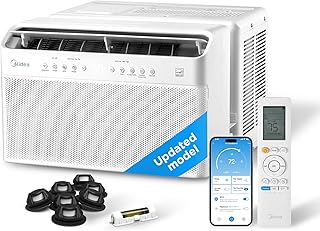
Midea 10,000 BTU U-Shaped Smart Inverter Window Air Conditioner
The Midea U-shaped model takes a different approach, leaving more of the window opening available and using inverter operation to prioritize quieter, steadier performance. Smart-home compatibility with Alexa and Google Assistant can reduce physical interaction, especially when the unit is installed above shoulder height. Its design may be attractive for certain window layouts, but casement-window compatibility must be verified rather than assumed.
BLACK+DECKER 12,000 BTU Window Air Conditioner
With a stated coverage area of up to 550 square feet, this BLACK+DECKER unit is aimed at larger rooms or spaces with greater heat gain. Three cooling speeds, fan-only operation, and a remote provide useful day-to-day flexibility. Because higher-capacity window units can be heavy, assess the sill, bracket, and frame condition carefully; it may be better suited to a compatible sliding-window installation than a conventional crank-out window.
Air Choice 10,000 BTU Portable Air Conditioner
Although it is not a traditional casement window unit, the Air Choice portable AC is a practical fallback when a window-mounted appliance cannot be safely supported. Its remote, sleep mode, 24-hour timer, dehumidifier, and fan functions are ergonomically convenient, while the exhaust hose can be adapted to some casement-window kits. Expect more floor-space use and a less streamlined installation than with a purpose-built window model.
Frequently Asked Questions
Can a standard window air conditioner fit a casement window?
Usually not without modification. Most standard units are designed for horizontal sliding windows, whereas casement windows open outward and lack the broad lower track used to support conventional units. A purpose-built casement model or a portable AC with a suitable window panel is generally safer.
How do I measure for a casement air conditioner?
Measure the clear opening at several points, noting the smallest height and width. Also measure the available sill depth and the space outside the window for the cabinet, bracket, and exhaust path. Compare those figures with the installation manual, not just the product listing.
Is a portable AC better for a crank-out window?
It can be easier to install because the main appliance remains on the floor and only the exhaust panel occupies the window opening. However, the hose, sealing panel, and floor footprint require planning, and a poorly sealed panel can reduce cooling efficiency.
How can I reduce vibration and protect the window?
Use the manufacturer’s support hardware, keep the unit level as directed, and never improvise with unstable shelves or furniture. Inspect the sill and frame for rot before installation, tighten fasteners without crushing the frame, and replace compressed weatherstripping when necessary.
Final Thoughts
The Perfect Aire is the strongest starting point for a true casement-window installation, while the ELEMENT offers a simpler dedicated alternative. For layouts that cannot safely support a window unit, the Air Choice portable model is the more adaptable fallback; the Midea is worth considering when its U-shaped design and smart controls match your window configuration.