Key takeaways
- Measure your rack, then subtract: Interior width is not usable width. Leave at least an inch of total clearance so the tray clears the rails and the door gasket without you tilting it. A 15.5-inch tray in a 16-inch cavity is a daily annoyance.
- Handle clearance over handle looks: Look for handles that stand proud of the rim with roughly an inch of vertical gap underneath. That gap is where an oven mitt goes. Stamped tabs pressed flat to the frame force a pinch grip, which is exactly the grip that fails when you are carrying two pounds of wings.
- Frame rigidity beats coating claims: Press the center of the mesh with your thumb once it arrives. If the panel oil-cans or the perimeter bows, the tray will sag under load and warp with heat cycling. Heavier gauge stainless and a fully welded or double-rolled perimeter hold their shape far longer than tack-welded thin stock.
- Mesh aperture and weld count: Tighter apertures hold fries and vegetables without parchment; wider ones drain fat faster but drop small food. Either way, count the attachment points around the rim. More joins mean less flex at the corners, which is where these trays usually fail first.
- Plan for the dishwasher, expect to hand wash: Nonstick surfaces on perforated steel take a beating from detergent and high-heat drying cycles. Bare or lightly coated stainless with a smooth finish survives abrasive cleanup better, and parchment inserts extend any coating’s life considerably.
What's inside
Most people buy an oven air fry set because they want crisp results without another countertop appliance. What they rarely think about is the moment that actually matters: reaching into a 400°F oven with a mitt on and lifting a loaded tray out at arm’s length. That single motion exposes every design flaw a pan has. Thin gauge steel flexes and dumps food. Handles that sit flush against the rim leave no room for padded fingers. Rolled edges that were never fully finished catch on the oven rack and force a wrist twist you can feel the next morning. The crisping performance is usually fine across the category. The handling and the lifespan are where sets separate.
This guide looks at oven air fryer baskets through a durability and body-mechanics lens: how much the frame deflects under weight, whether the handle geometry gives real mitt clearance, how the mesh is joined to the perimeter, and how the pan behaves after fifty or sixty high-heat cycles rather than five. Sizing gets attention too, since a tray that overhangs your rack rails by even half an inch turns every removal into a two-handed negotiation. Below are six sets worth considering in 2026, followed by the criteria I’d use to pick between them.
As an Amazon Associate we earn from qualifying purchases.




How to Choose a Air Fryer Pan For Oven (2026)
- Measure your rack, then subtract: Interior width is not usable width. Leave at least an inch of total clearance so the tray clears the rails and the door gasket without you tilting it. A 15.5-inch tray in a 16-inch cavity is a daily annoyance.
- Handle clearance over handle looks: Look for handles that stand proud of the rim with roughly an inch of vertical gap underneath. That gap is where an oven mitt goes. Stamped tabs pressed flat to the frame force a pinch grip, which is exactly the grip that fails when you are carrying two pounds of wings.
- Frame rigidity beats coating claims: Press the center of the mesh with your thumb once it arrives. If the panel oil-cans or the perimeter bows, the tray will sag under load and warp with heat cycling. Heavier gauge stainless and a fully welded or double-rolled perimeter hold their shape far longer than tack-welded thin stock.
- Mesh aperture and weld count: Tighter apertures hold fries and vegetables without parchment; wider ones drain fat faster but drop small food. Either way, count the attachment points around the rim. More joins mean less flex at the corners, which is where these trays usually fail first.
- Plan for the dishwasher, expect to hand wash: Nonstick surfaces on perforated steel take a beating from detergent and high-heat drying cycles. Bare or lightly coated stainless with a smooth finish survives abrasive cleanup better, and parchment inserts extend any coating’s life considerably.
The Best Air Fryer Pan For Oven (2026)s Reviewed
OPENICE Oven Air Fryer Basket and Tray Set
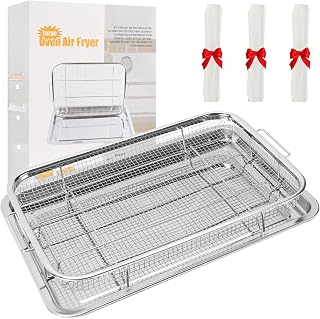
At 15.3 by 11 inches, this is the sweet spot for standard 30-inch wall ovens and most countertop convection units, and the stainless build resists the corner warping that plagues lighter trays. The included 30 parchment sheets are a sensible starter supply, though the real appeal is a rim stiff enough that the basket lifts flat rather than folding.
DEGOVIN Crisper Tray Two-Set with Cooking Guide
Having a large and a medium in the same stack means you are not hauling a full-width tray for two chicken thighs, which meaningfully reduces the load you carry across the kitchen. The nonstick finish releases cleanly, and the printed cooking guide is genuinely useful for dialing in convection times on the smaller pan.
15.5″ x 11.6″ Stainless Air Fryer Basket and Pan
The 100-sheet parchment supply is the standout here, since paper liners are the single best way to protect a nonstick perforated surface over years of use. Verify your rack depth before ordering, as 11.6 inches is generous and leaves less wiggle room on compact ovens.
DEGOVIN Three-Piece Air Fryer Pan and Tray Set
The 18.8-inch pan is aimed at full-size ovens and sheet-pan-scale batches, and it needs two hands regardless of how good the handles are, so treat it as a weekend tool rather than a weeknight one. The 12.8-inch member of the set is the one you will reach for most, and it handles like a proper single-serving basket.
THORSES Stainless Air Fryer Rack and Crisper Tray
The dark finish hides the browning and discoloration that eventually shows on bare stainless, and the food-grade steel holds a flat profile through repeated high-heat cycles. Two sizes plus 60 parchment sheets makes this an easy default recommendation for anyone starting from nothing.
Frequently Asked Questions
Do I need a special pan to air fry in a regular oven?
You need airflow underneath the food, which is what a perforated basket sitting in a catch pan provides. A solid sheet pan traps steam against the underside and gives you soft, pale results no matter how hot the oven runs.
Will these trays warp at high temperatures?
Thin-gauge trays often do, usually as a slow bow across the long axis. Heavier stainless with a rolled or welded perimeter resists it, and avoiding cold-water quenching on a hot tray helps considerably.
Is the parchment necessary?
Not for function, but it protects nonstick coatings from spatula abrasion and cuts scrubbing time dramatically. On bare stainless it mainly saves cleanup effort rather than the pan itself.
What about the Ninja drip tray replacement?
The GXF crumb tray for Ninja DT201 and DT251 Foodi XL Pro ovens is a repair part, not a crisping accessory. If your original grease pan is pitted or warped, replacing it restores proper drainage and stops smoke, and the reusable liners make routine cleanup a two-minute job.
Final Thoughts
For most kitchens, the THORSES two-set is the best-balanced pick: rigid steel, a forgiving dark finish, and two sizes so you match the tray to the batch instead of over-lifting. The OPENICE set is the one to choose if your oven cavity is tight and you want a single well-built tray in the standard 15.3-inch footprint, while the DEGOVIN two-set earns its place for anyone who cooks small portions often and wants a lighter pan in easy reach. Ninja Foodi XL Pro owners should look at the GXF drip tray separately, since a sound grease pan does more for daily performance than any new basket will.