Key takeaways
- Match CFM to cubic volume, not floor area: Square footage charts ignore ceiling height. A 12-foot shop ceiling needs roughly double the airflow of an 8-foot room with the same footprint, so size by volume and target 4 to 6 air changes per hour.
- Insist on a DC or PMSM motor: Brushless DC and permanent-magnet synchronous motors draw a fraction of the wattage of AC induction motors at equivalent airflow, run cooler, and shed the electrical hum that causes listening fatigue over long sessions.
- Check usable speed, not peak speed: Ask which setting you’ll realistically run. A fan that moves 7,000 CFM on speed four is more valuable than one that hits 8,000 on speed six and becomes unbearable there.
- Scrutinize blades and hardware: Extruded aluminum resists warping and moisture far better than MDF or laminated plywood. Look for through-bolted blade irons, a properly sized hanging ball, and multiple downrod lengths so you can dial in clearance instead of accepting a compromise.
- Plan for maintenance access: Sealed bearings, a serviceable capacitor bay, and remote receivers housed in the canopy rather than buried behind the blades all reduce ladder time later. Damp ratings matter for garages and covered patios even when rain never touches the fan.
What's inside
Airflow numbers are the most abused spec in the ceiling fan category. A manufacturer can publish a peak CFM figure measured at maximum speed, then pair it with a motor that hums audibly at that setting, a blade set that flutters after two summers, and a downrod that transmits every vibration straight into the joist. The buyer ends up running the fan at speed three forever, which means they paid for airflow they never use and inherited a noise floor they can’t escape.
This guide evaluates high-CFM ceiling fans the way a durability engineer would: sustained airflow at livable noise levels, motor type and bearing longevity, blade material and mounting hardware, and how comfortable the fan actually is to live under and service. Below you’ll find picks spanning 52-inch bedroom fans to 120-inch HVLS units for shops and warehouses, with notes on where each one earns its keep.
As an Amazon Associate we earn from qualifying purchases.




How to Choose a/an Cfm Ceiling Fan (2026)
- Match CFM to cubic volume, not floor area: Square footage charts ignore ceiling height. A 12-foot shop ceiling needs roughly double the airflow of an 8-foot room with the same footprint, so size by volume and target 4 to 6 air changes per hour.
- Insist on a DC or PMSM motor: Brushless DC and permanent-magnet synchronous motors draw a fraction of the wattage of AC induction motors at equivalent airflow, run cooler, and shed the electrical hum that causes listening fatigue over long sessions.
- Check usable speed, not peak speed: Ask which setting you’ll realistically run. A fan that moves 7,000 CFM on speed four is more valuable than one that hits 8,000 on speed six and becomes unbearable there.
- Scrutinize blades and hardware: Extruded aluminum resists warping and moisture far better than MDF or laminated plywood. Look for through-bolted blade irons, a properly sized hanging ball, and multiple downrod lengths so you can dial in clearance instead of accepting a compromise.
- Plan for maintenance access: Sealed bearings, a serviceable capacitor bay, and remote receivers housed in the canopy rather than buried behind the blades all reduce ladder time later. Damp ratings matter for garages and covered patios even when rain never touches the fan.
The Best Cfm Ceiling Fan (2026)s Reviewed
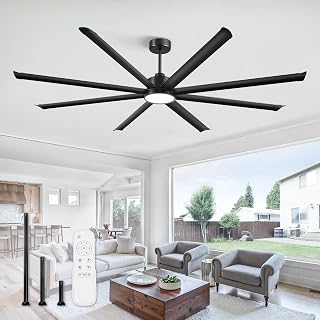
AA-Orion 120″ HVLS Industrial Ceiling Fan
The PMSM motor is the differentiator here: it delivers north of 28,000 CFM while spinning slowly enough that the airflow reads as a steady breeze rather than turbulent gusting, which is exactly what you want over a gym floor or workbench. Six speeds and a reversible direction give you a genuine winter destratification mode, and the low RPM operation means dramatically less bearing wear per hour of runtime.
120 Inch Extra Large Industrial Ceiling Fan
Six heavy-gauge silver aluminum blades and three included downrods make this the most adaptable large-format option for shops and garages with awkward truss geometry. The quiet DC motor holds its composure at mid-range speeds, and the blade set’s mass acts as a flywheel, smoothing out the pulsing you often feel under lighter fans of this diameter.
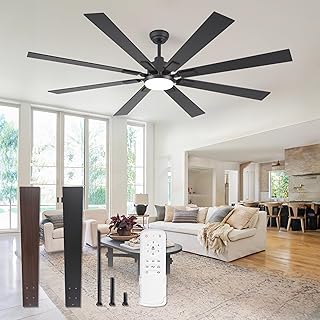
ZMISHIBO 96 Inch Ceiling Fan with Lights
Eight reversible aluminum blades spread the load across more mounting points, which pays off in reduced vibration over the long haul. The damp rating and 3CCT lighting make it a practical single-fixture solution for gazebos and covered patios where you want serious air movement plus usable light without adding a second circuit.
ZMISHIBO 72″ Ceiling Fan with Lights
This is the sweet spot for large living rooms and deep patios: enough sweep to circulate a big volume, but low enough profile that it doesn’t visually dominate the ceiling. The dual-finish housing and 24W 3CCT LED handle the aesthetics, while the quiet DC motor keeps the fan usable during conversation or television at any speed.
60 in Ceiling Fan with 7400+ CFM and Mute Remote
Three-blade designs generally trade efficiency for reach, but this one hits 7,400+ CFM with a noiseless reversible DC motor, making it a strong pick for medium indoor rooms where the fan runs overnight. The timer and CCT control are the ergonomic wins, letting you set it and forget it rather than climbing out of bed to adjust.
Frequently Asked Questions
How much CFM do I actually need?
For an average 8-foot-ceiling bedroom, 4,000 to 6,000 CFM is ample. Great rooms and covered patios want 7,000 to 10,000. Shops, barns, and warehouses with high ceilings are a different category entirely, which is where HVLS fans in the 20,000-plus range come in.
Are DC motors worth the premium?
Yes, on both energy and longevity grounds. They typically consume 60 to 70 percent less power for the same airflow, run cooler, and offer finer speed granularity, which means you spend more time at a comfortable setting and less time at the extremes that accelerate wear.
Can these fans go on a covered porch?
Only if they carry a damp or wet rating. Damp-rated fans like the ZMISHIBO models suit covered locations with no direct water contact. Direct exposure requires a wet rating, and using an indoor-rated fan outdoors will corrode bearings and blade hardware quickly.
Why does my fan wobble, and does it matter?
Wobble usually traces to an unseated hanging ball, uneven blade weight, or a loose junction box. It matters because repeated lateral stress fatigues the downrod connection over time. Balance the blades, verify the box is fan-rated, and confirm the ball is fully seated in the canopy.
Final Thoughts
For large commercial and shop spaces, the AA-Orion 120″ HVLS is the durability standout thanks to its PMSM motor and low-RPM operation. Residential buyers with big rooms or covered patios should look hard at the ZMISHIBO 72″, which balances real airflow against a livable noise floor, while the 60-inch 7,400+ CFM model is the smarter pick for bedrooms and mid-sized living areas where overnight quiet is non-negotiable.