Key takeaways
- Load rating with headroom: Aim for a stated capacity of at least three times your combined sleeping weight plus the mattress. Published figures are static ratings measured on level floors; real use adds impact and edge loading, so headroom is not overkill.
- Center support that reaches the floor: A center rail is only useful if vertical legs carry it down to the ground. Two or three floor-contacting center legs prevent the mid-frame dip that ruins mattresses and lower backs.
- Slat spacing under three inches: Wide gaps let foam and hybrid mattresses bulge downward between supports, creating pressure ridges and voiding many warranties. Tighter spacing spreads load and preserves the comfort layers.
- Joint design and hardware: Welded corners and thick-gauge steel outperform thin tubing held by a single bolt. Look for double bolts at each junction, and plan on retorquing the hardware after the first month of use.
- Deck height for easy transfers: With your mattress on top, the sleep surface should sit roughly level with the crease behind your knee. Fourteen to eighteen inches of frame height suits most mattresses and makes standing up dramatically easier on the knees and hips.
What's inside
Most bed frame failures don’t announce themselves. They start as a faint tick when you roll over, progress to a sag under the hips, and end with a bent center rail or a slat that has quietly walked out of its bracket. For sleepers carrying more weight, that timeline compresses fast, because the loads at play are rarely the calm, evenly spread numbers printed on the box. Sitting on the edge to put on shoes concentrates several hundred pounds onto a few inches of side rail. Dropping onto the mattress at the end of a long day multiplies static weight by two or three in an instant. Frames engineered around gentle, distributed loading simply aren’t built for that reality.
This guide looks at bed frames through an ergonomics-and-durability lens: where the stress actually travels, which joints tend to loosen first, how slat spacing affects mattress life, and why deck height matters as much as load rating for comfortable sit-to-stand transfers. Below are six frames worth a serious look in 2026, followed by the specifications I’d check before buying anything.
As an Amazon Associate we earn from qualifying purchases.



How to Choose a Bed Frame For Fat Person (2026)
- Load rating with headroom: Aim for a stated capacity of at least three times your combined sleeping weight plus the mattress. Published figures are static ratings measured on level floors; real use adds impact and edge loading, so headroom is not overkill.
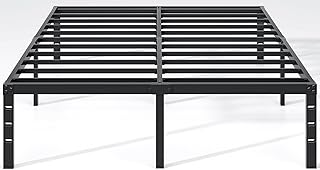
- Center support that reaches the floor: A center rail is only useful if vertical legs carry it down to the ground. Two or three floor-contacting center legs prevent the mid-frame dip that ruins mattresses and lower backs.
- Slat spacing under three inches: Wide gaps let foam and hybrid mattresses bulge downward between supports, creating pressure ridges and voiding many warranties. Tighter spacing spreads load and preserves the comfort layers.
- Joint design and hardware: Welded corners and thick-gauge steel outperform thin tubing held by a single bolt. Look for double bolts at each junction, and plan on retorquing the hardware after the first month of use.
- Deck height for easy transfers: With your mattress on top, the sleep surface should sit roughly level with the crease behind your knee. Fourteen to eighteen inches of frame height suits most mattresses and makes standing up dramatically easier on the knees and hips.
The Best Bed Frame For Fat Person (2026)s Reviewed
ROIL 18 Inch Queen Bed Frame
The four mattress baffles are the detail I appreciate most here, since they stop lateral creep that otherwise grinds the mattress cover against steel every night. Combine the 3,500-pound rating with rounded corners and 16 inches of usable clearance underneath, and this is the frame I’d point most heavier sleepers toward first.
Upcanso 16 Inch Queen Bed Frame
Upcanso’s closely spaced steel slats do the quiet work of load distribution, which is exactly what keeps a foam mattress from developing a hip-level trough. The 16-inch deck lands in the sweet spot for comfortable transfers without needing a step or a running start.
JETO 14 Inch Metal Bed Frame
A straightforward heavy-duty platform that skips the box spring and keeps the assembly steps minimal, which matters when you’re wrestling a queen frame alone. The 14-inch profile suits taller mattresses well and still leaves genuine storage room beneath.
Maenizi 14 Inch Full Size Bed Frame
Rated to 3,000 pounds in a full footprint, this is a sensible pick for solo sleepers or smaller rooms where a queen won’t fit. Noise-free brackets keep the metal-on-metal fretting that plagues cheap frames from ever starting.
Mellow Naturalista Classic 12 Inch
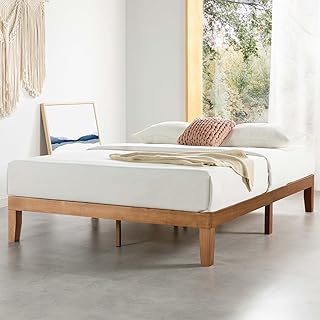
Solid pine with wooden slats behaves differently from steel: it flexes slightly and dampens movement rather than transmitting it. Just note the 12-inch height sits lower than the metal options, so pair it with a thicker mattress if easy standing is a priority.
Frequently Asked Questions
Are the advertised weight capacities trustworthy?
Treat them as static laboratory figures, not guarantees. They assume even distribution, correct assembly, and a flat floor, so buying well above your actual requirement is the practical move.
Do I still need a box spring?
No. Every frame here is a platform design with integrated slats, and adding a box spring only raises the surface and introduces another component that can compress unevenly.
Why does my frame squeak, and can I fix it?
Squeaks usually come from bolts that have loosened slightly, letting steel rub steel. Retorque all hardware, and add adhesive felt pads at slat contact points if noise persists.
What size should I choose for a couple?
Queen is the practical minimum; a full XL like the Lutown-Teen frame works better for one person needing extra length than for two sharing space.
Final Thoughts
If durability under real-world loading is the deciding factor, the ROIL 18 Inch frame earns the top spot for its baffled deck, high capacity, and transfer-friendly height, with the Upcanso 16 Inch a close second thanks to its tightly spaced slats. For a warmer, quieter feel with less steel in the room, the Mellow Naturalista Classic is the one to consider, provided you pair it with a taller mattress.