Key takeaways
- A U-shaped or dual-sided sleeve that closes around blade thickness without needing pressure to stay seated.
- Split or fluffy microfiber rather than tightly woven cloth; split fibers trap and hold particles instead of pushing them off the edge.
- A pivoting or bendable neck so you can match the blade’s pitch angle without rotating your forearm. The Storystore Adjustable Microfiber Duster and bendable options such as the 3 Pcs Fan Cleaning Brush Bendable Cobweb Duster handle awkward angles well.
- A removable head — washability is the whole value proposition of reusable microfiber.
What's inside
Ceiling fan blades collect dust in a way few other surfaces do: they sit in still air for most of the year, carry a light static charge from motion, and face upward where nothing disturbs the buildup. Then you flip the switch and that layer becomes airborne, settling on bedding, screens, and the tops of your furniture. From a durability standpoint, the cost is quieter but real — caked dust on one blade more than another creates a small imbalance, and an imbalanced fan works its downrod bearings and mounting bracket harder over thousands of hours of runtime.
The other half of the problem is your body. Most people clean fans from a ladder or a dining chair, arms overhead, neck extended, one hand gripping for balance. That posture is the single riskiest thing about a five-minute chore. This guide covers a floor-based method that spares your shoulders and cervical spine, how to read a duster’s specs for reach and stiffness, what separates a tool that survives fifty washes from one that sheds after five, and a maintenance rhythm that keeps buildup from ever getting stubborn.
As an Amazon Associate we earn from qualifying purchases.



Work From the Floor, Not From a Ladder
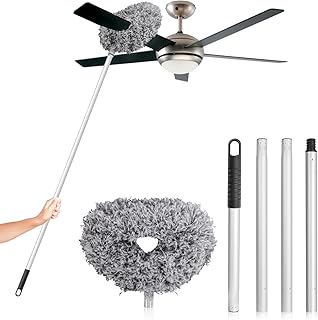
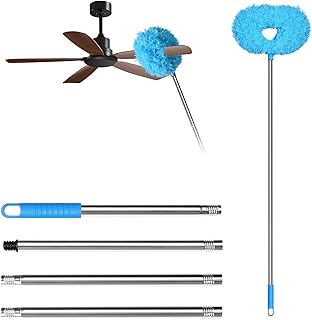
The fundamental shift is treating this as a reach task rather than a climb task. An extendable microfiber sleeve on a telescoping pole lets you stand with your feet planted, elbows below shoulder height, and eyes forward instead of craned upward. Extension models like the DRQ Ceiling Fan Cleaner Duster or the FONUNO Ceiling Fan Blade Cleaner adjust from roughly 13 inches to just under 50, which covers standard 8-foot ceilings comfortably and most 9-foot ceilings if you are of average height. For vaulted or stairwell installations, the Eyliden 68″ Adjustable Ceiling Fan Duster buys you meaningful extra reach, and at three quarters of a pound it does not turn into a lever that strains your wrist at full extension.
Choose a Head That Wraps Both Faces at Once
A flat duster forces you to do each blade twice — once on top, once underneath — doubling your overhead time. A sleeve or pocket-style head slides over the blade and grips both surfaces in one pass. Look for these traits:
- A U-shaped or dual-sided sleeve that closes around blade thickness without needing pressure to stay seated.
- Split or fluffy microfiber rather than tightly woven cloth; split fibers trap and hold particles instead of pushing them off the edge.
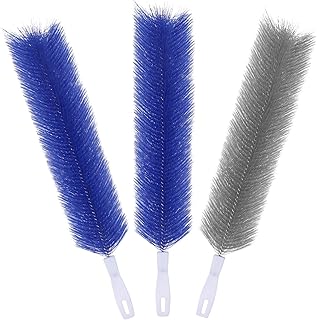
- A pivoting or bendable neck so you can match the blade’s pitch angle without rotating your forearm. The Storystore Adjustable Microfiber Duster and bendable options such as the 3 Pcs Fan Cleaning Brush Bendable Cobweb Duster handle awkward angles well.
- A removable head — washability is the whole value proposition of reusable microfiber.
Judge Durability at the Joints, Not the Fabric
Microfiber rarely fails first. Telescoping poles fail at the twist-lock collars, and heads fail where the fabric meets the plastic frame. Before you commit to a tool, extend it fully and press sideways: a collar that slips under light lateral load will slip when you are pushing dust off a blade. Check whether the head attaches by a wide friction collar or an elastic band, since elastic perishes fast in warm cupboards. Poles that flex slightly are fine, even preferable — rigidity in a long lightweight tube usually means brittleness. What you do not want is a pole that visibly bows enough to lose contact with the blade, which forces you to compensate by lifting your arms higher.
The Sequence That Keeps Dust Off Your Furniture
Turn the fan off and wait for it to stop fully; a coasting blade will snatch a duster head. Lay an old sheet over the bed or sofa below — this takes ten seconds and saves you a vacuuming session. Work each blade from the motor housing outward, following the direction the dust settled, and let the sleeve carry material rather than flicking it. Do all four or five blades before you shake anything out. Finish with the motor housing and the light kit, then take the head outside, shake it firmly, and wash it in warm water with a little detergent. Skip fabric softener; it coats the fibers and kills their grab.
Set a Cadence Matched to Your Home
Monthly is right for most homes. Every two weeks makes sense if you run the fan year-round, have shedding pets, live near a construction site or unpaved road, or have anyone in the house with dust sensitivity. Short frequent passes are far easier on your shoulders than a quarterly deep clean, and they keep the film from bonding into the sticky grey crust that requires a damp cloth and real pressure to shift.
Tips
- Extend the pole only as far as the job needs. Every extra inch multiplies the torque your wrist absorbs.
- Keep two heads in rotation so one can air-dry fully. Damp microfiber stored compressed grows mildew and starts to smell.
- If dust has hardened, mist the sleeve lightly with water rather than spraying the blade — liquid running toward the motor is a real risk.
- Give the blades a look for wobble while you are up close. Uneven dust that returns fast on one blade often points to a loose blade screw.
Frequently Asked Questions
Can I use one of these dusters on other surfaces?
Yes, and it is the main reason to buy a good one. The same sleeve handles wall corners, door frames, tops of wardrobes, blinds, and vent grilles. Multi-surface tools tend to earn their storage space where single-purpose ones do not.
Do I need to shut off the breaker?
Not for dry dusting with the fan switched off. Kill the power at the breaker if you are removing a light shade, using any moisture, or working near exposed wiring.
How many washes should a microfiber head survive?
A well-made head handles 50 or more warm-water washes before it loses grab. Air-dry it rather than tumble-drying, since heat melts the fine split fibers that do the actual capturing.
Is a bendable brush better than a rigid pole?
They solve different problems. Rigid telescoping poles give you controlled pressure across a whole blade. Bendable brushes get into vents, behind blade brackets, and around light fixtures. Many people end up owning both.
Conclusion
The best way to dust a ceiling fan in 2026 is unglamorous: stand on the floor, use a sleeve-style microfiber head on a pole sized for your ceiling, work outward from the motor, and repeat monthly before buildup gets a grip. Choose the tool for its locking collars and washable head rather than its fluff, protect your neck and shoulders by keeping the work below eye strain territory, and your fan will run quieter and last longer for it.