Key takeaways
- Verify the load rating, not the label: “Fan rated” is a floor, not a spec. Match the printed static rating to your fan’s dry weight plus any light kit and glass, and leave margin — a 50 lb rating on a 38 lb fan is comfortable, on a 48 lb fan it is not.
- Match the box to the access you have: Open joists during a remodel let you nail or screw directly to framing. A finished ceiling with a single 4-inch hole calls for an expanding brace bar, which you feed through the opening and ratchet outward until the feet bite into the joists.
- Check depth against your wiring volume: Shallow pans are fine for two-conductor runs with a ground, but stuffing three cables plus a receiver into a half-inch-deep box means fighting the conductors during install and stressing insulation long-term. Depth-adjustable designs solve this without a drywall repair.
- Look at the threads and the fastener path: Steel boxes with tapped, reinforced screw bosses hold torque far better under vibration than thin stamped tabs. Anything you have to hold overhead while starting a machine screw one-handed should have generous, chamfered thread entries.
- Weatherproofing for anything not fully conditioned: Covered patios, breezeways, and screened porches see humidity swings and UV bounce. Non-metallic weatherproof housings with reducer bushings and gasketed connections resist corrosion where galvanized steel will eventually bloom.
What's inside
A ceiling fan is the only fixture in most homes that hangs from the structure and then shakes itself for a decade straight. That combination punishes shortcuts. The pancake box left over from a flush-mount light was never engineered for the cyclical load a 52-inch fan generates, and the failure mode is rarely dramatic at first: a faint tick on high speed, a hairline crack in drywall compound, a canopy that drifts a quarter inch off the ceiling. By the time the wobble is obvious, the fasteners have already been working loose for months. Buyers get stuck here because the box that came with the house looks fine, the fan manufacturer’s instructions say “fan-rated outlet box” without explaining what that means, and the whole assessment has to happen with your arms over your head on a ladder.
This guide looks at ceiling fan boxes through two lenses that matter once you are actually on the ladder: how the assembly behaves under repeated dynamic load over years, and how much strain it takes to install correctly on the first attempt. Overhead work degrades fast — grip weakens, alignment slips, and fatigue is what turns a solid box into an under-torqued one. Below are the models worth considering for 2026, from depth-adjustable new-construction boxes to retrofit braces that expand between joists through an existing 4-inch hole, plus outdoor-rated options for covered porches.
As an Amazon Associate we earn from qualifying purchases.


How to Choose a/an Electrical Box For Ceiling Fan (2026)
- Verify the load rating, not the label: “Fan rated” is a floor, not a spec. Match the printed static rating to your fan’s dry weight plus any light kit and glass, and leave margin — a 50 lb rating on a 38 lb fan is comfortable, on a 48 lb fan it is not.
- Match the box to the access you have: Open joists during a remodel let you nail or screw directly to framing. A finished ceiling with a single 4-inch hole calls for an expanding brace bar, which you feed through the opening and ratchet outward until the feet bite into the joists.
- Check depth against your wiring volume: Shallow pans are fine for two-conductor runs with a ground, but stuffing three cables plus a receiver into a half-inch-deep box means fighting the conductors during install and stressing insulation long-term. Depth-adjustable designs solve this without a drywall repair.
- Look at the threads and the fastener path: Steel boxes with tapped, reinforced screw bosses hold torque far better under vibration than thin stamped tabs. Anything you have to hold overhead while starting a machine screw one-handed should have generous, chamfered thread entries.
- Weatherproofing for anything not fully conditioned: Covered patios, breezeways, and screened porches see humidity swings and UV bounce. Non-metallic weatherproof housings with reducer bushings and gasketed connections resist corrosion where galvanized steel will eventually bloom.
The Best Electrical Box For Ceiling Fan (2026)s Reviewed
Southwire MSBFAN Depth-Adjustable Fan Box
The 50 lb fan and 75 lb fixture ratings give you real headroom on mid-size fans, and the depth adjustment is the ergonomic standout here — you set the box flush to finished ceiling thickness instead of shimming blind. Solid choice when drywall is off and you want one box that covers fans, heavy fixtures, and future changes of mind.
RACO RETRO-BRACE 936 Old-Work Fan Box
Purpose-built for the worst version of this job: an existing 4-inch hole, no attic access, and no interest in patching plaster. The brace spans 16 to 24 inch joist bays and supports 35 to 70 lb, and the 1.5-inch depth means you are not wrestling conductors while your shoulders burn.
Fan Brace Electrical Box and Support Bar
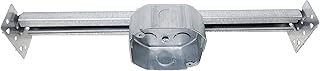
A straightforward box-and-bar combination that works for both new runs and remodels, transferring load into framing rather than into ceiling board. The bar geometry keeps the box centered as it expands, which saves the small corrections that eat time overhead.
Hubbell-Bell PRCF57550GY Outdoor Fan Box
Weatherproof PVC with three reducer bushings and a 45-degree mount option, cULus listed, which makes it the sensible pick for covered outdoor installs and sloped soffits. PVC sidesteps the corrosion issue that shortens steel box life in humid coastal air.
RACO 8293 4-Inch Round Ceiling Pan
A half-inch-deep pan with five knockouts, best understood as a light-fixture box rather than a fan solution. Keep it in mind for the fixtures you are relocating, and treat any pan this shallow as a signal to upgrade before hanging a fan.
Frequently Asked Questions
Can I hang a ceiling fan from a standard light box?
No. Standard boxes are rated for static fixture weight only and are typically fastened to drywall or a single nailing tab. A fan adds rotational and cyclical loading that will loosen those fasteners over time.
Do I need attic access to install a fan-rated box?
Not with an expanding brace bar. It feeds through the existing 4-inch opening and ratchets out to grip the joists, so the ceiling stays intact.
How much weight should the box support?
Most residential boxes are rated 35 to 70 lb. Add your fan’s weight, light kit, and glass shades, then choose a rating comfortably above that total.
Is a metal or plastic box better?
Steel indoors for thread retention and load transfer; weatherproof non-metallic outdoors for corrosion resistance. Wiring and grounding methods differ between the two, so follow the instructions supplied with the box.
Final Thoughts
For open framing, the Southwire MSBFAN gives you the widest load margin and the least guesswork on depth. For a finished ceiling, the RACO RETRO-BRACE 936 is the least punishing way to get a properly braced box in place, with the Fan Brace support bar a capable alternative for mixed new-work and remodel jobs. Whichever you choose, confirm local code requirements and bring in a licensed electrician if the circuit work is outside your comfort zone.