Key takeaways
- Match diameter to the room, not the ceiling: Under 200 sq ft, a 52-inch fan is plenty. Between 300 and 500 sq ft, step up to 60 or 72 inches — a larger disc moving air slowly beats a small one screaming at full tilt, both for comfort and for bearing longevity.
- Read CFM alongside blade pitch: Airflow ratings mean little without a pitch above roughly 12 degrees. Steeper blades bite the air and push it downward in a coherent column instead of stirring it sideways.
- Insist on a DC motor for daily-driver duty: DC motors run cooler, draw a fraction of the current, and give you real speed granularity. Less heat inside the housing means less thermal cycling on windings and lubricant — the two things that usually kill a fan.
- Check mounting stress and drop height: Blade tips need at least 18 to 24 inches of wall clearance, and the fan body should sit 8 to 9 feet off the floor. Too close to the ceiling and the fan starves for intake air, working harder for less output.
- Verify the damp or wet rating and the remote ergonomics: Covered porches need damp-rated housings and sealed motor caps. And a remote with tactile, distinguishable buttons is something you’ll appreciate a thousand times more than a flush touch panel you have to look at in the dark.
What's inside
Most people shopping for a ceiling fan buy a light fixture that happens to spin. Then July arrives, the blades turn dutifully overhead, and the room still feels like a parked car. The gap between “moving” and moving air comes down to a handful of physical realities: swept diameter, blade pitch, motor torque under load, and how much of that energy survives the trip down to where you’re actually sitting. A 44-inch fan with shallow blades can spin all day and never break the boundary layer of still air near your skin.
This guide looks at fans through a durability and ergonomics lens rather than a decor one. I’ve weighted airflow at the occupant’s height, bearing and motor design that survives years of continuous duty, vibration behavior at top speed, and the small usability details that decide whether you actually reach for the remote. Six current options are compared below, spanning 52-inch bedroom fans up to 72-inch great-room and patio movers.
As an Amazon Associate we earn from qualifying purchases.


How to Choose a Ceiling Fan To Move Air (2026)
- Match diameter to the room, not the ceiling: Under 200 sq ft, a 52-inch fan is plenty. Between 300 and 500 sq ft, step up to 60 or 72 inches — a larger disc moving air slowly beats a small one screaming at full tilt, both for comfort and for bearing longevity.
- Read CFM alongside blade pitch: Airflow ratings mean little without a pitch above roughly 12 degrees. Steeper blades bite the air and push it downward in a coherent column instead of stirring it sideways.
- Insist on a DC motor for daily-driver duty: DC motors run cooler, draw a fraction of the current, and give you real speed granularity. Less heat inside the housing means less thermal cycling on windings and lubricant — the two things that usually kill a fan.
- Check mounting stress and drop height: Blade tips need at least 18 to 24 inches of wall clearance, and the fan body should sit 8 to 9 feet off the floor. Too close to the ceiling and the fan starves for intake air, working harder for less output.
- Verify the damp or wet rating and the remote ergonomics: Covered porches need damp-rated housings and sealed motor caps. And a remote with tactile, distinguishable buttons is something you’ll appreciate a thousand times more than a flush touch panel you have to look at in the dark.
The Best Ceiling Fan To Move Air (2026)s Reviewed
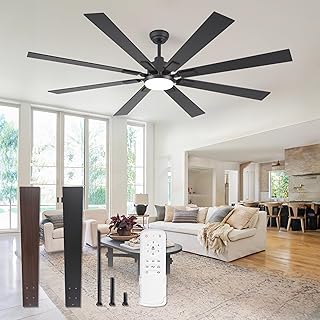
60″ Ceiling Fan, 7400+ CFM with Light and Remote
This is the sweet spot for open living rooms: 7,400 CFM from three deeply pitched blades and a reversible DC motor across six speeds, with 3-CCT lighting and a timer. The high output arrives without the low-frequency hum that makes cheaper AC fans fatiguing to sit beneath for hours.
Minislak 72″ Ceiling Fan, No Light, 8 Aluminum Blades
Eight aluminum blades on a 72-inch span produce a broad, even downdraft rather than the pulsing chop of a three-blade fan — noticeably easier on the eyes and ears in a garage or workshop. Aluminum also resists the warping and moisture uptake that eventually throws wood-composite blades out of balance.
ZMISHIBO 72″ Ceiling Fan with Lights, Damp Rated
A genuine large-room mover with a quiet DC motor, 24W 3-CCT LED, and damp-rated construction for covered patios. The dual-finish housing is a nice touch, but the durability story here is the sealed motor and low operating temperature at sustained mid speeds.
OPONL 52″ Ceiling Fan, 6-CCT Dimmable
The most refined control set in this group: six color temperatures, smooth dimming, and a reversible motor that stays genuinely quiet at speeds you’d actually sleep through. Ideal for bedrooms where the fan runs eight hours a night, every night.
52″ Modern Ceiling Fan, DC Reversible Motor, 3-CCT
A clean, well-balanced 52-inch fan with a DC reversible motor and 3-CCT lighting that suits apartments and mid-size bedrooms. Reverse mode is worth using in winter to push warm ceiling air back down without a perceptible draft.
Frequently Asked Questions
How much CFM do I actually need?
Roughly 3,000 to 4,000 CFM handles a bedroom. Living rooms and open-plan spaces want 5,000 to 7,000, and large great rooms or patios benefit from 7,000 and up. Bigger diameter at lower speed always feels better than the reverse.
Do more blades move more air?
Not directly. Three steep blades typically move more air per watt; six or eight blades distribute that airflow more evenly and run quieter. Choose by how the room feels, not by blade count.
Why does my fan wobble?
Almost always blade weight imbalance, a loose canopy screw, or a downrod pin that never fully seated. Wobble is worth fixing promptly — repeated lateral load is what wears bearings and loosens the ceiling box.
Can I put an indoor fan on a covered porch?
No. Humidity corrodes unsealed motors and swells blade material. Use a damp-rated fan under full cover, and a wet-rated one where rain can reach it.
Final Thoughts
For most open living areas, the 60-inch 7,400 CFM fan delivers the best balance of reach, quiet operation, and everyday usability. Step up to the Minislak 72-inch if you need to move air across a garage or long patio, and choose the OPONL 52-inch when bedroom-grade silence and lighting control matter more than raw output.