Key takeaways
- Measure the tall dimension first: Vertical sliders are limited by width, not height. Record the clear opening width at its narrowest point and compare it against the unit’s stated width before anything else, since a half-inch shortfall makes installation impossible.
- Check where the weight lands: A unit that cantilevers off a narrow sash puts leverage on hinges and crank mechanisms. Look for designs that shift mass toward the interior sill or that come with support brackets rated for the full operating weight.
- Judge the seal material, not the marketing: Thin foam compresses permanently within a season. Dense closed-cell foam, reinforced PVC panels, and zippered canvas keep their shape and resist mildew where condensation collects.
- Plan for the controls you will actually reach: Casement units sit higher than standard window models, so top-mounted buttons become awkward. Remote control with a follow-me sensor, or app and voice control, spares you repeated stretching.
- Weigh maintenance access: Filters need cleaning every few weeks in summer. Front-slide filter trays and tool-free panels keep upkeep from becoming a chore you skip, which is the single biggest factor in long-term airflow and compressor health.
What's inside
Vertical sliding windows, often called casement or crank-out styles, create a real problem for anyone shopping for cooling. The opening is tall and narrow rather than wide and short, so a conventional window air conditioner has nothing to rest on and no way to seal. Force one in anyway and you get sagging sashes, stressed frames, and gaps that leak conditioned air all season. From a durability standpoint, that mismatch is what shortens the life of both the unit and the window hardware.
This guide looks at the two workable paths: purpose-built casement units engineered for tall narrow frames, and vent kits that let a portable unit exhaust cleanly through a vertical track. Every recommendation is judged on load distribution, seal integrity over repeated seasons, reach-and-adjust ergonomics, and how the materials behave after a year of sun, humidity, and temperature swings.
As an Amazon Associate we earn from qualifying purchases.




How to Choose a/an Air Conditioner For Vertical Sliding Window (2026)
- Measure the tall dimension first: Vertical sliders are limited by width, not height. Record the clear opening width at its narrowest point and compare it against the unit’s stated width before anything else, since a half-inch shortfall makes installation impossible.
- Check where the weight lands: A unit that cantilevers off a narrow sash puts leverage on hinges and crank mechanisms. Look for designs that shift mass toward the interior sill or that come with support brackets rated for the full operating weight.
- Judge the seal material, not the marketing: Thin foam compresses permanently within a season. Dense closed-cell foam, reinforced PVC panels, and zippered canvas keep their shape and resist mildew where condensation collects.
- Plan for the controls you will actually reach: Casement units sit higher than standard window models, so top-mounted buttons become awkward. Remote control with a follow-me sensor, or app and voice control, spares you repeated stretching.
- Weigh maintenance access: Filters need cleaning every few weeks in summer. Front-slide filter trays and tool-free panels keep upkeep from becoming a chore you skip, which is the single biggest factor in long-term airflow and compressor health.
The Best Air Conditioner For Vertical Sliding Window (2026)s Reviewed
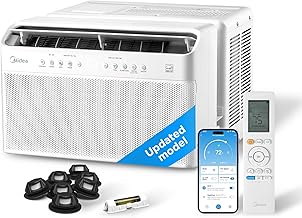
Midea 12,000 BTU U Shaped Window Air Conditioner
The U-shaped chassis lets the sash close through the middle of the unit, which distributes load across the sill instead of hanging it off one edge and cuts transmitted noise considerably. At 550 square feet of coverage with inverter control and roughly 37% energy savings, it is the strongest choice for larger rooms where the window geometry allows it.
Perfect Aire 10,000 BTU Casement Window Air Conditioner
Built specifically for sliding and crank-out frames at 14.75 inches wide and 23.5 inches tall, this is the most straightforward fit for a genuine vertical slider. The follow-me remote reads temperature at your seat rather than at the unit, which matters when the chassis sits above shoulder height and manual adjustment means climbing.
Midea 8,000 BTU U Shaped Smart Inverter
The same open-window design in a lighter, smaller package that suits 350 square feet and puts less strain on older frames and hinge hardware. Ultra-quiet operation and Alexa or Google integration make it a sensible pick for bedrooms and home offices where you want to set it once and forget the controls exist.
LOVIGA Portable AC Window Kit
An adjustable panel spanning 10 by 40 to 64 inches with waterproof sealing, this converts a vertical slider into a clean exhaust port for a portable unit. The upgraded sealing holds tight through seasonal humidity swings, and the panel is rigid enough that it does not bow under hose weight over time.
Portable AC Window Vent Kit, 5.9″ No-Coupler Design
The coupler-free connection removes the most common failure point in portable AC venting, where a threaded joint works loose and dumps warm air back into the room. Length adjusts from 16.9 to 62.1 inches and it handles both vertical and horizontal tracks, making it the more versatile option if you move between apartments.
Frequently Asked Questions
Can I use a standard window air conditioner in a vertical sliding window?
No. Standard units are wider than they are tall and cannot be secured or sealed in a narrow vertical opening. Attempting it risks the unit falling and damages the window hardware.
Is a casement unit or a portable with a vent kit more durable?
A casement unit generally lasts longer because it has fewer moving connections and no flexible hose to degrade. Portables plus a quality vent kit offer more flexibility if you rent.
Will a U-shaped unit fit my crank-out window?
Only if the sash slides horizontally past the unit. True crank-out casements swing outward and need a dedicated casement model instead.
How do I stop condensation damage around the seal?
Use closed-cell foam rather than open foam, confirm the unit tilts slightly outward for drainage, and inspect the seal at mid-season for compression or mildew.
Final Thoughts
For a genuine vertical slider, the Perfect Aire 10,000 BTU casement unit remains the cleanest fit and the least stressful on your window frame. If your sash slides horizontally, the Midea 12,000 BTU U-shaped model delivers better efficiency and noise performance, with the 8,000 BTU version covering smaller rooms. Renters using a portable should pair it with the LOVIGA kit for a seal that survives more than one summer.