Key takeaways
- Hang point and load path: The single most common failure isn’t the motor — it’s the hook, carabiner, or plastic loop taking a 6–10 lb dynamic load with vibration. Look for a steel hook with a closing gate and a mounting boss that’s molded into the chassis rather than screwed into a thin shell. An extension hook is a genuine ergonomic feature, not an accessory: it lets you drop the fan below a canopy peak without stooping.
- Sweep versus clearance: A 31.5″ fan moves substantially more air than a 20″ model at the same RPM, and it does it quieter because it doesn’t need to spin as fast. But a wider sweep needs more vertical room. Under an 8-foot canopy with seated guests, 20–21″ is the practical ceiling; over a patio table with 9 feet of headroom, go large.
- Battery capacity you can actually spend: Rated milliamp-hours describe the pack, not the evening. Assume manufacturer runtime figures reflect speed one with the light off, then plan on a third to half of that for real use with dimmed light and mid-speed airflow. A 40,000mAh pack is what gets you through a full dinner-to-dark stretch without a recharge break.
- Solar as a supplement, not a promise: Panel-equipped models are excellent for a shed or coop where the fan lives permanently and trickles up all week. Under a canopy — where the fan is, by definition, in shade — treat the panel as a slow topper and keep the USB-C cable handy.
- Materials that survive outdoors: Ask what happens after 400 hours of UV and a few unplanned rain exposures. UV-stabilized ABS housings, sealed switchgear, and a magnetically retained remote holder age far better than glossy untreated plastic and rubber-membrane buttons, which chalk, yellow, and go mushy.
What's inside
Anyone who has spent a July evening under a gazebo knows the arithmetic doesn’t work: shade blocks the sun but also traps still air, and the nearest outlet is thirty feet away behind a locked garage door. Running conduit to a pergola or canopy means an electrician, a permit conversation, and a fan you can never relocate. That mismatch — a fixed installation for a seasonal, movable space — is why the cordless overhead fan category exploded, and why so many buyers end up with something that sags off its hook by the second summer.
I evaluate these fans the way I’d evaluate a task chair or a stepladder: how the load travels, how the body interacts with it, and what fails first. This guide looks at hook geometry and hang weight, blade sweep versus head clearance, remote reachability, housing materials under UV, and realistic runtime at the speeds people actually use. Below are the models worth your attention in 2026, followed by a buying framework and answers to the questions that come up most.
As an Amazon Associate we earn from qualifying purchases.



How to Choose a Battery Powered Ceiling Fan No Wiring (2026)
- Hang point and load path: The single most common failure isn’t the motor — it’s the hook, carabiner, or plastic loop taking a 6–10 lb dynamic load with vibration. Look for a steel hook with a closing gate and a mounting boss that’s molded into the chassis rather than screwed into a thin shell. An extension hook is a genuine ergonomic feature, not an accessory: it lets you drop the fan below a canopy peak without stooping.
- Sweep versus clearance: A 31.5″ fan moves substantially more air than a 20″ model at the same RPM, and it does it quieter because it doesn’t need to spin as fast. But a wider sweep needs more vertical room. Under an 8-foot canopy with seated guests, 20–21″ is the practical ceiling; over a patio table with 9 feet of headroom, go large.
- Battery capacity you can actually spend: Rated milliamp-hours describe the pack, not the evening. Assume manufacturer runtime figures reflect speed one with the light off, then plan on a third to half of that for real use with dimmed light and mid-speed airflow. A 40,000mAh pack is what gets you through a full dinner-to-dark stretch without a recharge break.
- Solar as a supplement, not a promise: Panel-equipped models are excellent for a shed or coop where the fan lives permanently and trickles up all week. Under a canopy — where the fan is, by definition, in shade — treat the panel as a slow topper and keep the USB-C cable handy.
- Materials that survive outdoors: Ask what happens after 400 hours of UV and a few unplanned rain exposures. UV-stabilized ABS housings, sealed switchgear, and a magnetically retained remote holder age far better than glossy untreated plastic and rubber-membrane buttons, which chalk, yellow, and go mushy.
The Best Battery Powered Ceiling Fan No Wiring (2026)s Reviewed
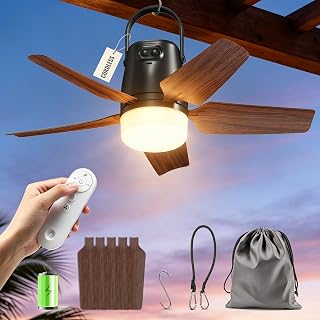
Gazebo Outdoor Ceiling Fan Light 31.5″, 40000mAh
This is the airflow-and-endurance pick, and the large sweep lets it produce a broad, low-velocity column rather than a narrow draft, which is far more comfortable over a seated group. The 3000K–6500K dimmable range and generous pack mean it doubles as the primary light source for a pop-up tent without draining before the evening ends.
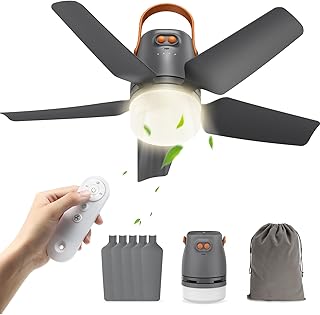
21″ Portable Ceiling Fan with Light & Remote, 20400mAh
The best-balanced option for canopies with limited headroom, offering slightly more blade area than the common 20″ designs without adding meaningful hang weight. Remote logic is straightforward, which matters more than feature count when you’re operating it in the dark from a lounge chair.
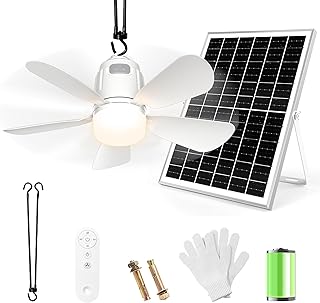
Gliztech Solar Ceiling Fan Light, 20000mAh
The 30W panel makes this the sensible choice for semi-permanent installs — a shed, a covered porch, a chicken coop — where the fan stays put and self-replenishes between uses. Airflow is modest by design, but the reduction in charging chores is the real ergonomic win.
Canopy Fan 20″, 20000mAh with Extension Hook
The included extension hook is the standout detail here, dropping the fan into the effective airflow zone under a peaked canopy instead of leaving it buried in the apex. Controls are pared back and intuitive, which suits shared or rental spaces where nobody wants to explain a menu.
20″ Canopy Fan with 2×10W Solar Panels
A dual-panel arrangement gives you flexibility to position collectors in sun while the fan hangs in shade — the practical fix for the solar-under-a-canopy paradox. Dimming is smooth enough for use as ambient light in an RV awning or garage bay.
Frequently Asked Questions
Will it hold on a standard gazebo crossbar?
Most will, but verify the bar’s rating rather than the fan’s. A 6–8 lb fan with rotational vibration imposes more stress than a static 8 lb load, so use a gated steel hook and avoid hanging from thin fabric loops or single-screw fittings.
How long does one charge really last?
Expect roughly 6–12 hours on lower speeds with the light off, dropping toward 3–5 hours at high speed with lighting on. Larger packs like the 40,000mAh model buy you the most margin.
Can these stay outside year-round?
No. Nearly all are rated for covered outdoor use, not weather exposure. Bring the unit in for rain and winter storage — repeated soaking accelerates bearing wear and lithium cells degrade badly in freezing conditions.
Are they quiet enough for conversation?
Larger-diameter fans are, because they hit the same airflow at lower RPM. Small fans on maximum speed generate noticeable blade noise, which is another argument for buying more sweep than you think you need.
Final Thoughts
If you want one fan to cover a full evening over a patio table, the 31.5″ 40000mAh gazebo model is the clear choice on airflow, runtime, and acoustic comfort. For tighter canopies and frequent repositioning, the 21″ 20400mAh unit hits the right weight-to-performance balance, while the Gliztech solar model is the one to install and forget in a shed, coop, or covered porch.