Key takeaways
- Door swing and reach envelope: Measure the arc, not just the footprint. A 4L cube needs roughly 9 inches of clear side space to open fully, and a right-hinged door parked against a wall on the right forces an awkward cross-body reach every single use. Check which side the hinge is on before you buy.
- Delta-T, not absolute temperature: Thermoelectric units cool relative to the room, typically 30–40°F below ambient. In a 78°F bathroom, a “50°F” claim quietly becomes closer to 55°F. If your space runs warm, prioritize models that publish a regulated setpoint rather than a vague cool mode.
- Fan noise and vibration transfer: Peltier modules are silent; the fan is not. Sleeve-bearing fans get louder as they age. Rubber or silicone feet matter more than most buyers expect, since a hard-footed unit on a wooden vanity turns the whole surface into a soundboard.
- Shelf architecture and bottle retention: Look for a raised front lip or a divider you can reposition. Flat, lipless shelves let tall toners tip forward the moment the door opens, and a removable shelf is the difference between a five-minute cleanup and a sticky permanent stain.
- Cord entry, plug options, and carry hardware: A molded strain relief at the cabinet wall is a genuine longevity indicator. Dual AC/DC gives you desk-to-car flexibility, and an integrated recess or handle beats gripping a smooth painted shell when the unit is loaded.
What's inside
Most skincare fridges are built around the same thermoelectric guts, which makes the shopping experience frustratingly flat: six listings, six near-identical spec blocks, and almost no information about the parts that actually decide whether the unit is still in service two years from now. The failure points on these units are rarely the cooling element. They are the hinge that develops slop, the latch that stops holding, the internal fan whose bearing starts to whine at 2 a.m., and the door gasket that takes a permanent set and lets humid room air condense on your serum bottles.
This guide evaluates six popular models through an ergonomics-and-durability lens: door swing and reach geometry on a crowded vanity, shelf retention when you pull a tall dropper bottle out one-handed, cord strain relief at the entry point, and how each cabinet tolerates repeated wipe-downs. Capacity and cooling range matter too, but they are the easy part. Below, the picks that hold up.
As an Amazon Associate we earn from qualifying purchases.


How to Choose a Mini Fridge for Skincare (2026)
- Door swing and reach envelope: Measure the arc, not just the footprint. A 4L cube needs roughly 9 inches of clear side space to open fully, and a right-hinged door parked against a wall on the right forces an awkward cross-body reach every single use. Check which side the hinge is on before you buy.
- Delta-T, not absolute temperature: Thermoelectric units cool relative to the room, typically 30–40°F below ambient. In a 78°F bathroom, a “50°F” claim quietly becomes closer to 55°F. If your space runs warm, prioritize models that publish a regulated setpoint rather than a vague cool mode.
- Fan noise and vibration transfer: Peltier modules are silent; the fan is not. Sleeve-bearing fans get louder as they age. Rubber or silicone feet matter more than most buyers expect, since a hard-footed unit on a wooden vanity turns the whole surface into a soundboard.
- Shelf architecture and bottle retention: Look for a raised front lip or a divider you can reposition. Flat, lipless shelves let tall toners tip forward the moment the door opens, and a removable shelf is the difference between a five-minute cleanup and a sticky permanent stain.
- Cord entry, plug options, and carry hardware: A molded strain relief at the cabinet wall is a genuine longevity indicator. Dual AC/DC gives you desk-to-car flexibility, and an integrated recess or handle beats gripping a smooth painted shell when the unit is loaded.
The Best Mini Fridges for Skincare (2026), Reviewed
CROWNFUL 4L Mini Fridge
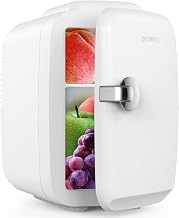
The most sensibly engineered small cabinet in this group: the door closes with a positive, repeatable click rather than friction alone, and the ETL listing means the power circuit has passed third-party scrutiny, which is not universal in this category. The removable shelf and smooth interior corners make cleanup genuinely quick after a spilled ampoule.
Cooluli 4L Mini Fridge
Cooluli’s USB option alongside 12V DC and standard AC makes this the most adaptable unit here, and the low-draw USB mode also runs the fan slower, which noticeably reduces the buzz on a bedside table. The shell is a matte finish that resists fingerprints better than the glossy alternatives.
CUTIEWORLD 4L Skincare Fridge
The leather-wrapped exterior is more than cosmetic, adding a soft outer layer that dampens vibration and shrugs off the scuffs a bare painted panel would show. It is the pick for a visible vanity, though the wrap needs a damp cloth rather than a spray cleaner to stay presentable.
JSTPRO 12L Skincare Fridge
At 12 liters with actual thermostatic regulation around 50°F, this is the model to buy if you are storing vitamin C serums, retinoids, or sheet masks in volume and want a stable setpoint instead of an ambient-dependent guess. The taller cavity also means fewer bottles laid on their sides, which cuts down on leaks around dropper caps.
FANSEXPERT 6L Glass Panel Skincare Fridge
The glass door is the real ergonomic win, letting you locate a product without breaking the thermal seal, and glass will not craze or yellow the way a clear plastic panel does. Six liters splits the difference nicely for anyone who found 4L cramped but does not need a full 12.
Frequently Asked Questions
Do skincare fridges actually help products last longer?
For unstable actives such as vitamin C, retinol, and peptide serums, cooler storage genuinely slows oxidation. For most oils, balms, and clay masks it makes little difference and can thicken them to the point of being hard to dispense.
How cold do these units get?
Expect roughly 30–40°F below room temperature, so a realistic range is the mid-40s to mid-50s Fahrenheit in a typical home. Models with a regulated setpoint, like the JSTPRO, hold that figure more consistently.
Is the warming function worth having?
It reverses the same thermoelectric module, so it costs nothing extra and is handy for warming a cleansing oil or a towel. Do not use it for food storage, since the temperature band sits in an unsafe range for perishables.
Can I run one in a bathroom?
Yes, but bathrooms are the hardest environment for these units: high ambient humidity means more interior condensation and a warmer room means less effective cooling. A bedroom or vanity nook is the better placement, and it also keeps the plug away from splash zones.
Final Thoughts
For most buyers, the CROWNFUL 4L is the soundest small-format choice thanks to its solid latch, ETL-listed circuit, and easy-clean interior. Step up to the JSTPRO 12L if you need real temperature regulation and room for a full routine, or the FANSEXPERT 6L glass-panel model if you would rather see your shelf than open the door to find it.