Key takeaways
- Load at full extension: A duster’s felt weight multiplies as the pole lengthens. Under a pound total is the threshold where most people can work overhead without shoulder fatigue; anything heavier wants a two-handed grip and frequent breaks.
- Pole stiffness over pole length: Maximum reach numbers mean little if the shaft deflects under light pressure. Look for thicker wall tubing on the base section and a taper that keeps the tip from whipping when you change direction.
- Locking mechanism: Twist-lock collars are quieter and infinitely adjustable but wear smooth over time. Button-and-detent locks hold position reliably for years, though you’re stuck with fixed increments. Either way, test whether the joint slips when you pull down against resistance.
- Head geometry and pivot: A sleeve that wraps both blade faces at once halves your passes. A pivoting or bendable neck lets you match blade pitch without twisting your forearm, which is where most wrist strain originates.
- Washability and fiber recovery: Microfiber loses grab after repeated hot washes. Check for stitched rather than glued seams, and expect to replace sleeves every 20 to 30 launderings even on well-made heads.
What's inside
Dusting a ceiling fan is one of those jobs where the tool fails before the user does. Halfway through the second blade, the pole starts flexing, the head droops off-axis, and you end up pressing upward with your wrist cocked at an angle no one should hold for four minutes straight. Add a stepladder to the equation and a ten-minute chore becomes a balance exercise. The dust, meanwhile, mostly relocates to the floor rather than staying in the fibers where it belongs.
This guide looks at ceiling fan dusters through two lenses that matter more than marketing claims: ergonomics — how the load sits in your hands across a full cleaning session — and durability, meaning whether the locking collars, seams, and pole walls survive a year of real use. Below are the models worth considering in 2026, with notes on reach, head geometry, and where each one starts to compromise.
As an Amazon Associate we earn from qualifying purchases.




How to Choose a Ceiling Fan Duster (2026)
- Load at full extension: A duster’s felt weight multiplies as the pole lengthens. Under a pound total is the threshold where most people can work overhead without shoulder fatigue; anything heavier wants a two-handed grip and frequent breaks.
- Pole stiffness over pole length: Maximum reach numbers mean little if the shaft deflects under light pressure. Look for thicker wall tubing on the base section and a taper that keeps the tip from whipping when you change direction.
- Locking mechanism: Twist-lock collars are quieter and infinitely adjustable but wear smooth over time. Button-and-detent locks hold position reliably for years, though you’re stuck with fixed increments. Either way, test whether the joint slips when you pull down against resistance.
- Head geometry and pivot: A sleeve that wraps both blade faces at once halves your passes. A pivoting or bendable neck lets you match blade pitch without twisting your forearm, which is where most wrist strain originates.
- Washability and fiber recovery: Microfiber loses grab after repeated hot washes. Check for stitched rather than glued seams, and expect to replace sleeves every 20 to 30 launderings even on well-made heads.
The Best Ceiling Fan Dusters (2026), Reviewed
DRQ Ceiling Fan Cleaner Duster
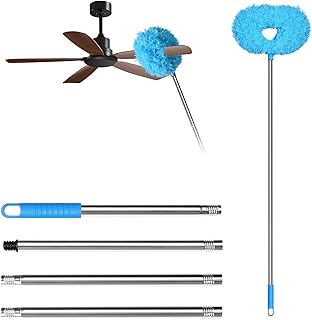
The wrap-style sleeve here closes over the blade so top and bottom surfaces clear in a single pass, and the 13 to 48 inch pole keeps the center of mass close enough to your body that standard eight-foot ceilings need no ladder. Removable head construction is the practical win — you swap and wash without wrestling the whole assembly.
Reusable Microfiber Fan Blade Cleaner (13–49.7″)
Nearly two extra inches of extension over the DRQ, with the same removable-duster approach and a slightly firmer collar feel through the mid-range positions. A sensible pick for nine-foot ceilings where you’d otherwise be reaching at the very limit of a 48-inch pole.
Eyliden 68″ Adjustable Ceiling Fan Duster
At 0.75 lbs across a 68-inch span, this is the most ergonomically honest tool on the list — the dual-sided 360° head does the work with contact pressure rather than force from your arms. The tradeoff is a lighter-gauge pole, so treat it as a duster rather than a scrubbing implement.
Storystore Adjustable Microfiber Fan Duster
The 4.2-foot collapsed length and 13 to 50 inch working range make this the most storage-friendly option that still reaches a standard fan without a step stool. Its brush-style head is more aggressive on cobwebs and door frames than sleeve designs, which suits homes where the duster pulls double duty.
SetSail 100-inch Extra-Long Duster
The bendable microfiber head is the differentiator: you set the angle once, lock it, and let the pole geometry do the reaching on vaulted ceilings up to roughly 12 feet. Expect noticeable flex past 80 inches, so work in short strokes and let the fibers trap the dust instead of pushing.
Frequently Asked Questions
How often should I dust ceiling fan blades?
Every three to four weeks keeps buildup light enough that a dry sleeve clears it in one pass. Once dust bonds with airborne cooking grease, you’re into damp-wiping territory, which is harder on both the blades and the tool.
Do I need to wet the microfiber?
Dry is better for routine work — damp fibers smear residue across the blade and load up faster. Reserve light dampening for kitchens and bathrooms, and let the head dry fully before storing it.
Will a duster scratch the fan blade finish?
Clean microfiber won’t, but embedded grit will. Shake or wash the head before each session and avoid dragging a used sleeve across high-gloss or lacquered wood blades.
Can I skip the ladder entirely?
With a 48- to 68-inch pole, yes, for ceilings up to about nine feet. Above that, a 100-inch or telescoping pole is safer than a ladder, though you lose the tactile feedback that tells you the sleeve is actually contacting the blade.
Final Thoughts
For most homes, the DRQ duster hits the right balance of pole rigidity, wrap-style efficiency, and a head you can actually remove and wash. Choose the Eyliden 68″ if overhead fatigue is your main complaint — the sub-pound weight genuinely changes how the job feels — and step up to the SetSail 100-inch for vaulted ceilings where reach outranks stiffness.