Key takeaways
- Deck height and transfer ease: A 17–20″ top-of-mattress height lets most adults rise with knees near 90 degrees and no drop-and-lurch. Low platform decks look sleek but force a deep squat on the way up — a real problem for older guests and anyone with knee history.
- Trundle mechanism type: Pop-up scissor lifts create a level king surface but concentrate stress on four pivot points; look for steel arms with bolted (not riveted) joints. Roll-out trundles are simpler and more durable, though they leave a step-down between decks.
- Slat pitch and center support: Slats spaced under 3″ apart with a center rail on legs is the baseline for foam and hybrid mattresses. Wider gaps let foam sag between slats and void many mattress warranties.
- Rail joinery and capacity rating: Corner blocks, bolt-through hardware, and a stated weight rating (400 lb per surface or better) tell you far more than the wood species does. Cam-lock-only assembly in a piece that gets sat on daily will loosen within a season.
- Reach zones for built-ins: LED strips, shelves, and USB ports only help if they land within a seated arm’s reach — roughly 24″ from the headboard face. Ports buried behind a mattress or low in a bookcase get abandoned fast.
What's inside
A twin-to-king daybed asks one piece of furniture to do three jobs: sofa by day, single bed most nights, and king-width sleeping platform when family descends. That triple duty is exactly where most of these frames fail. Sit on the front rail for a year and the deck slats begin to bow; roll a pop-up trundle out fifty times and the scissor lift starts to bind; join two mattresses into a king and the seam gapes because the trundle deck sits a half-inch low. None of that shows up in a product photo.
I evaluate furniture the way a physical therapist evaluates a chair — by transfer height, reach distance, joint stress, and how the whole assembly behaves after the honeymoon period. This guide looks at six current twin-to-king daybeds through that lens: the geometry that makes them comfortable to sit on and easy to get out of, the hardware that determines whether they survive five years of nightly use, and the small design decisions (slat pitch, drawer glide type, USB placement) that separate a frame you keep from one you re-list secondhand.
As an Amazon Associate we earn from qualifying purchases.


How to Choose a Twin To.King Daybed (2026)
- Deck height and transfer ease: A 17–20″ top-of-mattress height lets most adults rise with knees near 90 degrees and no drop-and-lurch. Low platform decks look sleek but force a deep squat on the way up — a real problem for older guests and anyone with knee history.
- Trundle mechanism type: Pop-up scissor lifts create a level king surface but concentrate stress on four pivot points; look for steel arms with bolted (not riveted) joints. Roll-out trundles are simpler and more durable, though they leave a step-down between decks.
- Slat pitch and center support: Slats spaced under 3″ apart with a center rail on legs is the baseline for foam and hybrid mattresses. Wider gaps let foam sag between slats and void many mattress warranties.
- Rail joinery and capacity rating: Corner blocks, bolt-through hardware, and a stated weight rating (400 lb per surface or better) tell you far more than the wood species does. Cam-lock-only assembly in a piece that gets sat on daily will loosen within a season.
- Reach zones for built-ins: LED strips, shelves, and USB ports only help if they land within a seated arm’s reach — roughly 24″ from the headboard face. Ports buried behind a mattress or low in a bookcase get abandoned fast.
The Best Twin To.King Daybed (2026)s Reviewed
Corner Daybed with Wood Trundle and Storage Bookcase Headboard, Gray
The corner layout turns two walls into back support, which meaningfully reduces the forward-lean fatigue you get on a single-backed daybed used as seating. Its wood trundle and shelf-plus-charging headboard put storage and power inside easy reach, though the L-shape needs a genuinely square corner to sit flat and avoid racking the frame.
Twin Corner Bed Frame, L-Shaped Daybed, Vintage Brown
Essentially the same architecture in a warmer finish, with drawers, a bedside rack, and integrated LEDs consolidating a nightstand’s worth of function into the frame. Take the extra time to torque every rail bolt in sequence during assembly; L-shaped frames rely on that rigidity to keep drawers gliding true.
Martha Stewart Simone Twin Upholstered Daybed with Trundle
The cushioned headboard and footboard are the standout ergonomic feature here — upholstered surfaces on both ends make sideways lounging genuinely comfortable rather than tolerable. It skips box springs and uses a roll-out trundle, the lower-maintenance choice if you want fewer moving parts to fail.
Alaterre Harmony Twin to King Extendable Daybed with Trundle
At 36.75″ of frame height with solid wood construction and a 400 lb rating, this is the most structurally honest option in the group and the one I’d expect to still be tight in a decade. Two pull-out storage drawers plus a proper extendable deck make it the practical pick for a room doing double duty as an office or playroom.
Twin-to-King Daybed with Pop-Up Trundle, Linen, Beige
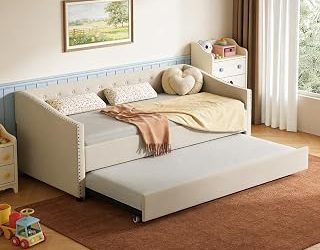
The pop-up trundle rises flush with the main deck, eliminating the seam-and-step problem that makes roll-out kings awkward for two sleepers. Soft linen upholstery and a built-in USB port suit guest rooms; just plan on periodically checking the lift arms, since that’s where wear concentrates.
Frequently Asked Questions
Do I need two mattresses of the same thickness?
For pop-up models, yes — matching thickness within about an inch is what keeps the king surface level. Mismatched heights create a ridge right where a couple’s shoulders land.
Can a twin-to-king daybed be an everyday adult bed?
Absolutely, provided the slat pitch is tight and there’s center support. Solid-wood frames with stated capacity ratings handle nightly adult use far better than particleboard platforms.
How much clearance does the trundle need?
Allow roughly 40 inches of open floor on the pull-out side, plus room to stand and operate the lift without twisting. Cramped clearance is the main reason people stop using the feature.
Are built-in USB ports worth paying for?
Only when they’re positioned within seated reach and rated for modern fast charging. Otherwise a bedside power strip does the job with fewer parts to fail.
Final Thoughts
For long-term durability and the safest transfer height, the Alaterre Harmony extendable daybed is my primary recommendation — solid wood, a real capacity rating, and simple mechanics. If flush king geometry matters more, the linen pop-up trundle model delivers the most seamless two-person sleeping surface, while the Martha Stewart Simone is the comfort pick for rooms where the daybed serves as everyday seating.